GS 1: Art & CultureGS 1: Modern HistoryPrelimsGS 1: ArchitectureGS 1: Art Forms
ASI begins fresh probe at Kashipur — a site believed to have Mahabharata link, Pg15
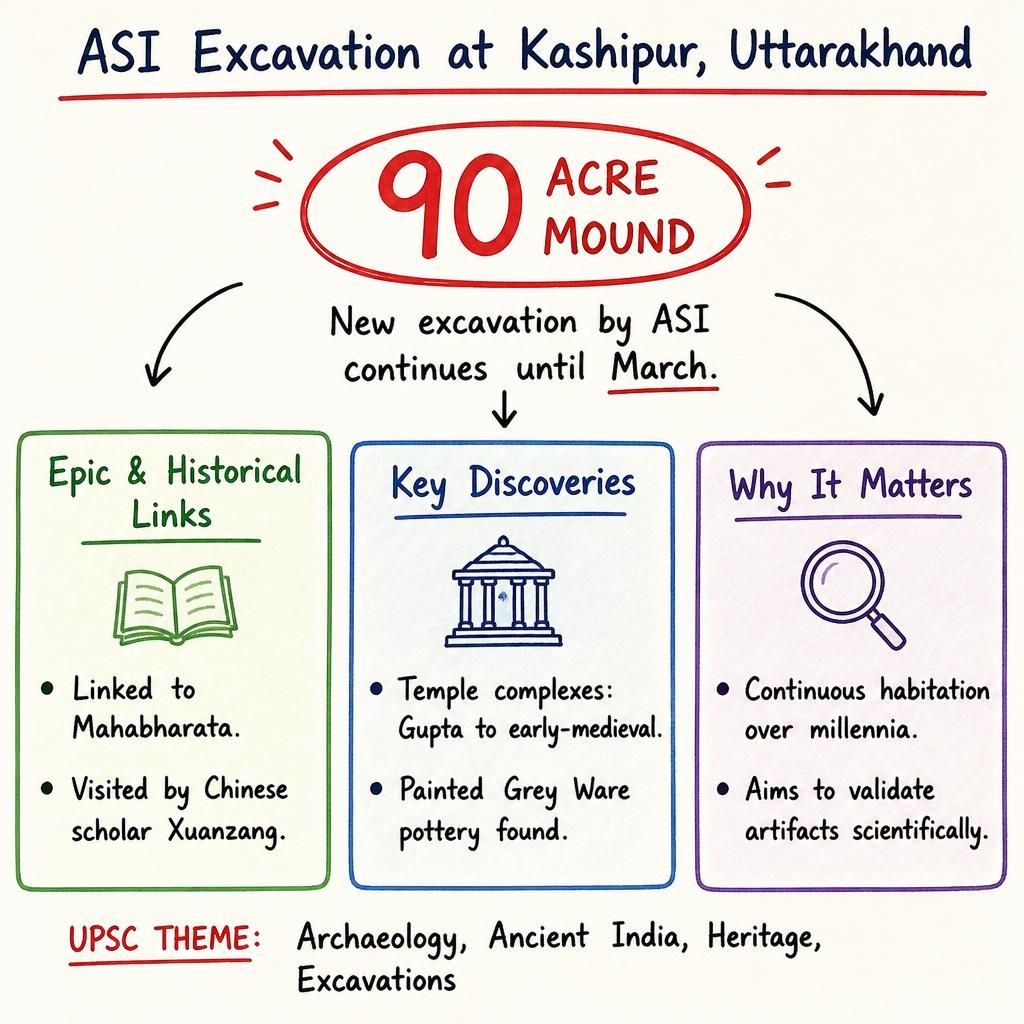
ASI commences fresh excavations at Kashipur, a 90-acre mound linked to Mahabharata and Xuanzang, seeking scientific evidence and cultural sequencing of ancient periods.
Practice MCQs
767 Students attempted
Key Highlights:
- The Archaeological Survey of India (ASI) has initiated a new excavation at a 90-acre mound in Kashipur, Uttarakhand.
- The site is believed to have connections to the epic Mahabharata and the 6th-century Chinese scholar Xuanzang.
- Local legends identify Kashipur as the training ground of Guru Dronacharya, with Drona Sagar Lake built by the Pandavas as 'guru dakshina'.
- The current excavation, which commenced recently, is slated to continue until March.
- Previous probes at Kashipur have uncovered temple complexes dating from the Gupta to early-medieval periods and pottery from the Painted Grey Ware era.
ASI Excavation.jpg
Detailed Insights:
- Kashipur is historically identified with Govisana, a significant city visited and documented by Xuanzang during his travels in India.
- Alexander Cunningham, the first Director-General of the ASI, played a crucial role in identifying Kashipur as Govisana in the 19th century and tracing large ancient structures there.
- Earlier ASI excavations in 1939-40, 1965-66, and 1970-71 revealed a temple constructed in three phases, initially a soil-brick platform during the Gupta period.
- The current archaeological endeavor aims to scientifically validate previously retrieved artifacts and establish a comprehensive cultural sequence of the site.
- The presence of pottery from the Kushan, Gupta, and Medieval periods suggests continuous human habitation in the region over millennia.
- The Painted Grey Ware (PGW) culture found at Kashipur is strongly associated with early advanced civilizations of northern India and the Mahabharata period.
- Noted archaeologist B.B. Lal famously linked the discovery of PGW at Hastinapur to the historical sites and chronology of the Mahabharata.
- Recent findings, including brick structures and a circular formation, have reignited archaeological interest in Kashipur's ancient narrative.
Key Concepts Involved:
- Archaeological Survey of India (ASI): The premier Indian government agency responsible for archaeological research, excavation, and the conservation of cultural heritage.
- Painted Grey Ware (PGW) Culture: An Iron Age culture (c. 1200-600 BCE) in the Indo-Gangetic plain, characterized by distinctive grey pottery with black geometric patterns, often linked to the Mahabharata period.
- Xuanzang: A 7th-century Chinese Buddhist monk and traveler who extensively documented India's geography, culture, and Buddhist sites, including Govisana (Kashipur).
- Alexander Cunningham: A British army engineer and the first Director-General of the ASI, widely regarded as the "Father of Indian Archaeology" for his pioneering work in identifying ancient sites.

SuperKalam is your personal mentor for UPSC preparation, guiding you at every step of the exam journey.
Download the App


STUDY RESOURCES
CONTACT US
ⓒ Snapstack Technologies Private Limited