GS 3: Science & TechnologyGS 3: Environment & EcologyPrelimsGS 1: Changes in Critical Geographical Features, Water Bodies, Ice Caps, Flora and FaunaGS 3: Achievements of Indians in Science and Technology
Why scientists are rethinking the chemical ‘arms race’ against fungi, Pg II
Scientists rethink strategies against rising drug-resistant fungal infections like Candida auris, driven by global warming and genetic evolution, challenging current antifungal treatments.
Practice MCQs
760 Students attempted
Key Highlights:
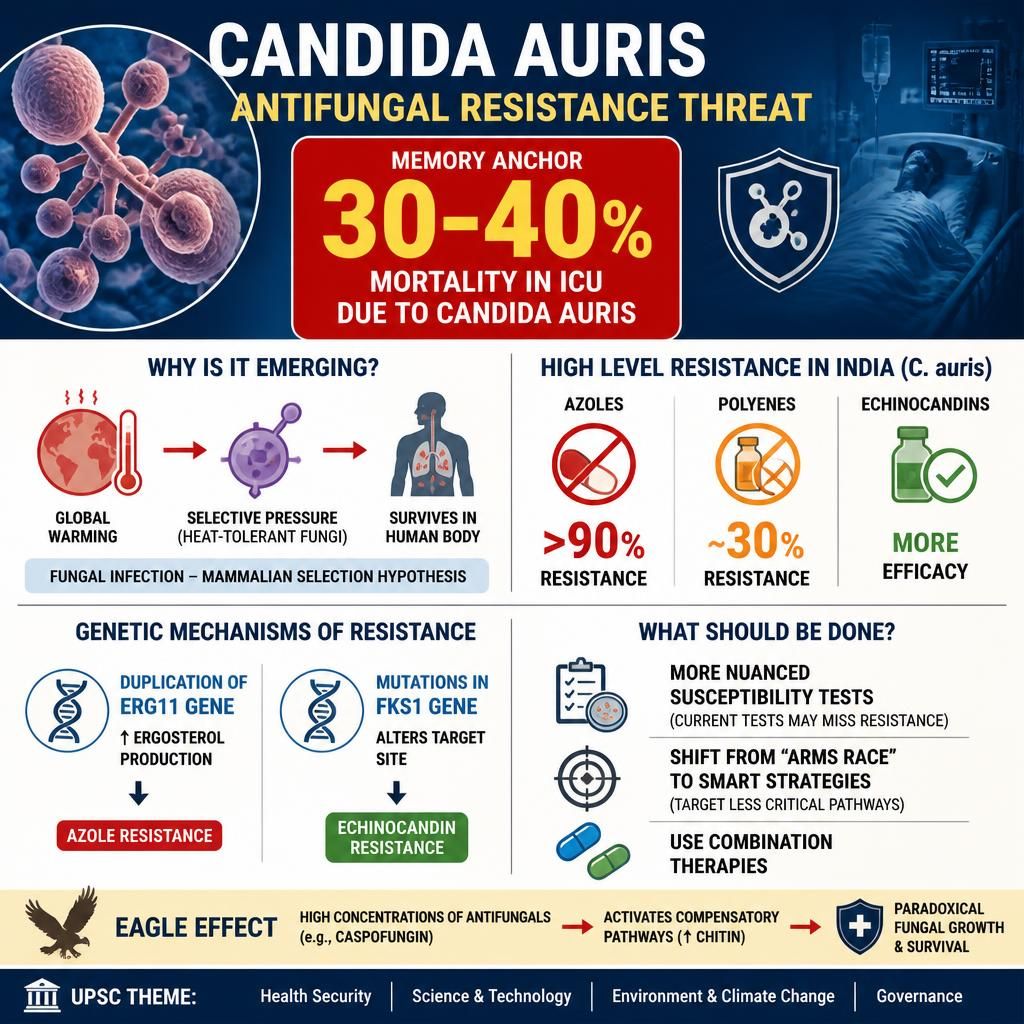
- Multidrug-resistant fungal infections, particularly from Candida auris, are rapidly emerging, posing a significant threat in ICU facilities with a 30-40% mortality rate.
- Global warming is identified as a key factor, applying selective pressure that favors heat-tolerant fungi capable of surviving in the human body, a concept known as the fungal infection – mammalian selection hypothesis.
- Research on Indian clinical isolates of Candida auris revealed widespread resistance to common antifungals like azoles (over 90%) and polyenes (30%), with echinocandins showing more efficacy.
- Genetic mechanisms of resistance include duplication of the Erg11 gene (leading to increased ergosterol production) and mutations in the Fks1 gene, which confer resistance to azoles and echinocandins, respectively.
- Scientists are advocating for more nuanced susceptibility tests and a shift from an "arms race" approach to targeting less critical fungal pathways or using combination therapies.
Fungi.jpg
Detailed Insights:
- Dermatophytosis, caused by dermatophytes, represents common skin fungal infections, but systemic infections like those by Candida auris are far more severe.
- Candida auris was first reported in Japan in 2009 and has since become a global menace, highlighting the recent increase in fungal pathogenicity.
- The Postgraduate Institute of Medical Education and Research (PGIMER) in Chandigarh has maintained a repository of 15,000 fungal isolates for 25 years, aiding research and identification.
- Current clinical susceptibility tests for antifungals like caspofungin may be insufficient, as Candida auris can resist concentrations higher than standard testing limits.
- The Eagle effect describes the paradoxical growth of fungi, where high concentrations of certain antifungals like caspofungin can activate compensatory pathways, such as increased chitin production, allowing survival.
- Future strategies involve combination therapies to overcome cellular compensatory pathways and developing antifungals that target less critical molecular pathways to reduce evolutionary pressure.
Scientific/Technical Concepts Involved:
- Dermatophytosis: Common fungal infections affecting skin, hair, and nails, caused by dermatophytes.
- Candida auris: An emerging, multidrug-resistant yeast pathogen known for causing severe, often untreatable, infections in healthcare settings.
- Fungal infection – mammalian selection hypothesis: Theory suggesting global warming selects for fungi that can tolerate higher temperatures, enabling them to infect mammals.
- Antifungals: Drugs used to treat fungal infections, categorized into classes like azoles, polyenes, and echinocandins, each targeting different fungal components.
- Ergosterol: A sterol found in the fungal cell membrane, analogous to cholesterol in animal cells, and a primary target for many antifungal drugs.
- Chitin: A structural polysaccharide that is a major component of the fungal cell wall, providing rigidity and protection.
- Eagle effect: A phenomenon where microorganisms exhibit paradoxical survival or growth at very high concentrations of an antimicrobial agent.

SuperKalam is your personal mentor for UPSC preparation, guiding you at every step of the exam journey.
Download the App


STUDY RESOURCES
CONTACT US
ⓒ Snapstack Technologies Private Limited