GS 2: GovernanceGS 3: Science & TechnologyGS 2: International RelationsPrelimsGS 2: Bilateral, Regional and Global Groupings and Agreements
Unsafe Space, Pg6
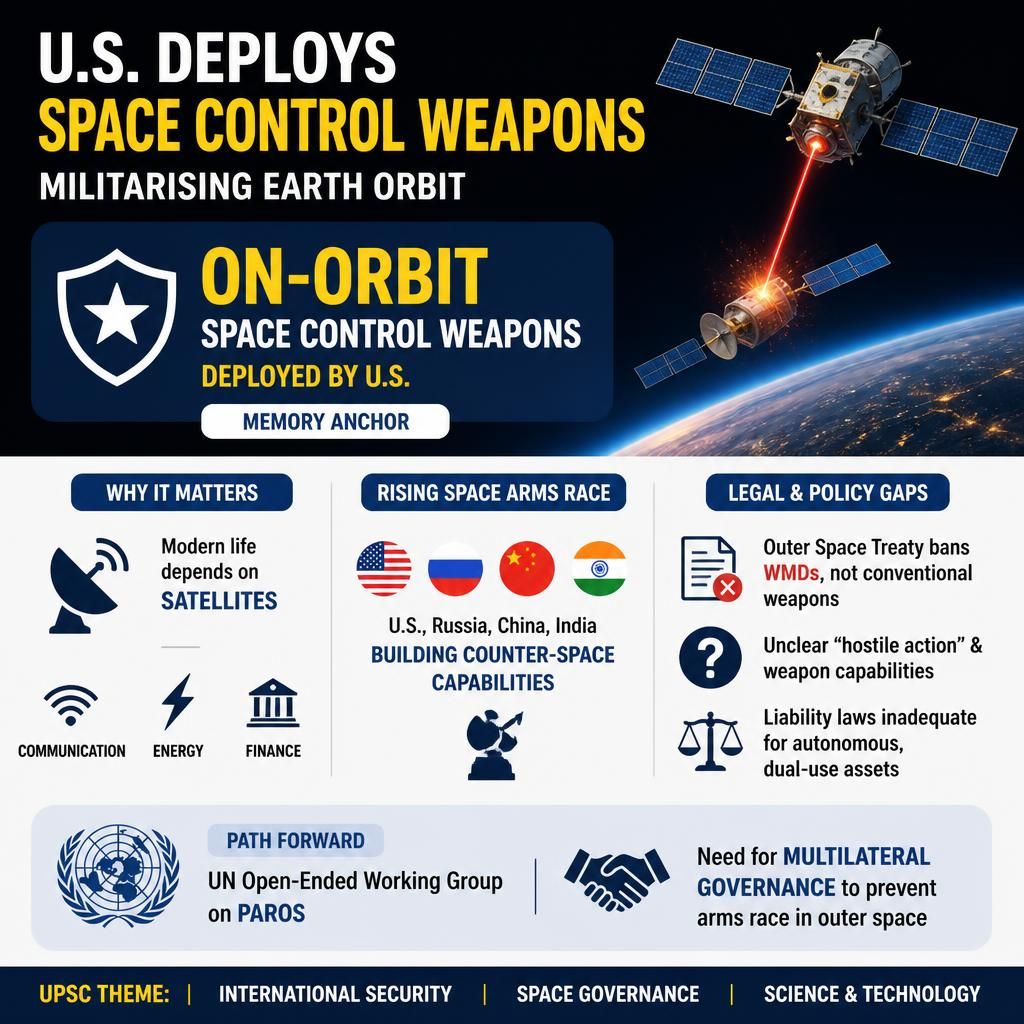
US admission of deploying 'on-orbit space control weapons' raises global concerns about an arms race, international law, and stability in the increasingly militarized outer space.
Practice MCQs
760 Students attempted
Key Highlights:
- U.S. Air Force Secretary Troy Meink and Space Force chief Gen. Douglas Schiess confirmed the deployment of "on-orbit space control weapons" by the U.S.
- These weapons are intended to "defend against hostile adversary action" in space.
- The deployment raises concerns due to the increasing reliance of global communications, energy, and financial networks on satellite systems.
- Countries like the U.S., Russia, China, and India are developing counter-space capabilities, contributing to the militarization of Earth orbit.
- The Outer Space Treaty prohibits nuclear weapons or other weapons of mass destruction in orbit but does not explicitly ban conventional weapons.
Space weapons.jpg
Detailed Insights:
- The U.S. military doctrine of "space control" encompasses both offensive and defensive operations, despite the weapons being described as defensive.
- The increasing military use of commercial and dual-use satellites complicates their protection under international humanitarian law.
- Ambiguity exists regarding what constitutes "hostile action" and the specific capabilities of the deployed weapons, leading to potential instability.
- Existing international laws like the Liability Convention are inadequate for determining accountability in scenarios involving autonomous, dual-use orbital assets.
- The UN Open-Ended Working Group on the 'Prevention of an Arms Race in Outer Space' is seen as a platform to address these disclosures and establish multilateral governance.
- There is a call for the U.S. to reveal weapon particulars and engage in multilateral arrangements to define thresholds of action and escalation.
Key Concepts Involved:
- On-orbit space control weapons: Weapons deployed in space designed to control or deny adversary access to space assets.
- Counter-space capabilities: Technologies and methods used to disrupt, degrade, or destroy an adversary's space systems.
- Outer Space Treaty (1967): A foundational international treaty governing the exploration and use of outer space, prohibiting WMDs in orbit.
- Liability Convention (1972): An international treaty establishing liability for damage caused by space objects.
- UN Open-Ended Working Group on the 'Prevention of an Arms Race in Outer Space': A UN forum aimed at discussing and developing measures to prevent an arms race in outer space.

SuperKalam is your personal mentor for UPSC preparation, guiding you at every step of the exam journey.
Download the App


STUDY RESOURCES
CONTACT US
ⓒ Snapstack Technologies Private Limited