GS 1: World GeographyGS 2: International RelationsPrelimsGS 2: Bilateral, Regional and Global Groupings and AgreementsGS 2: Effect of Policies and Politics of Developed and Developing Countries on India's Interests
A Malacca-Singapore Model For Resolving Hormuz, Pg6
Article proposes Malacca-Singapore Straits' UNCLOS-based cooperative model as a framework to resolve the ongoing geopolitical siege and security concerns in the Strait of Hormuz.
Practice MCQs
760 Students attempted
Key Highlights:
- The article proposes the Malacca-Singapore Straits model as a potential solution for resolving ongoing issues in the Strait of Hormuz.
- In 1971, Malaysia, Indonesia, and Singapore jointly asserted 12-nautical-mile territorial seas over the Malacca-Singapore Straits, challenging their previous "international" status.
- The United Nations Convention on the Law of the Sea (UNCLOS) introduced the concept of "transit passage" for straits connecting high seas or Exclusive Economic Zones (EEZs).
- A Cooperative Mechanism was established in 2007 for the Malacca-Singapore Straits, involving littoral and user states to ensure navigation safety and fund maintenance.
- The Strait of Hormuz shares geographical similarities, with Iran and Oman's territorial waters intersecting, but Iran (not an UNCLOS signatory) requires authorization for foreign warships.
- While Iran and Oman have reportedly agreed on a framework for Hormuz, the United States has not accepted the arrangement.
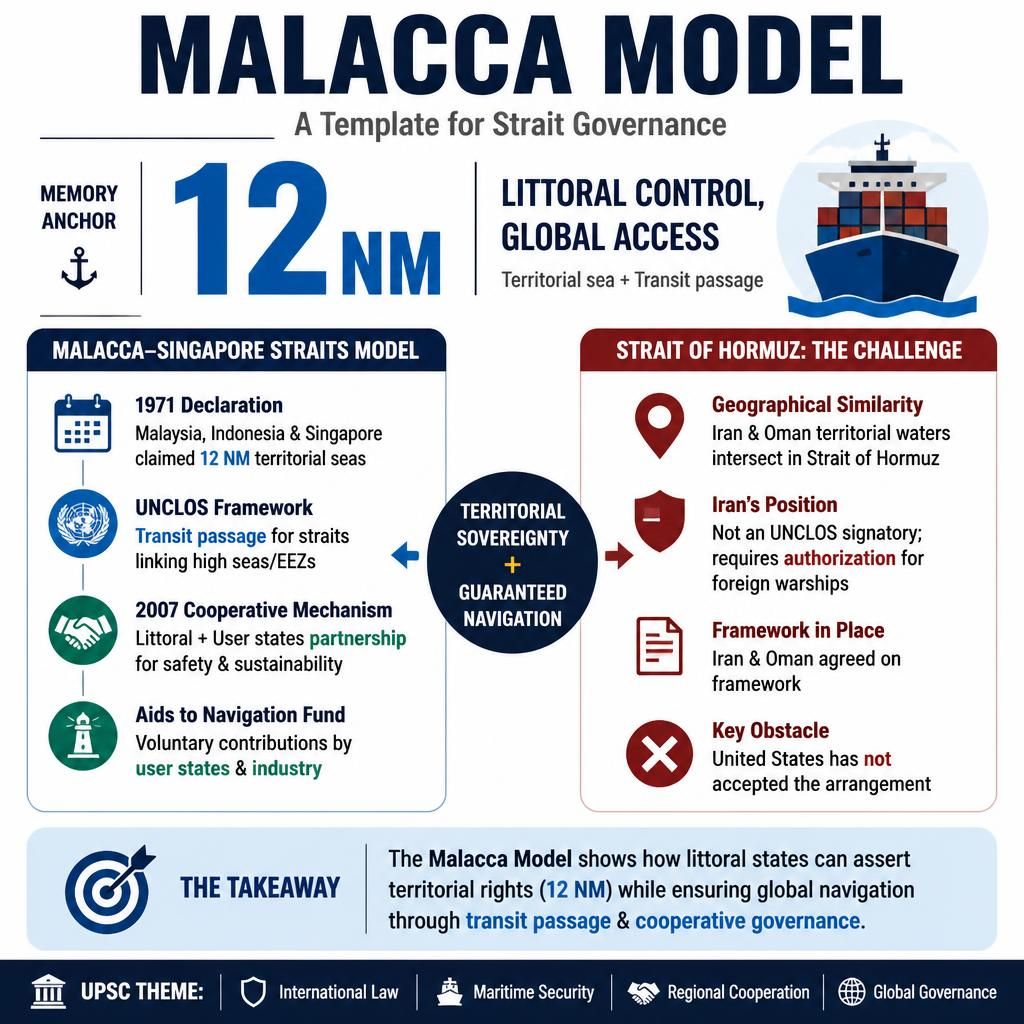
Malacca Model.jpg
Detailed Insights:
- The Strait of Malacca and Strait of Singapore form a crucial maritime corridor connecting the Andaman Sea to the South China Sea.
- Post-decolonization, Indonesia asserted sovereignty over waters between its islands, influencing the 1971 joint declaration with Malaysia and Singapore.
- Malaysia and Indonesia's claims of 12-nautical-mile territorial seas effectively made the straits territorial waters, allowing only "innocent passage".
- The right of "innocent passage" for foreign vessels can be suspended for security reasons and excludes submerged submarines.
- "Transit passage" under UNCLOS allows continuous and expeditious transit, including for warships, going beyond mere innocent passage.
- Japan, through the Malacca Strait Council, played a significant role in fostering cooperation among the littoral states.
- The Cooperative Mechanism includes an Aids to Navigation Fund, supported by voluntary contributions from user states and industry, administered jointly with the littoral states.
- The primary concern in the Malacca-Singapore Straits was navigation safety and environmental protection, whereas in the Strait of Hormuz, Iran's security is the central issue.
- Iran's 1993 law, requiring authorization for foreign warships in Hormuz, remains a point of contention as Iran has not ratified UNCLOS.
Key Concepts Involved:
- United Nations Convention on the Law of the Sea (UNCLOS): An international treaty establishing a legal framework for all marine and maritime activities.
- Territorial Waters: A belt of coastal waters extending up to 12 nautical miles from the baseline of a coastal state, over which the state has full sovereignty.
- Innocent Passage: The right of foreign vessels to navigate through the territorial waters of another state, provided it is not prejudicial to the peace, good order, or security of the coastal state.
- Transit Passage: The right of vessels and aircraft to navigate through international straits connecting two parts of the high seas or Exclusive Economic Zones (EEZs), continuously and expeditiously.
- Exclusive Economic Zone (EEZ): A sea zone over which a state has special rights regarding the exploration and use of marine resources, extending 200 nautical miles from the baseline.

SuperKalam is your personal mentor for UPSC preparation, guiding you at every step of the exam journey.
Download the App


STUDY RESOURCES
CONTACT US
ⓒ Snapstack Technologies Private Limited