GS 3: Internal SecurityGS 2: International RelationsGS 3: EconomyPrelimsGS 3: Infrastructure: Energy, Ports, Roads, Airports, Railways etc.
Unimpeded Trade Needs IPMDA As The Answer, Pg8
Quad's IPMDA, bolstered by US-India cooperation, is vital for securing unimpeded trade and combating maritime threats across the geostrategic Indo-Pacific region.
Practice MCQs
753 Students attempted
Key Highlights:
- The Indo-Pacific Partnership for Maritime Domain Awareness (IPMDA) is crucial for ensuring unimpeded trade in the Indo-Pacific region.
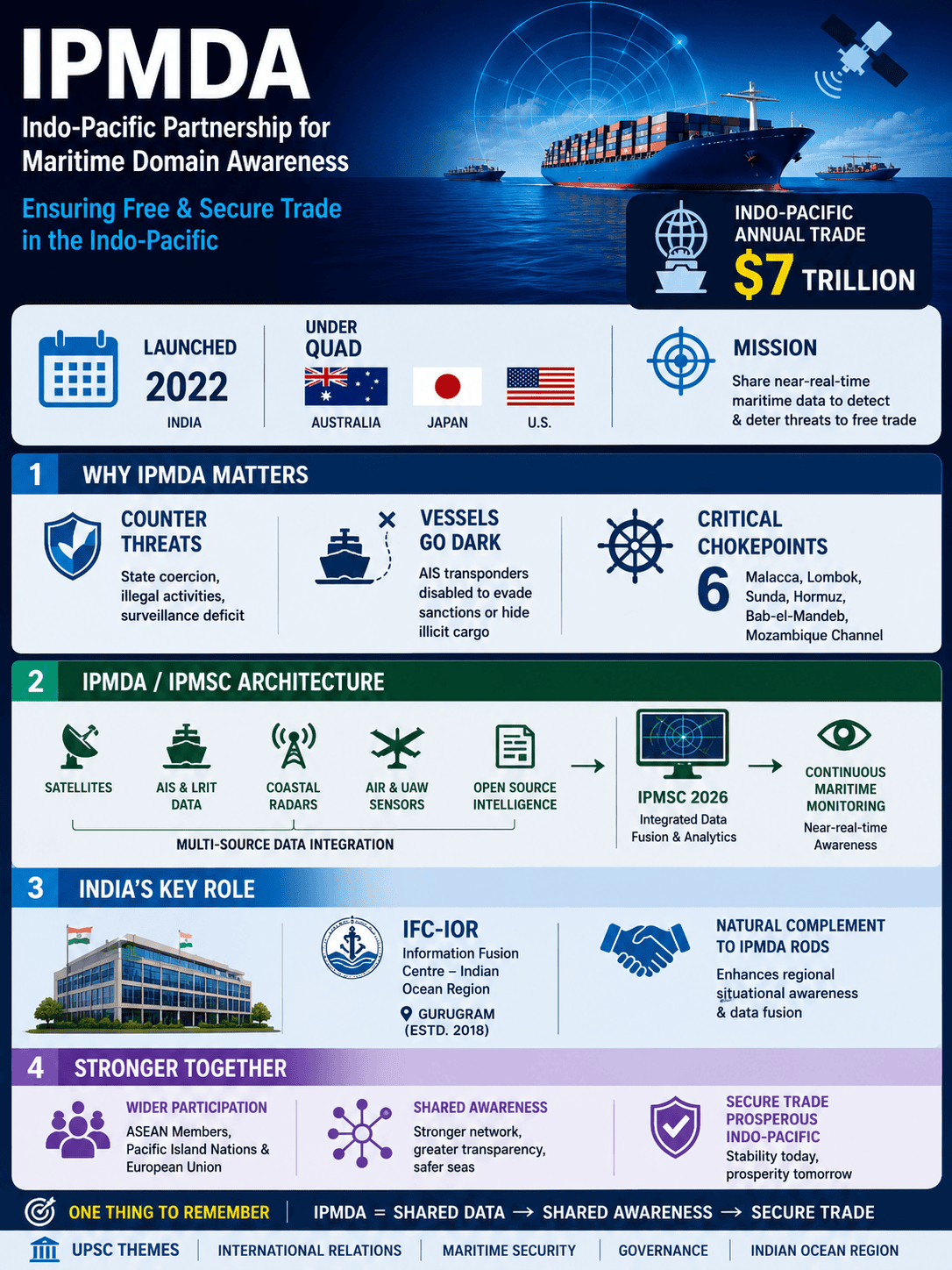
- IPMDA was launched in 2022 under the Quad framework (India, Australia, Japan, U.S.) to address maritime threats.
- The Indo-Pacific is a vital global trade artery, facilitating nearly $7 trillion in annual trade.
- It aims to share near-real-time maritime data among partner nations to detect and deter threats to free trade.
- Robust U.S.-India cooperation is essential for the full operationalization of IPMDA.
IPMDA.png
Detailed Insights:
- The Indo-Pacific region encompasses critical maritime chokepoints such as the Straits of Malacca, Lombok, Sunda, Hormuz, Bab-al-Mandeb, and Mozambique channels.
- The region faces significant challenges including state-sponsored coercion, illegal maritime activities, and a widespread surveillance deficit.
- Many vessels "go dark" by disabling their Automatic Identification System (AIS) transponders to evade sanctions or conceal illicit cargo.
- The Quad’s Indo-Pacific Maritime Surveillance Collaboration 2026 (IPMSC), part of the IPMDA architecture, integrates various data sources for continuous maritime monitoring.
- India's Information Fusion Centre-Indian Ocean Region (IFC-IOR), established in Gurugram in 2018, serves as a natural complement to IPMDA's regional hub structure.
- The full potential of IPMDA/IPMSC requires active participation from ASEAN member states, Pacific Island nations, and the European Union.
- It offers significant benefits to smaller, capacity-constrained partners like Bangladesh, Maldives, Seychelles, Sri Lanka, and Fiji by extending surveillance capabilities beyond their immediate jurisdictions.
Key Concepts Involved:
- Indo-Pacific Partnership for Maritime Domain Awareness (IPMDA): A technology-based mechanism under the Quad for sharing real-time maritime data to ensure free and open trade.
- Maritime Domain Awareness (MDA): A comprehensive understanding of all activities and factors within the maritime environment that could affect security, safety, the economy, or the environment.
- Automatic Identification System (AIS): A tracking system used on ships and by vessel traffic services for identifying and locating vessels by electronically exchanging data.
- Information Fusion Centre-Indian Ocean Region (IFC-IOR): An Indian initiative based in Gurugram to enhance maritime safety and security in the Indian Ocean Region through collaborative information sharing.

SuperKalam is your personal mentor for UPSC preparation, guiding you at every step of the exam journey.
Download the App


STUDY RESOURCES
CONTACT US
ⓒ Snapstack Technologies Private Limited