GS 2: GovernanceGS 2: PolityPrelimsGS 3: Changes in Industrial Policy and Effects on Industrial GrowthGS 2: Government policies and interventions for development in various sectors
How to define 'industry': Inside SC's split verdict, Pg16
Supreme Court's nine-judge bench delivers split verdict defining 'industry' under labour law, retaining 1978 'triple test' for pending cases.
Practice MCQs
753 Students attempted
Key Highlights:
- A nine-judge Supreme Court Constitution Bench delivered a fractured verdict on the definition of "industry" under Indian labour law.
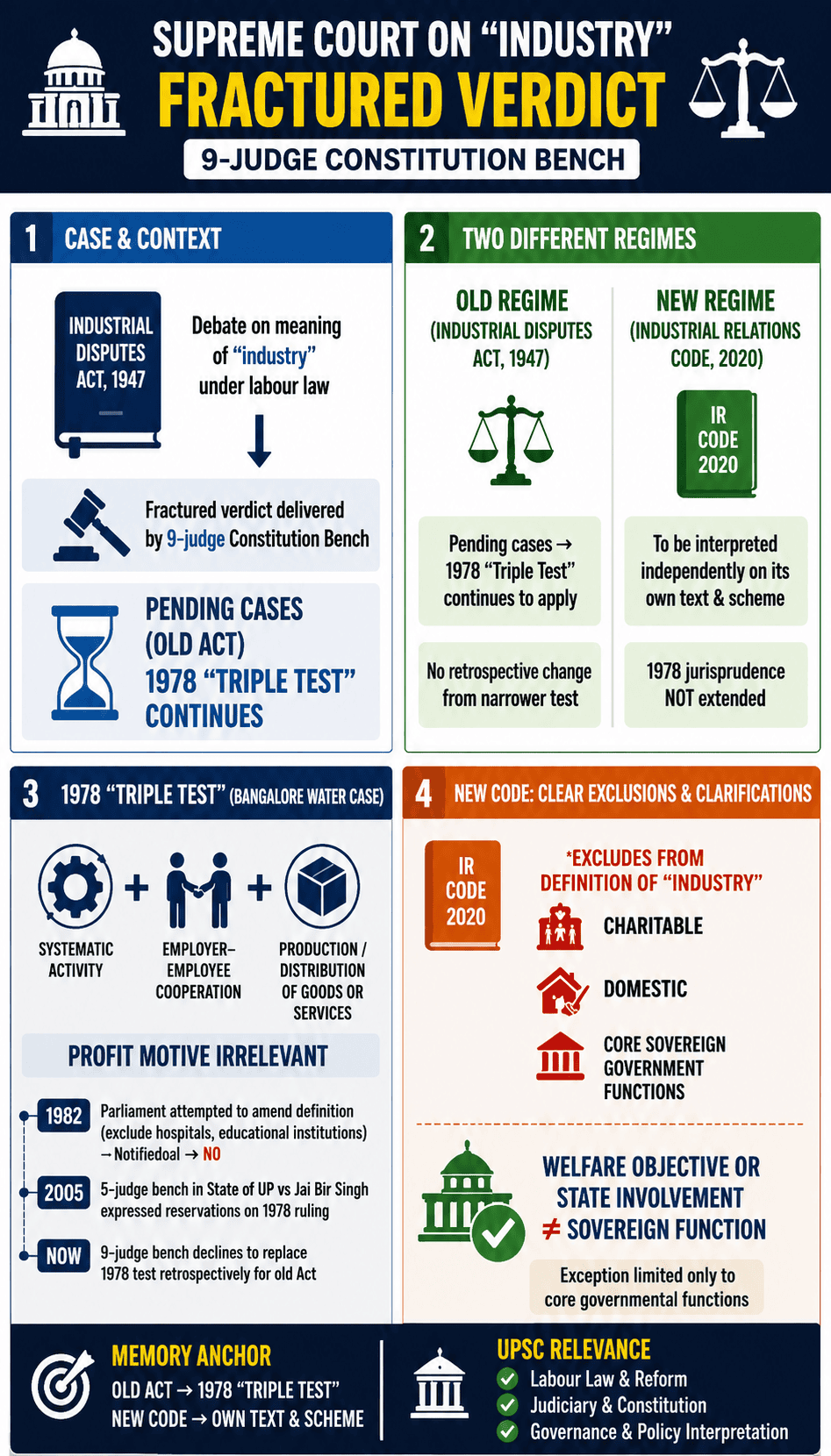
- For pending cases under the repealed Industrial Disputes Act, 1947, the 1978 "triple test" from Bangalore Water Supply and Sewerage Board vs A Rajappa will continue to apply.
- The new Industrial Relations Code, 2020, will be interpreted independently based on its own text and scheme.
- The verdict resolved the immediate issue for pending cases without extending the 1978 jurisprudence to the new code.
Industry Definition.png
Detailed Insights:
- The legal debate centered on Section 2(j) of the Industrial Disputes Act, 1947, which broadly defined "industry".
- The 1978 Bangalore Water Supply judgment adopted an expansive interpretation, laying down the "triple test" for systematic activity, employer-employee cooperation, and production/distribution of goods or services.
- This "triple test" held that the absence of a profit motive was irrelevant for an activity to be considered an industry.
- Parliament attempted to amend the definition in 1982 via the Industrial Disputes (Amendment) Act to exclude certain entities like hospitals and educational institutions, but it was never notified.
- A 2005 five-judge bench in State of UP vs Jai Bir Singh expressed reservations about the 1978 ruling, leading to the reference to the current nine-judge bench.
- The Supreme Court declined to retrospectively replace the 1978 test with a narrower one for cases under the old Act.
- The new Industrial Relations Code, 2020, explicitly excludes charitable institutions, domestic services, and core sovereign government functions from its definition of "industry".
- The ruling clarified that an activity is not sovereign merely because it is performed by the state or has a welfare objective; the exception is limited to core governmental functions.
Key Concepts Involved:
- Industry: Under Indian labour law, a systematic activity involving cooperation between employer and employee for the production or distribution of goods or services.
- Triple Test: A judicial principle established in 1978 to determine if an undertaking qualifies as an industry, focusing on systematic activity, employer-employee cooperation, and service/goods production.
- Sovereign Functions: Core governmental activities that are traditionally considered exclusive to the state and generally excluded from the definition of "industry" under labour laws.
- Industrial Disputes Act, 1947: An erstwhile Indian legislation that provided for the investigation and settlement of industrial disputes.
- Industrial Relations Code, 2020: A new Indian labour code that consolidates and amends laws relating to trade unions, conditions of employment, and industrial disputes.

SuperKalam is your personal mentor for UPSC preparation, guiding you at every step of the exam journey.
Download the App


STUDY RESOURCES
CONTACT US
ⓒ Snapstack Technologies Private Limited