GS 3: Science & TechnologyGS 1: Art & CulturePrelimsGS 1: ArchitectureGS 3: Biotechnology
Rakhigarhi skeletons to undergo DNA tests, facial reconstruction, Pg8
5,000-year-old Rakhigarhi skeletons undergo DNA tests, facial reconstruction to unlock Harappan civilization's ancient mysteries.
Practice MCQs
739 Students attempted
Key Highlights:
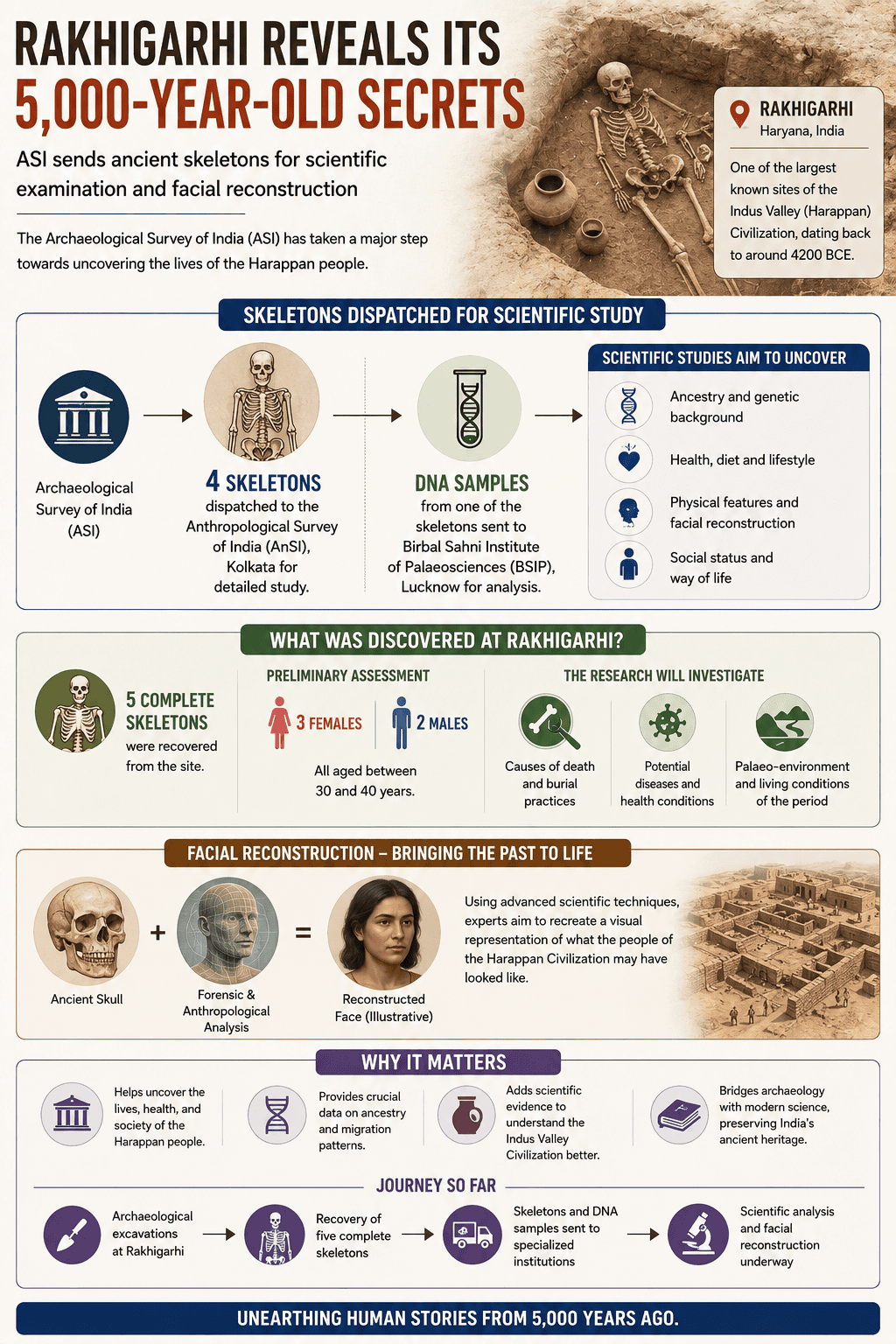
- The Archaeological Survey of India (ASI) has sent 5,000-year-old skeletons from Rakhigarhi, the largest known site of the Harappan Civilization, for scientific examination and facial reconstruction.
- Four skeletons were dispatched to the Anthropological Survey of India (AnSI) in Kolkata for detailed study.
- DNA samples from one of the skeletons have been sent to the Birbal Sahni Institute of Palaeosciences (BSIP) in Lucknow for analysis.
- The scientific studies aim to determine ancestry, health, physical features, and social status of the ancient inhabitants, along with facial reconstruction.
Rakhigarhi.png
Detailed Insights:
- Rakhigarhi, located in Haryana, is a significant archaeological site of the Indus Valley Civilization, dating back approximately 4200 BCE.
- Five complete skeletons were recovered, with preliminary assessments suggesting three females and two males, all aged between 30 and 40 years.
- The research will investigate causes of death, identify potential diseases, and reconstruct the palaeo-environment of the period.
- Facial reconstruction is a key objective, aiming to create a visual representation of what the Harappan people may have looked like.
- Three additional fragmentary burials were found at Mound No. 7, the ancient cemetery area, which were likely disturbed by agricultural activity.
- The ASI is the premier government agency responsible for archaeological research and the conservation of cultural heritage in India.
- The AnSI conducts extensive field studies and research in various domains of anthropology, including bio-cultural aspects and the study of human skeletal remains.
- The BSIP integrates plant and earth sciences to carry out palaeobotanical research, including DNA sequencing and palaeo-environmental studies.
Scientific/Technical Concepts Involved:
- DNA Analysis: A scientific technique used to study genetic material from ancient remains to understand ancestry, migration patterns, and health conditions of past populations.
- Facial Reconstruction: The process of recreating the likely facial appearance of an individual based on their skull, combining scientific analysis with artistic skill.
- Palaeo-environment: The study of past environments, including climate, flora, and fauna, to understand the ecological conditions in which ancient populations lived.
- Archaeogenetics: A multidisciplinary field combining archaeology, genetics, and paleontology to study the genetic makeup and population dynamics of ancient human groups.

SuperKalam is your personal mentor for UPSC preparation, guiding you at every step of the exam journey.
Download the App


STUDY RESOURCES
CONTACT US
ⓒ Snapstack Technologies Private Limited