GS 2: GovernanceGS 3: Science & TechnologyGS 2: International RelationsPrelimsGS 2: Government policies and interventions for development in various sectors
China's AI export order is a switch, not a wall, Pg12
China drafts new AI export controls, adding advanced technologies like foundation models to restricted lists, enabling Beijing to monitor and control global tech flow.
Practice MCQs
760 Students attempted
Key Highlights:
- China's Ministry of Commerce (MOFCOM) has proposed adding advanced AI technologies to its export-control list.
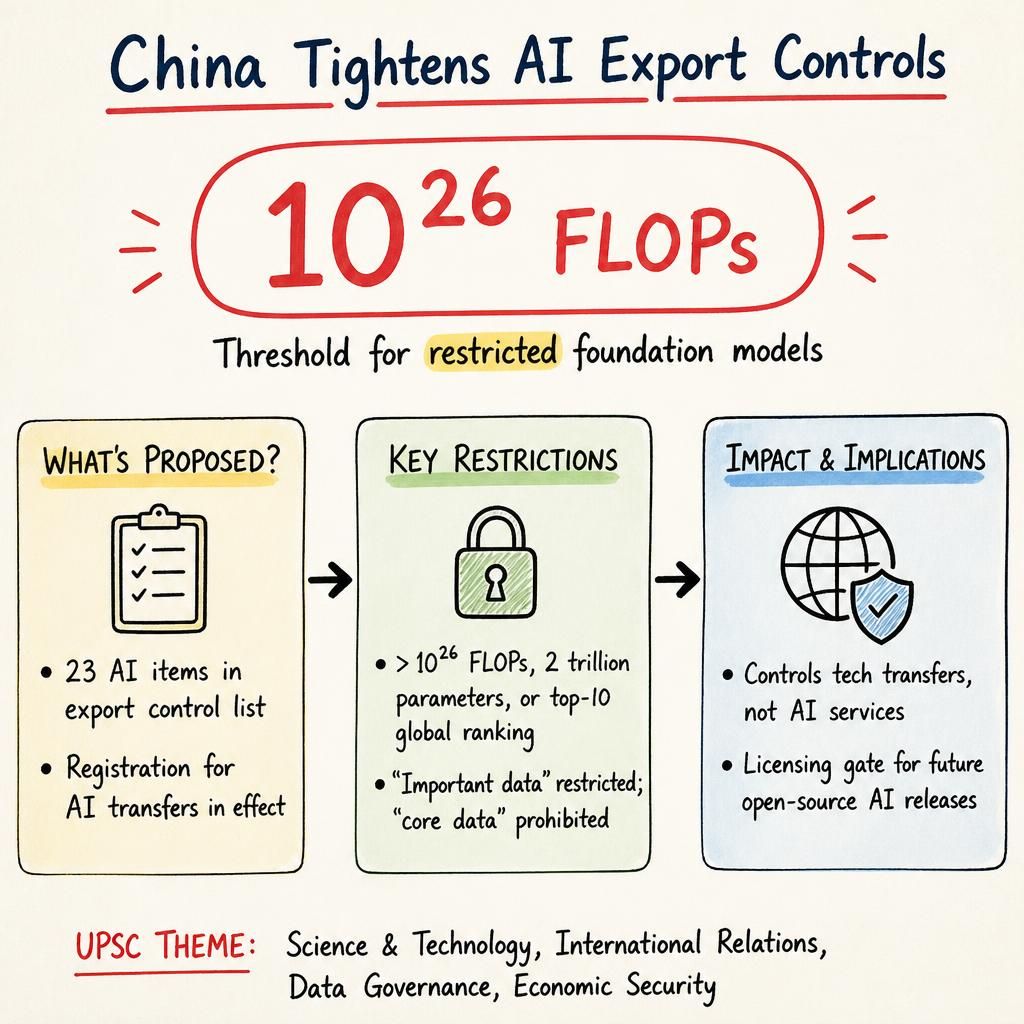
- The draft revises the Catalogue of Technologies Prohibited or Restricted from Export, incorporating 23 AI items.
- A temporary registration requirement for transfers of covered AI technology is already in effect.
- Restrictions apply to foundation models exceeding 10^26 training FLOPs, 2 trillion parameters, or a top-10 global ranking.
- Models trained on "important data" are restricted, while those on "core data" are prohibited under China's Data Security Law.
China AI Export Control.jpg
Detailed Insights:
- The new regulations grant China the ability to monitor, slow, or halt the international flow of its AI technology.
- Restricted items will necessitate an export license, whereas prohibited items cannot be exported under any circumstances.
- The controls specifically target transfers of technology, including model weights, code, architecture, and hardware optimizations, rather than AI services.
- Widely adopted open-weight models are eligible for "automatic licensing," implying a quicker and more procedural approval process.
- While framed around safety, the policy's design suggests it functions as an instrument of control, targeting broad capabilities and economically valuable technologies.
- The regulations do not restrict API access, which maintains foreign users' dependence on Chinese AI providers.
- A "change-of-control" clause targets foreign ownership or control changes in AI entities, even without physical code transfer.
- This move establishes a licensing gate for future open-source AI releases from China, influencing global AI development.
- It underscores the importance of diversifying AI ecosystems and technology stacks to prevent vendor lock-in, particularly for nations like India.
Key Concepts Involved:
- Export Control List: A government-maintained list of specific goods, software, and technologies whose export is regulated or forbidden.
- Foundation Models: Large-scale AI models trained on extensive datasets, designed to be adaptable across a wide array of tasks.
- Model Weights: The numerical parameters within an AI model that define its learned patterns and influence its output.
- Data Security Law: Chinese legislation that governs data processing activities and classifies data into different security tiers.

SuperKalam is your personal mentor for UPSC preparation, guiding you at every step of the exam journey.
Download the App


STUDY RESOURCES
CONTACT US
ⓒ Snapstack Technologies Private Limited