GS 2: GovernanceGS 3: Internal SecurityGS 3: Environment & EcologyPrelimsGS 3: Conservation, Pollution and Degradation
Urban demand is reorganising global wildlife trafficking web, Pg II
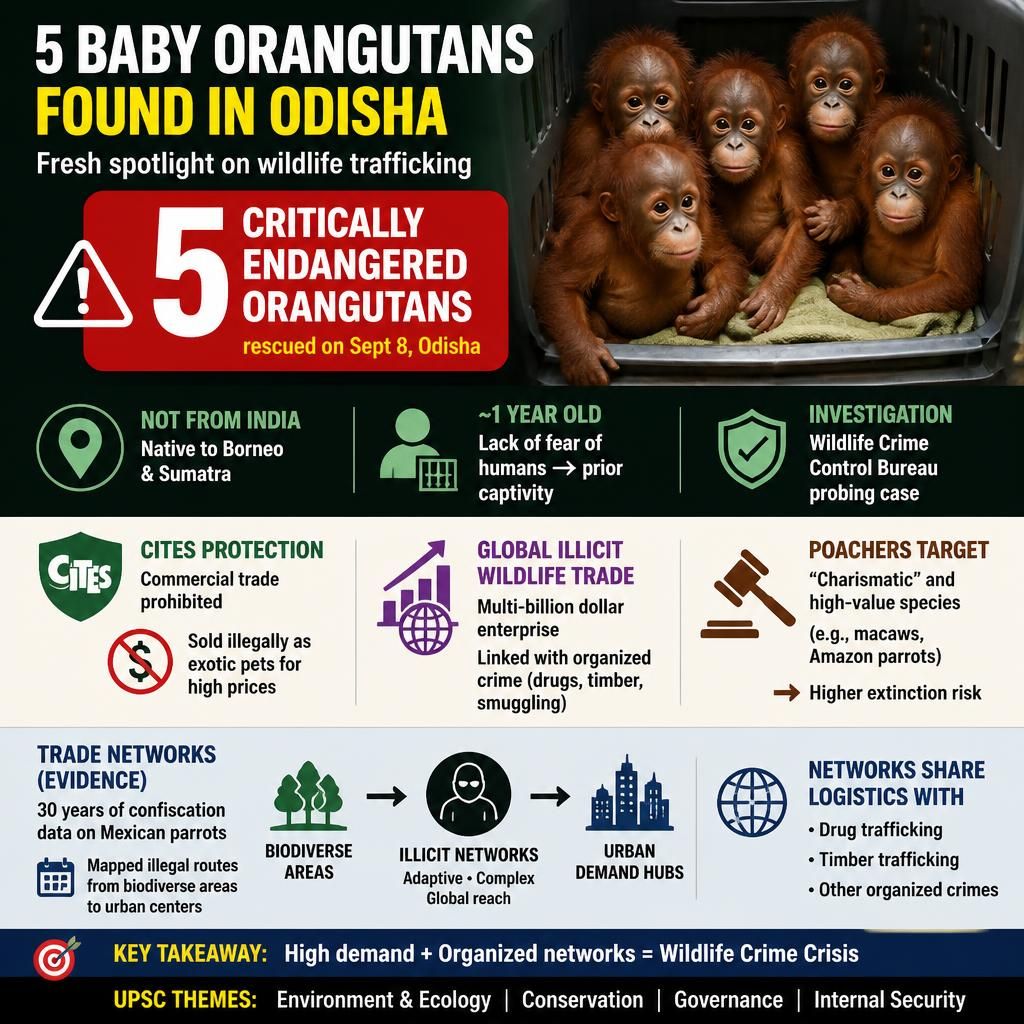
Discovery of five baby orangutans in Odisha exposes a global wildlife trafficking web, driven by urban demand and threatening endangered species.
Practice MCQs
753 Students attempted
Key Highlights:
- Five critically endangered baby orangutans were discovered in Odisha, India, on September 8, far from their natural habitat in Borneo and Sumatra.
- The discovery has reignited discussions on wildlife trafficking, with the Wildlife Crime Control Bureau tasked to investigate the incident.
- Orangutans are protected under CITES, which prohibits their commercial trade, yet they are sold as exotic pets for high prices.
- A study on parrot trafficking in Mexico highlights urban centers as key demand hubs, reorganizing global illicit wildlife networks.
- The illegal wildlife trade is a multi-billion dollar enterprise, increasingly converging with broader organized crime.
CITES.jpg
Detailed Insights:
- The orangutans, estimated to be around one year old, showed a lack of fear of humans, suggesting prior captivity.
- This incident follows a similar discovery in 2022, where two baby orangutans were found near the Assam-Mizoram border.
- The study on Mexican parrots used 30 years of confiscation data to map trade routes from biodiverse areas to urban centers.
- Poachers consistently target "charismatic" and high-value species, such as macaws and Amazon parrots, elevating their extinction risk.
- Illicit wildlife networks are complex, adaptive, and often share logistics with other criminal activities like drug and timber trafficking.
- The illegal wildlife trade poses significant threats, including biodiversity loss and an elevated risk of zoonotic disease transfer.
- In India, primates, turtles, and lizards are among the most smuggled species, primarily through land routes connecting India and Myanmar.
- Criminal networks involved in wildlife trafficking are "amoebic," constantly reconfiguring to safeguard their operations.
Key Concepts Involved:
- CITES (Convention on International Trade in Endangered Species of Wild Fauna and Flora): An international agreement regulating trade in endangered plants and animals to prevent their extinction.
- Wildlife Crime Control Bureau (WCCB): A statutory body in India established to combat organized wildlife crime in the country.
- Zoonotic diseases: Infectious diseases that can be transmitted from animals to humans.
- Organized crime: Criminal activities planned and controlled by powerful groups and carried out on a large scale.

SuperKalam is your personal mentor for UPSC preparation, guiding you at every step of the exam journey.
Download the App


STUDY RESOURCES
CONTACT US
ⓒ Snapstack Technologies Private Limited