GS 2: GovernanceGS 2: International RelationsGS 3: EconomyPrelimsGS 3: Changes in Industrial Policy and Effects on Industrial Growth
The paradox of self-reliance: India-China trade dynamics, Pg7
India's widening trade deficit with China exposes a paradox in Atmanirbhar Bharat, revealing deep dependence on Chinese supply chains despite manufacturing growth.
Practice MCQs
753 Students attempted
Key Highlights:
- Prime Minister Narendra Modi and Chinese President Xi Jinping discussed structural trade imbalance and supply chain issues during the BRICS summit on September 12.
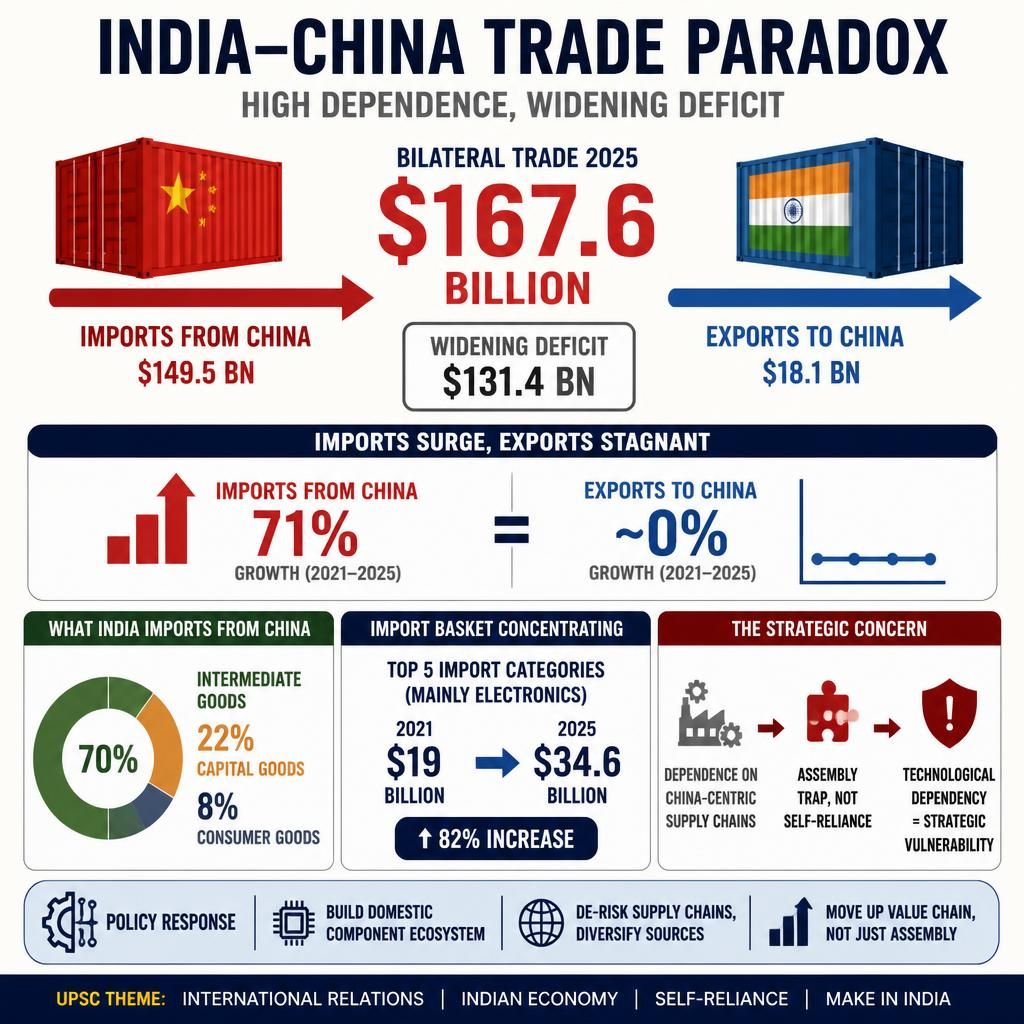
- India's bilateral trade with China reached $167.6 billion in 2025, marked by a widening trade deficit.
- Between 2021 and 2025, India's imports from China surged by 71% to $149.5 billion, while exports remained stagnant.
- Intermediate goods constitute nearly 70% and capital goods 22% of India's imports from China, indicating deep structural dependence.
- The top five import categories, predominantly electronics, grew from $19 billion in 2021 to $34.6 billion in 2025, showing increased concentration.
India-China Trade Paradox.jpg
Detailed Insights:
- The widening trade deficit with China presents a paradox for India's Atmanirbhar Bharat mission, aimed at bolstering domestic manufacturing.
- India's manufacturing expansion remains heavily reliant on China-centric supply chains, leading to an "assembly trap" rather than true self-reliance.
- This dependence extends to critical inputs, components, and semi-processed goods essential for India's manufacturing system.
- Despite initiatives like Make in India and the Phased Manufacturing Programme (PMP), India's import basket has become more concentrated in specific electronics categories.
- India's success in mobile phone assembly is largely driven by downstream assembly, lacking a robust domestic component ecosystem.
- Persistent reliance on sophisticated inputs and capital goods from China can transform technological dependencies into strategic vulnerabilities.
- Addressing these challenges requires shifting focus from incentivizing assembly to building domestic technological capability, innovation, and supplier networks.
- Calibrated tariffs on parts and components, rather than blanket restrictions, can help nurture domestic manufacturing value chains.
Key Concepts Involved:
- Atmanirbhar Bharat: A vision for a self-reliant India, launched in 2020, focusing on domestic manufacturing, reducing import dependence, and strengthening the economy.
- Make in India: A government initiative launched in 2014 to encourage companies to manufacture in India, attract foreign investment, and establish the country as a global manufacturing hub.
- Phased Manufacturing Programme (PMP): A policy introduced in 2017 to promote indigenous manufacturing and increase domestic value addition in specific sectors, particularly electronics, through a graded duty structure.

SuperKalam is your personal mentor for UPSC preparation, guiding you at every step of the exam journey.
Download the App


STUDY RESOURCES
CONTACT US
ⓒ Snapstack Technologies Private Limited