GS 2: GovernanceGS 1: Art & CulturePrelimsGS 1: Art FormsGS 2: Government policies and interventions for development in various sectors
Ralph Lauren to Fendi: Why Indian crafts are easy to borrow, hard to protect, Pg9
Luxury brands' cultural appropriation of Indian crafts exposes gaps in intellectual property protection and community rights, demanding a specialized framework.
Practice MCQs
753 Students attempted
Key Highlights:
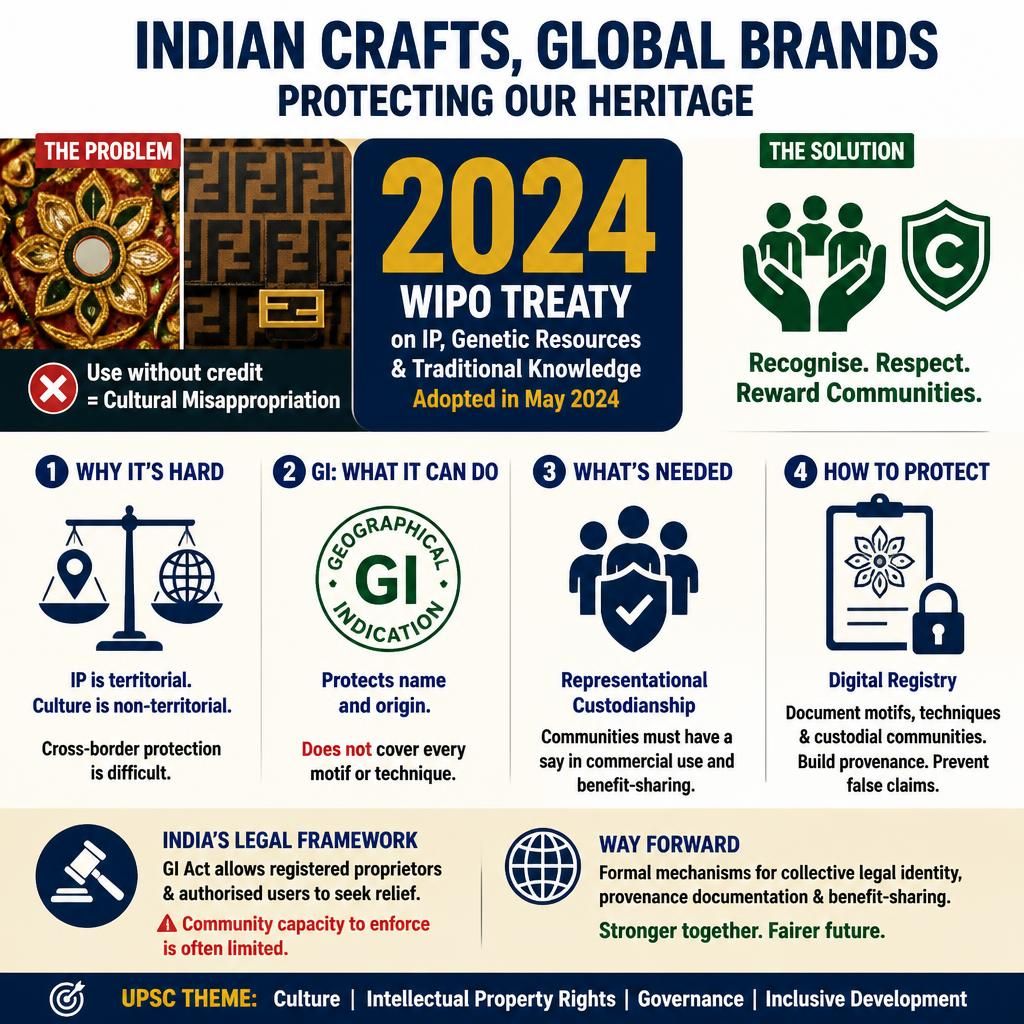
- Luxury fashion brands like Ralph Lauren and Fendi have been accused of cultural misappropriation of Indian crafts, such as aari/zardozi embroidery and mirror-work, without proper attribution or credit.
- This issue highlights the challenge of protecting traditional Indian crafts, which often lack clear legal ownership despite their cultural provenance.
- Geographical Indication (GI) can protect the name and origin of a product but not necessarily every motif or technique associated with a craft.
- The World Intellectual Property Organisation (WIPO) adopted a new treaty in May 2024 to address intellectual property, genetic resources, and associated traditional knowledge.
Indian Crafts.jpg
Detailed Insights:
- The core problem lies in the contradiction between intellectual property being territorial and culture being non-territorial, making cross-border protection difficult.
- Traditional crafts, evolving over generations within communities, do not fit neatly into conventional IP categories like patents or copyrights.
- Experts suggest the need for "representational custodianship," where communities sustaining the tradition have a meaningful role in commercial use decisions.
- While India's GI Act allows registered proprietors and authorized users to seek relief for infringement, practical capacity for communities to exercise these rights is often limited.
- Cross-border litigation for IP infringement is resource-intensive, necessitating formal mechanisms for collective legal identity, documented provenance, and benefit-sharing.
- A carefully maintained digital registry could document motifs, techniques, and custodial communities, making it harder for companies to claim original creation.
- There is a significant power imbalance between multinational corporations and craft communities, making enforcement of rights challenging.
- The government's role is crucial in facilitating registration, recognition, and enforcement, while ownership should remain with the community.
- The newly adopted WIPO Treaty on Intellectual Property, Genetic Resources and Associated Traditional Knowledge establishes disclosure requirements for patent applicants using genetic resources and associated traditional knowledge.
Key Concepts Involved:
- Intellectual Property (IP): Legal rights granted to creators over their original works, including inventions, literary and artistic works, designs, and symbols.
- Geographical Indication (GI): A sign used on products that have a specific geographical origin and possess qualities or a reputation due to that origin.
- World Intellectual Property Organisation (WIPO): A specialized agency of the United Nations dedicated to developing a balanced international IP system.
- Berne Convention: An international agreement governing copyright, which protects literary and artistic works.

SuperKalam is your personal mentor for UPSC preparation, guiding you at every step of the exam journey.
Download the App


STUDY RESOURCES
CONTACT US
ⓒ Snapstack Technologies Private Limited