GS 2: GovernanceGS 2: PolityGS 2: Social JusticeGS 3: EconomyPrelims
India’s NGOs at a new funding crossroads, Pg6
Proposed FCRA Amendment Bill, 2026, sparks debate over foreign funding for NGOs, raising fears of government control and impact on social welfare.
Practice MCQs
753 Students attempted
Key Highlights:
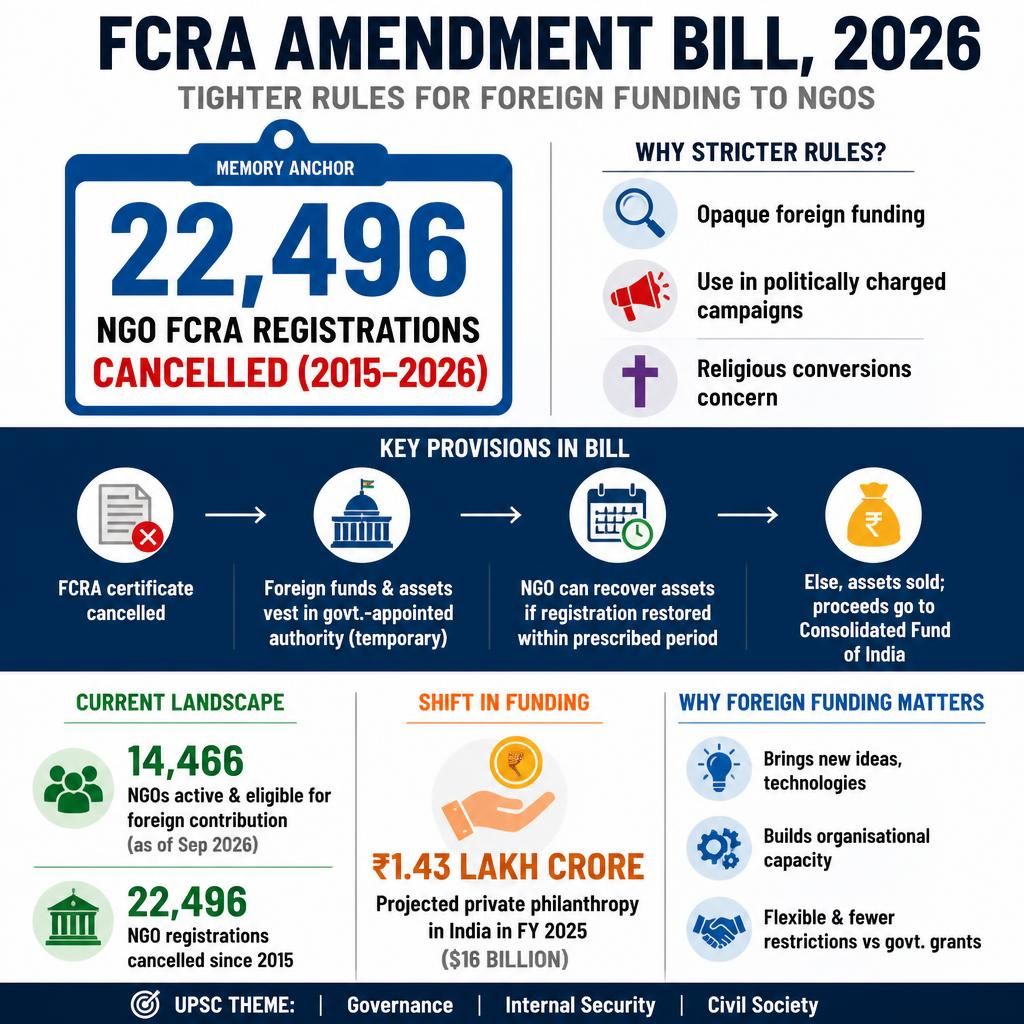
- The FCRA Amendment Bill, 2026, proposes stricter regulations for foreign funding to Non-Governmental Organizations (NGOs) in India.
- The government expresses concerns over opaque foreign funding, its potential use in politically charged campaigns, and religious conversions.
- The Bill suggests that if an FCRA certificate is cancelled, foreign contributions and assets created from them would temporarily vest in a government-appointed authority.
- Since 2015, FCRA registrations of 22,496 NGOs have been cancelled, leaving about 14,466 active associations eligible for foreign contributions as of September 2026.
- NGOs, particularly Christian organizations, fear the legislation may not be religion-neutral and could adversely affect beneficiaries of their social services.
- Domestic philanthropy, including private giving and Corporate Social Responsibility (CSR) spending, is growing, with private philanthropy projected to reach ₹1.43 lakh crore ($16 billion) in FY 2025.
FCRA Amendment.jpg
Detailed Insights:
- The original Foreign Contribution Regulation Act (FCRA) was enacted in 1976, driven by similar apprehensions about foreign interference in India's internal affairs.
- The proposed Bill allows for the recovery of assets by NGOs if their registration is restored within a prescribed period, otherwise, assets could be sold with proceeds going to the Consolidated Fund of India.
- Foreign funding, while a small proportion of overall development funds, is valued by NGOs for its flexibility and fewer restrictions compared to government grants.
- Historically, foreign aid has been credited with bringing new ideas, technologies, and organizational improvements to India's voluntary sector.
- The landscape of foreign aid is changing, with some international donors reducing contributions to India due to their own economic difficulties and India's growing economy.
- The Companies Act, 2013, made CSR spending mandatory for eligible companies, leading to ₹22,563 crore in spending in FY25, a potential alternative funding source for NGOs.
- A vibrant and independent civil society, supported by plural funding sources, is considered essential for a healthy democracy and to prevent the abuse of political power.
Key Concepts Involved:
- Foreign Contribution Regulation Act (FCRA): An Indian law regulating the acceptance and utilization of foreign contributions or hospitality by individuals, associations, or companies.
- FCRA Amendment Bill, 2026: Proposed legislation aiming to further tighten controls on foreign funding to NGOs, including provisions for asset vesting upon registration cancellation.
- Consolidated Fund of India: The primary government account where all revenues received by the government, loans raised, and receipts from loan recoveries are credited.
- Corporate Social Responsibility (CSR): A business approach where companies integrate social and environmental concerns into their business operations and interactions with stakeholders, often mandated by the Companies Act, 2013.

SuperKalam is your personal mentor for UPSC preparation, guiding you at every step of the exam journey.
Download the App


STUDY RESOURCES
CONTACT US
ⓒ Snapstack Technologies Private Limited