GS 3: Science & TechnologyGS 3: Environment & EcologyGS 3: EconomyPrelimsGS 3: Buffer Stocks and Food Security
Ethanol vision needs a feedstock reality check, Pg11
India's ethanol blending vision faces feedstock challenges, raising concerns over water consumption, crop prices, and food security amidst rising sugar costs.
Practice MCQs
753 Students attempted
Key Highlights:
- India's ethanol production program faces challenges regarding feedstock availability and water usage, despite its goal to reduce crude oil imports.
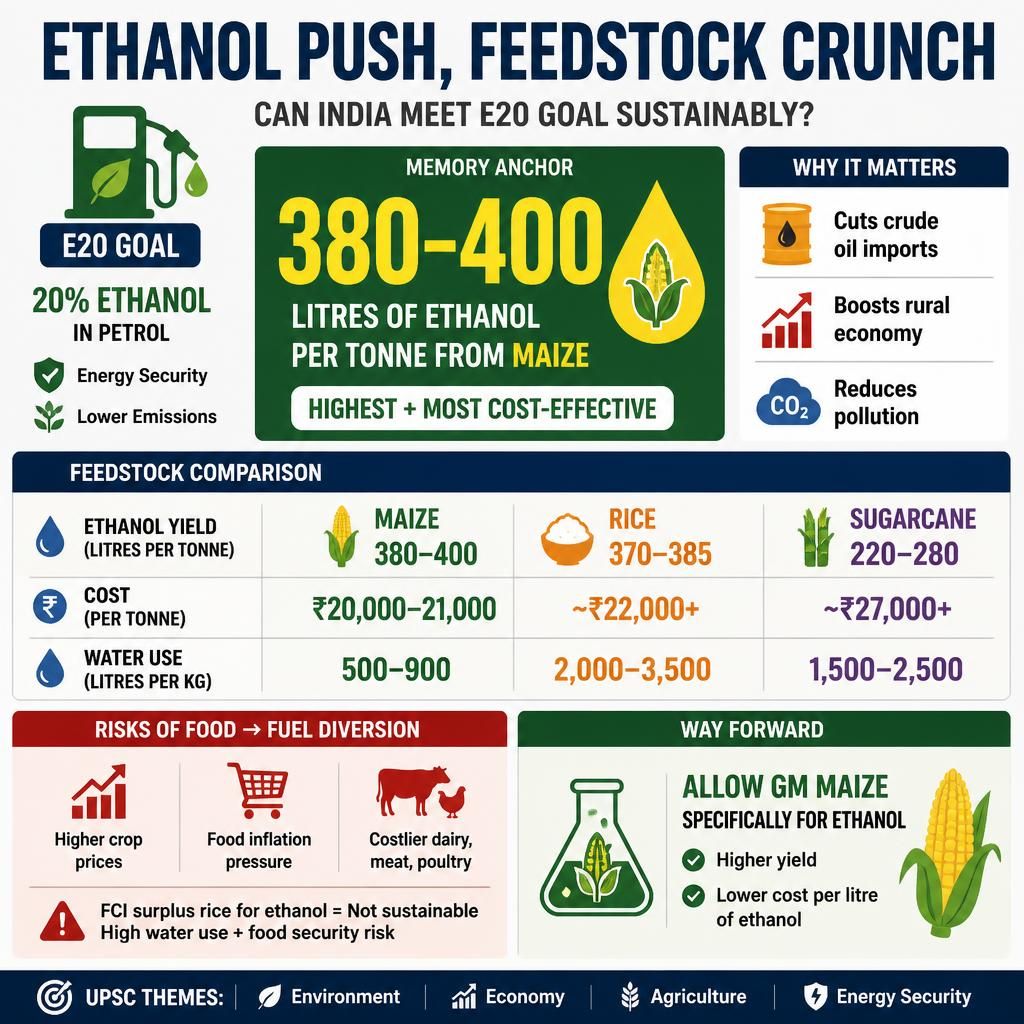
- Maize is identified as the most efficient and cost-effective feedstock for ethanol production compared to rice and sugarcane.
- The article highlights concerns about potential pressure on crop supplies and rising food prices if food grains are diverted for ethanol.
- High water consumption across all feedstocks, particularly rice and sugarcane, poses a significant environmental challenge.
- A potential solution suggested is allowing Genetically Modified (GM) maize specifically for ethanol production to enhance output.
Ethanol Push.jpg
Detailed Insights:
- The Ethanol Blending Program (EBP) aims for a 20% ethanol blend in petrol (E20) to enhance energy security and reduce pollution.
- Maize yields 380-400 litres of ethanol per tonne, while rice yields 370-385 litres, and sugarcane yields 220-280 litres.
- The cost of maize is approximately Rs 20,000-21,000 per tonne, making it economically preferable for ethanol producers.
- Increased demand for maize for ethanol could lead to higher prices, impacting the dairy, meat, and poultry sectors.
- The Food Corporation of India (FCI) has previously sold surplus low-quality rice for ethanol, but this is not a sustainable long-term strategy due to water intensity.
- Water consumption for maize is 500-900 litres per kg, for sugarcane 1,500-2,500 litres, and for rice 2,000-3,500 litres, exacerbating water stress.
- Allowing Genetically Modified (GM) maize for ethanol production could boost feedstock supply without affecting food security or domestic seed varieties.
Key Concepts Involved:
- Ethanol Blending Program (EBP): A government initiative to blend ethanol with petrol to reduce crude oil imports and promote biofuels.
- E20: Refers to a blend of 20% ethanol and 80% petrol, a target for India's fuel policy.
- Feedstock: Raw material used in an industrial process, in this context, for producing ethanol (e.g., sugarcane, maize, rice).
- Genetically Modified (GM) crops: Plants whose DNA has been altered using genetic engineering techniques to introduce new traits.
- Food Corporation of India (FCI): A government agency responsible for food grain procurement, storage, and distribution in India.

SuperKalam is your personal mentor for UPSC preparation, guiding you at every step of the exam journey.
Download the App


STUDY RESOURCES
CONTACT US
ⓒ Snapstack Technologies Private Limited