GS 2: GovernanceGS 2: Social JusticePrelimsGS 2: Government policies and interventions for development in various sectorsGS 2: Important Aspects of Governance, Transparency and Accountability
Puzzle of missing urgency around learning, Pg11
Despite policy push, foundational learning crisis persists due to lack of salience and accountability, hindering educational outcomes nationwide.
Practice MCQs
898 Students attempted
Key Highlights:
- India faces a learning crisis despite policy support and funding, with a lack of urgency in addressing Foundational Literacy and Numeracy (FLN).
- National Education Policy 2020 identifies FLN as a national priority, but this hasn't fully translated to field-level action.
- Factors contributing to the gap include the intangible nature of poor learning, power imbalances, under-recognition of the crisis scale, and a disconnect in perceived responsibility.
- Improving foundational learning at scale is possible through approaches like 'Teaching at the Right Level' and structured pedagogy.
Detailed Insights:
- The absence of salience, or a shared recognition that learning matters, is a key reason for the lack of urgency in addressing the learning crisis.
- Vietnam outperformed richer nations in learning outcomes by prioritizing learning, highlighting the importance of salience.
- Learning is difficult to observe, and the concept of oral reading fluency is not widely understood, leading to dismissal of reports like ASER.
- Power asymmetries weaken accountability, as children lack a voice and parents may lack the tools to assess learning.
- Schooling is often seen as the state's responsibility, while learning is seen as dependent on the child's ability or family support, undermining systemic factors.
- Acknowledging the scale of the crisis is difficult for educators and political actors, but the failure is due to systemic neglect of learning outcomes.
- Building salience involves making learning visible through village-level assessments and demonstrating that solutions exist.
Key Concepts Involved:
- Foundational Literacy and Numeracy (FLN): Basic reading, writing, and arithmetic skills necessary for further learning.
- Salience: The quality of being particularly noticeable or important; relevance.
- Oral Reading Fluency: The ability to read aloud effortlessly and accurately with appropriate speed and expression.
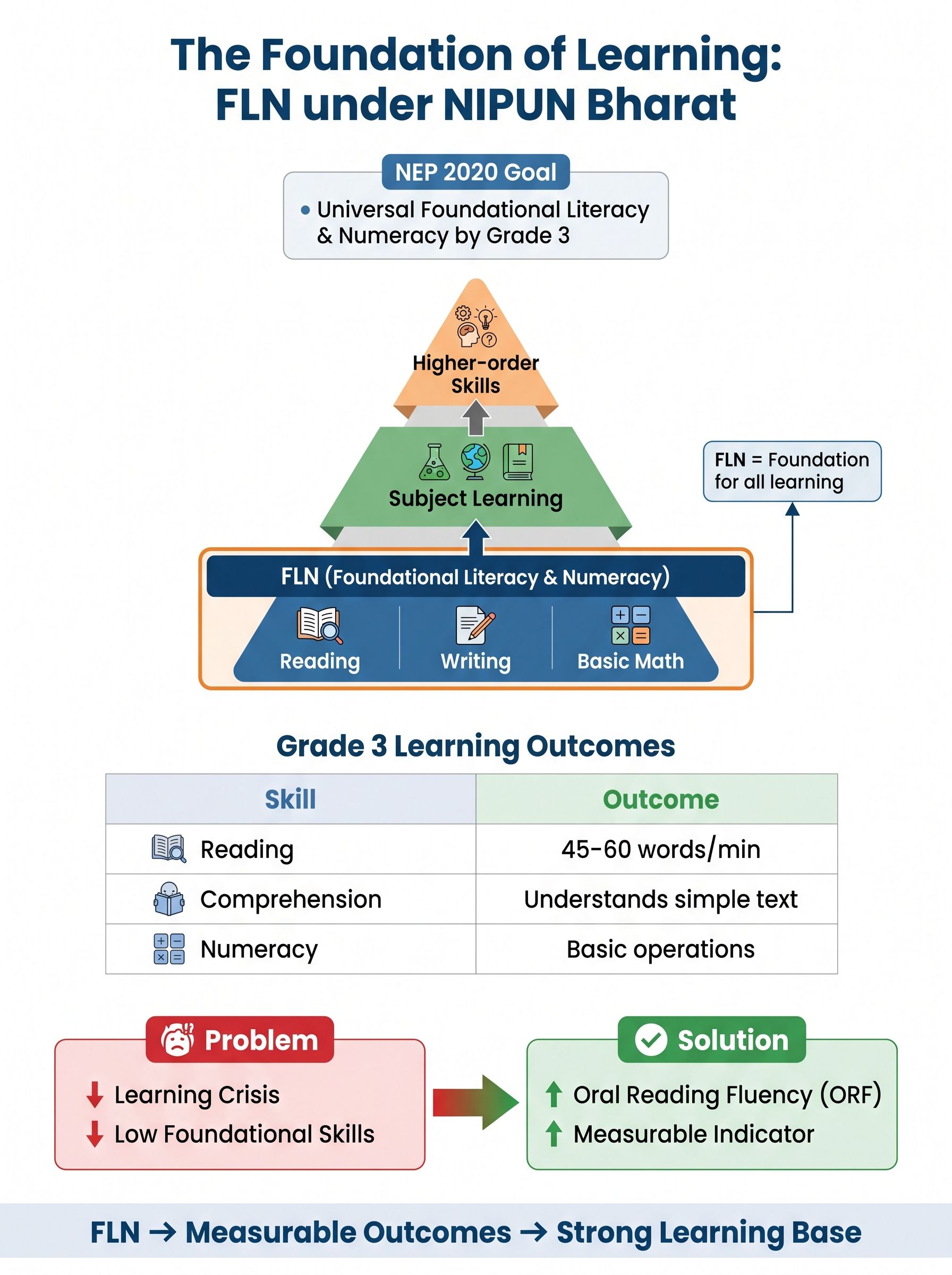
NIPUN

SuperKalam is your personal mentor for UPSC preparation, guiding you at every step of the exam journey.
Download the App


STUDY RESOURCES
CONTACT US
ⓒ Snapstack Technologies Private Limited