GS 2: GovernanceGS 2: Social JusticePrelimsGS 2: Government policies and interventions for development in various sectorsGS 2: Important International Institutions, Agencies and Fora
What does the WHO report say about India’s TB target?, Pg12
India misses its ambitious 2025 TB elimination target despite 38% mortality reduction, WHO report reveals, with incidence figures under review.
Practice MCQs
760 Students attempted
Key Highlights:
- India continues to bear nearly a quarter of the global Tuberculosis (TB) burden, despite expanded diagnostic and treatment services.
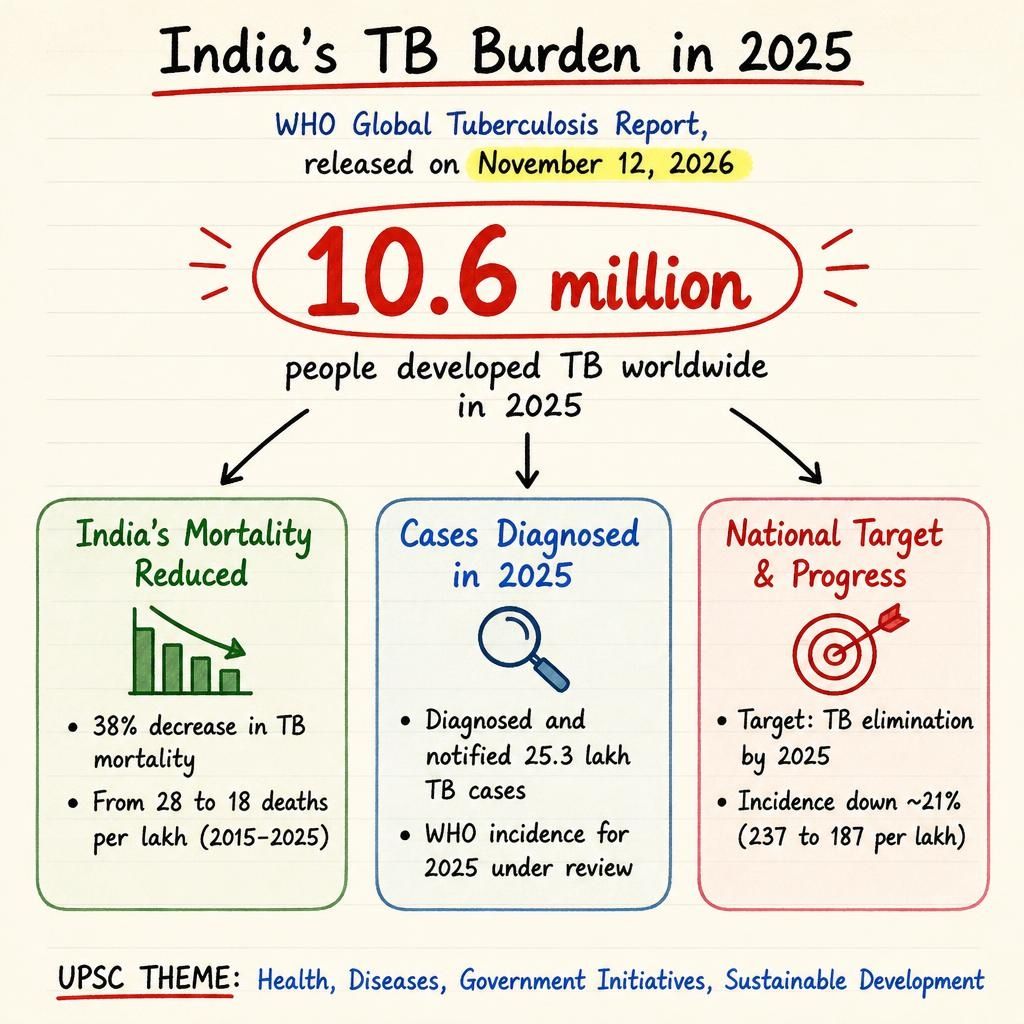
- The World Health Organization (WHO) Global Tuberculosis Report, released on November 12, 2026, estimated 10.6 million people developed TB worldwide in 2025.
- India's estimated TB mortality rate decreased by 38%, from 28 deaths per lakh population in 2015 to 18 per lakh in 2025.
- The country diagnosed and notified 25.3 lakh TB cases in 2025.
- The WHO has not published India’s estimated TB incidence for 2025, as the figures are currently under review.
- India set an ambitious national target to eliminate TB by 2025, five years ahead of the global Sustainable Development Goal (SDG) deadline of 2030.
Tb Burden.jpg
Detailed Insights:
- India's national target for TB elimination by 2025 was incorporated into the National Strategic Plan for TB Elimination 2017–2025.
- This plan aimed for an 80% reduction in estimated incidence (from 217 to 43 cases per lakh) and a 90% reduction in mortality (from 32 to 3 deaths per lakh) by 2025, compared to 2015 levels.
- The WHO's End TB Strategy set global targets of reducing incidence by 50% and mortality by 75% by 2025, relative to 2015.
- India's 38% reduction in TB mortality by 2025 exceeded the WHO's 2020 milestone of a 35% reduction, though it was achieved five years late.
- The estimated TB incidence in India declined by approximately 21% from 237 cases per lakh in 2015 to 187 per lakh in 2024, falling short of the national plan's reduction goals.
- Reasons for missing the target include challenges in diagnosing and treating all cases, uneven access to testing and follow-up, and issues with notification and treatment continuity in the private sector.
- Social and economic factors like undernutrition, crowded housing, poor ventilation, and catastrophic costs for patients also contribute to the persistence of TB.
- India has implemented measures like expanded active case-finding and rapid molecular tests, including through the TB Mukt Bharat Abhiyaan.
- The absence of India's 2025 incidence estimate is due to the WHO assessing data from a new district-level sentinel surveillance exercise and the 2020–21 national TB prevalence survey.
- Updated incidence figures for India are expected in early 2027, which will provide a clearer picture of the country's TB burden and the scale of the shortfall in meeting its targets.
Key Concepts Involved:
- Tuberculosis (TB): An infectious disease caused by bacteria, primarily affecting the lungs, but can also affect other parts of the body.
- Incidence: The rate at which new cases of a disease occur in a population over a specified period.
- Prevalence: The total number of existing cases of a disease in a population at a specific time or over a period.
- Notifications: Cases of a disease diagnosed and officially reported to the public health system.
- Sustainable Development Goals (SDGs): A collection of 17 interlinked global goals designed to be a "blueprint to achieve a better and more sustainable future for all".

SuperKalam is your personal mentor for UPSC preparation, guiding you at every step of the exam journey.
Download the App


STUDY RESOURCES
CONTACT US
ⓒ Snapstack Technologies Private Limited