GS 2: International RelationsGS 3: EconomyPrelimsGS 3: Infrastructure: Energy, Ports, Roads, Airports, Railways etc.GS 2: Effect of Policies and Politics of Developed and Developing Countries on India's Interests
West Asia crisis is the ‘largest threat’ to energy security: IEA, Pg18
IEA warns West Asia crisis, fueled by US-Israel bombing of Iran and Strait of Hormuz blockade, poses largest-ever threat to global energy security.
Practice MCQs
760 Students attempted
Key Highlights:
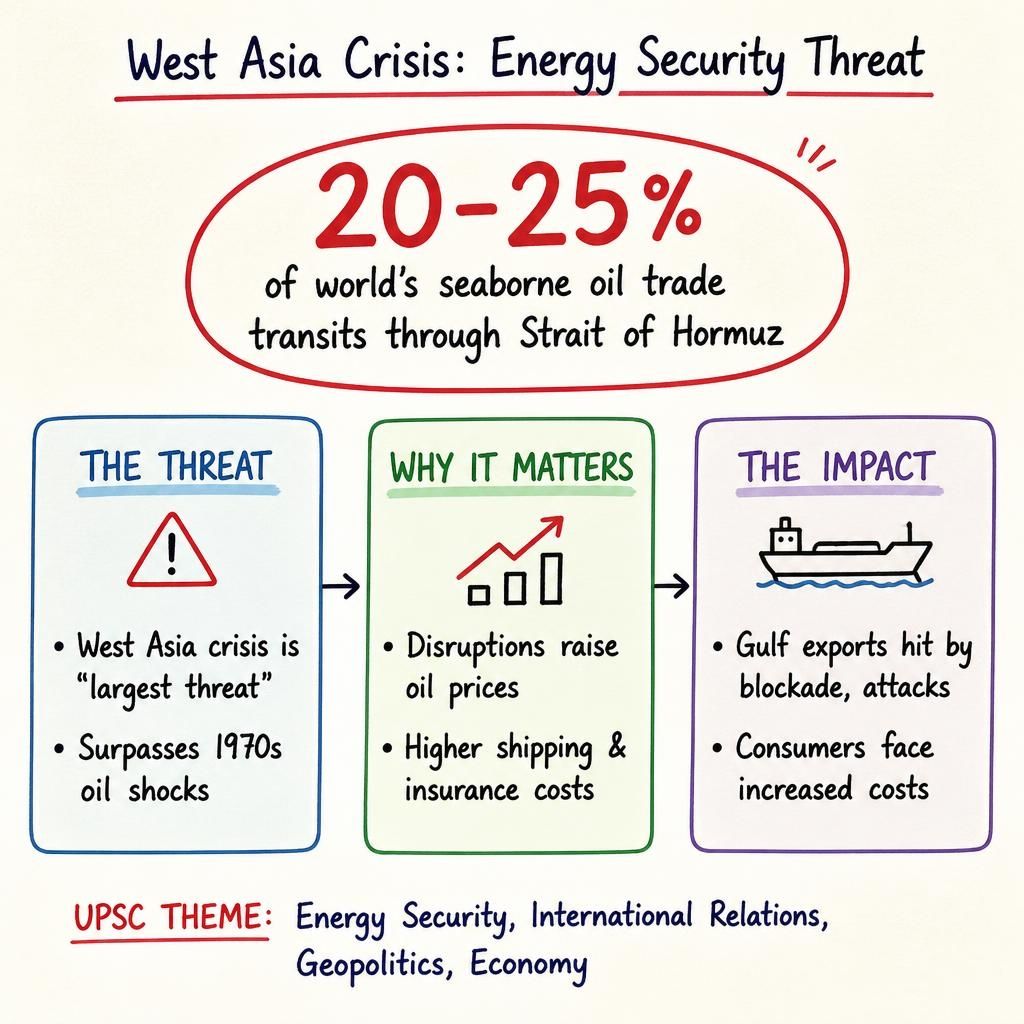
- The International Energy Agency (IEA) warned that the West Asia crisis, sparked by U.S. and Israeli bombing of Iran in February, poses the "largest threat" to energy security in history.
- The crisis has led to consumers bearing increased costs as global energy supply chains struggle to absorb the impact.
- IEA Executive Director Fatih Birol stated that the current threat surpasses the scale of the oil shocks experienced in the 1970s.
- Gulf countries are facing difficulties in exporting oil due to Iran's blockade of the Strait of Hormuz and targeting of tankers in the region.
West Asia Crisis.jpg
Detailed Insights:
- The IEA, established in 1974 after the 1973 oil crisis, advises member states on energy policy, focusing on energy security, economic development, and environmental protection.
- The Strait of Hormuz is a critical maritime chokepoint connecting the Persian Gulf to the Gulf of Oman, through which a significant portion of the world's oil and liquefied natural gas passes.
- Approximately 20-25% of the world's seaborne oil trade, or about 20 million barrels per day, transits through the Strait of Hormuz, making it vital for global energy supply.
- Disruptions in the Strait can immediately impact global oil prices, shipping costs, and maritime insurance premiums, affecting international energy markets and geopolitical stability.
- The oil shocks of the 1970s, triggered by events like the 1973 Yom Kippur War and the 1979 Iranian Revolution, caused significant petroleum shortages and price surges globally.
- These past crises led to economic stagflation, rationing, and a global shift towards energy conservation and diversification of energy sources.
- Energy security involves ensuring continuous, reliable, affordable, and sustainable energy supply, with both short-term (responding to disruptions) and long-term (investment in future supply) dimensions.
Key Concepts Involved:
- Energy Security: The uninterrupted availability of energy sources at an affordable price to meet national needs.
- Strait of Hormuz: A narrow, strategically vital waterway between the Persian Gulf and the Gulf of Oman, crucial for global oil and gas transit.
- International Energy Agency (IEA): An intergovernmental organization providing policy recommendations, analysis, and data on the global energy sector.
Previous15/15

SuperKalam is your personal mentor for UPSC preparation, guiding you at every step of the exam journey.
Download the App


STUDY RESOURCES
CONTACT US
ⓒ Snapstack Technologies Private Limited