GS 3: Internal SecurityGS 2: International RelationsPrelimsGS 2: Bilateral, Regional and Global Groupings and AgreementsGS 2: Effect of Policies and Politics of Developed and Developing Countries on India's Interests
In a first, Japanese forces to train in Indian firing ranges, Pg14
India and Japan deepen defence ties as Tokyo's forces gain first-time access to Indian firing ranges for live-fire training, including surface-to-ship missiles.
Practice MCQs
760 Students attempted
Key Highlights:
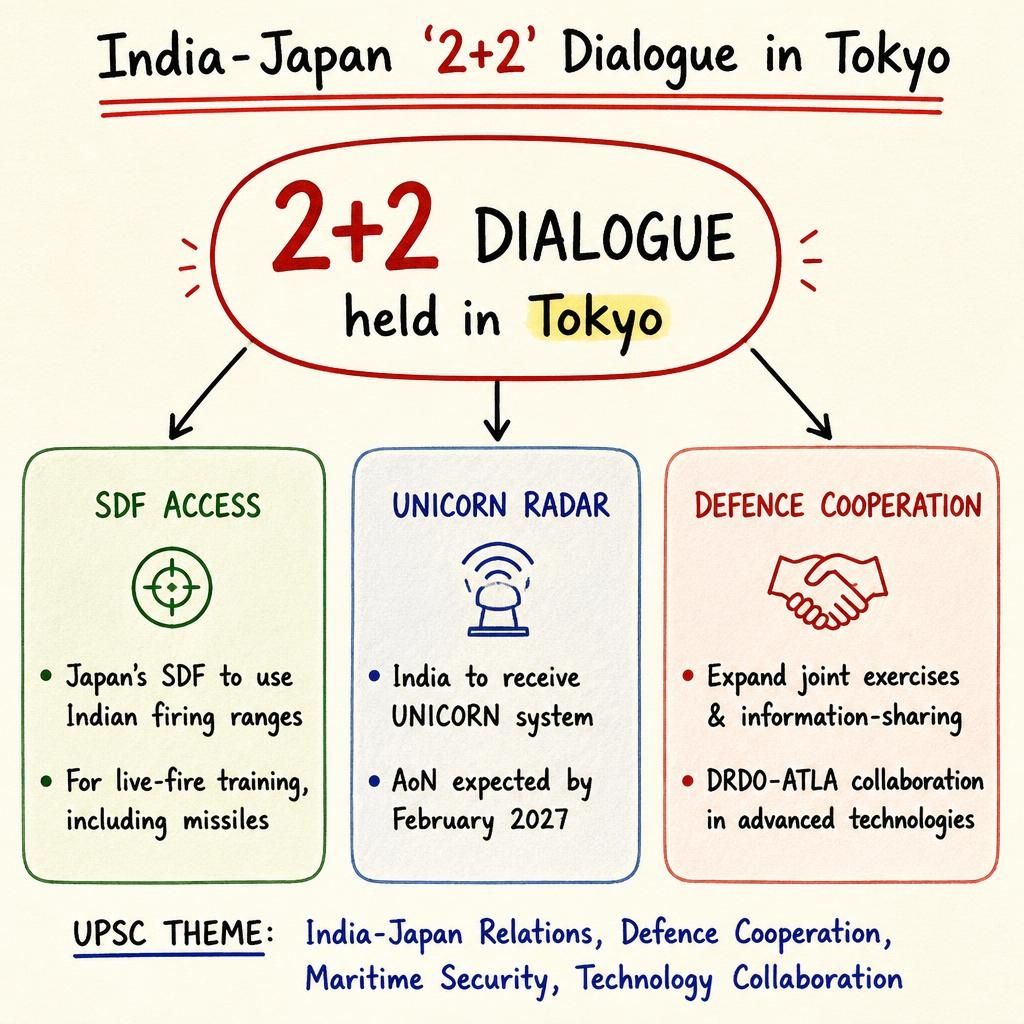
- India and Japan held their '2+2' Foreign and Defence Ministers' dialogue in Tokyo on Thursday.
- A Letter of Intent (LoI) was signed, allowing Japan's Self-Defence Forces (SDF) to use Indian firing ranges for live-fire training, including surface-to-ship missiles, for the first time.
- Discussions advanced on India receiving the Unified Complex Radio Antenna (UNICORN) naval radar system from Japan, with Acceptance of Necessity (AoN) expected by February 2027.
- Both nations agreed to deepen security and defence cooperation, including expanding joint exercises and information-sharing.
- Collaboration between India's Defence Research and Development Organisation (DRDO) and Japan's Acquisition, Technology and Logistics Agency (ATLA) in advanced missile and defence technologies was affirmed.
India-Japan Dialogue.jpg
Detailed Insights:
- The '2+2' dialogue is a high-level meeting format involving foreign and defence ministers, signifying deepening strategic ties between India and Japan.
- This agreement marks a significant step in bilateral defence cooperation, enhancing interoperability and mutual trust between the two forces.
- The UNICORN system is an integrated stealth mast that consolidates multiple antennas into a single structure, reducing a warship's radar signature and improving stealth capabilities.
- This co-development and co-production of UNICORN represents the first military technology collaboration between India and Japan.
- Japan's SDF, established in 1954, operates under constitutional constraints but has seen its roles expand, including collective self-defence.
- Both countries welcomed participation in the Malabar 2026 multilateral naval exercise and the Japan-India Maritime Exercise (JAIMEX 2026), held recently in Japan.
- Malabar is a key naval exercise involving the Quad nations (India, Japan, USA, Australia), aimed at enhancing maritime security in the Indo-Pacific.
- JAIMEX 2026 involved INS Sahyadri and JS Ise, focusing on tactical exercises and interoperability.
- The dialogue also covered enhancing mine countermeasures, joint naval shipbuilding and design, and cooperation in air domain awareness.
- These initiatives underscore a shared commitment to a free, open, and inclusive Indo-Pacific region amidst evolving global security challenges.
Key Concepts Involved:
- 2+2 Dialogue: A diplomatic format where foreign and defence ministers of two countries meet to discuss strategic and security issues.
- Japan Self-Defence Forces (SDF): Japan's unified military forces, constitutionally limited to self-defence but with evolving roles in regional security.
- UNICORN System: A stealth naval mast system integrating multiple communication and navigation antennas into a single, low-observable structure.
- Indo-Pacific: A geopolitical concept referring to the maritime region encompassing the Indian and Pacific Oceans, crucial for global trade and security.

SuperKalam is your personal mentor for UPSC preparation, guiding you at every step of the exam journey.
Download the App


STUDY RESOURCES
CONTACT US
ⓒ Snapstack Technologies Private Limited