GS 1: Post-Independence IndiaGS 2: GovernanceGS 3: EconomyPrelimsGS 3: Changes in Industrial Policy and Effects on Industrial Growth
Bending Towards Bold Reform: IDBI Stake Sale, 26-Year Arc of Governance, Pg10
IDBI stake sale signals India's bold shift from nationalization to privatization, marking a new era of economic reforms and governance under PM Modi.
Practice MCQs
753 Students attempted
Key Highlights:
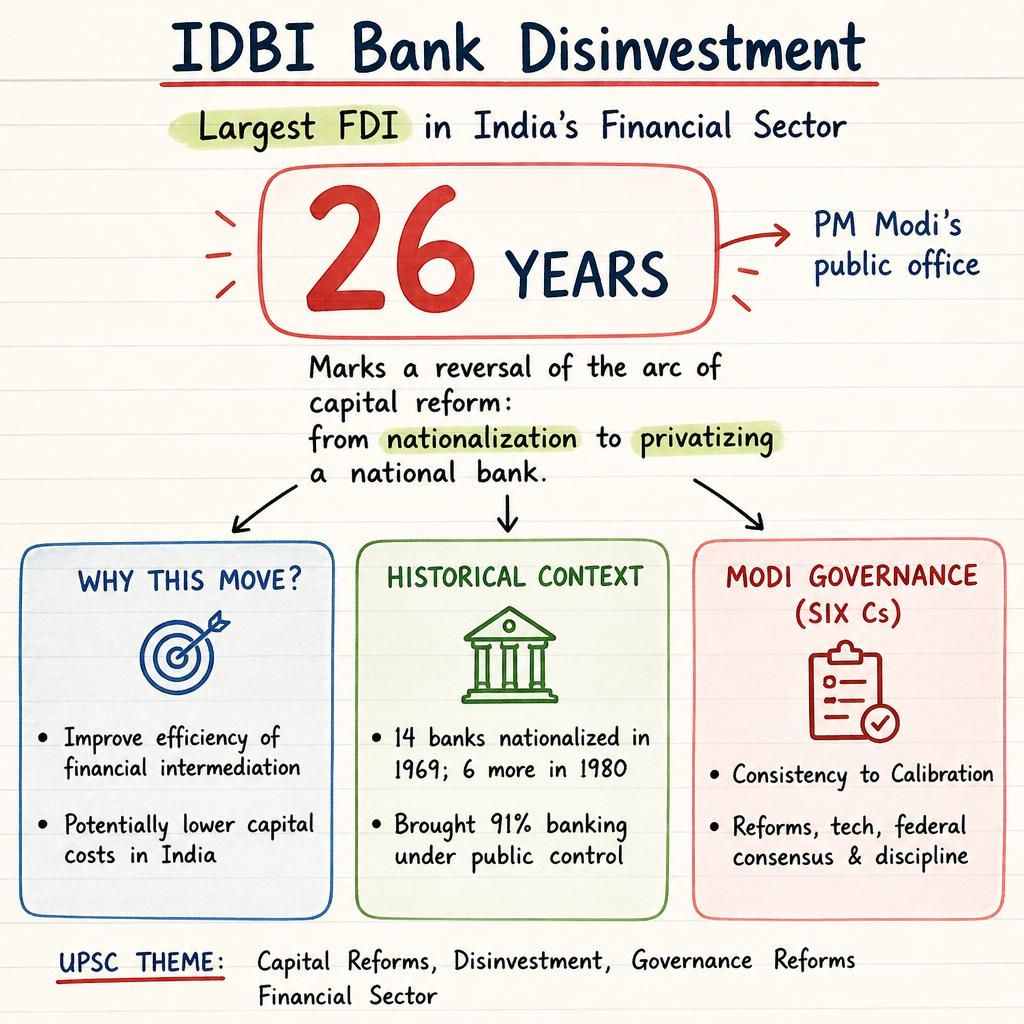
- The IDBI Bank strategic disinvestment marks the largest Foreign Direct Investment (FDI) in India's financial sector.
- This move signifies a reversal of the arc of capital reform, shifting from bank nationalization to privatizing a national bank.
- The disinvestment aims to improve the efficiency of financial intermediation and potentially lower capital costs in India.
- Prime Minister Narendra Modi has completed 26 years in public office, with this disinvestment being part of his broader governance reforms.
IDBI Disinvestment.jpg
Detailed Insights:
- The decision to divest IDBI Bank to a private entity is seen as a significant step towards enhancing the competitiveness of India's financial sector.
- India's cost of capital remains higher than ASEAN peers, impacting competitiveness, a challenge the disinvestment seeks to address.
- Historically, 14 banks were nationalized in 1969 and six more in 1980, bringing 91% of banking under public control, leading to political lending and bad-loan crises.
- The 1991 economic reforms largely bypassed structural changes in factors of production like land, labor, and capital, which are now being addressed.
- PM Modi's governance model is characterized by "Six Cs": Consistency, Continuity, Creativity, Consensus, Commitment, and Calibration.
- Consistency is exemplified by initiatives like Jan Dhan, Aadhaar, UPI, Swachh Bharat, Ayushman Bharat, IBC, GST, DBT, and PRAGATI.
- Continuity involves scaling inherited programs, such as expanding Aadhaar and linking MGNREGA to durable rural assets through VB-G RAM G.
- Creativity is evident in leveraging technology for governance, like PRAGATI for project resolution and Jan Dhan and UPI for large-scale benefit delivery.
- Consensus building is highlighted by the GST Council, a unique experiment in cooperative federalism where states pooled taxation sovereignty.
- Commitment to fiscal discipline is shown by the fiscal glide path, reduction in gross Non-Performing Assets (NPAs) under IBC, and inflation targeting.
- Calibration involves navigating a changing global order, with the Modi government signing nine Free Trade Agreements (FTAs) and giving a voice to the Global South through G20 and BRICS presidencies.
- Future priorities for Viksit Bharat 2047 include faster growth, completing factor market reforms, modern legal architecture, advanced manufacturing, and quality jobs with skilling and R&D.
Key Concepts Involved:
- Strategic Disinvestment: Government selling a significant portion of its stake in a Public Sector Undertaking (PSU) to a private entity, often with transfer of management control.
- Fiscal Glide Path: A pre-announced trajectory for reducing the fiscal deficit over a period, aiming for fiscal consolidation and macroeconomic stability.
- Cooperative Federalism: A concept where the central and state governments collaborate and cooperate on policy-making and implementation, sharing responsibilities.
- Factor Market Reforms: Policy changes aimed at improving the efficiency and flexibility of markets for factors of production, such as land, labor, and capital.

SuperKalam is your personal mentor for UPSC preparation, guiding you at every step of the exam journey.
Download the App


STUDY RESOURCES
CONTACT US
ⓒ Snapstack Technologies Private Limited