GS 2: GovernanceGS 2: International RelationsGS 3: Environment & EcologyPrelimsGS 3: Conservation, Pollution and Degradation
Developing Nations Wrongly Blamed For Emissions: Modi, Pg1
PM Modi asserts developing nations are wrongly blamed for emissions, highlighting India's early fulfillment of Paris Agreement commitments and low per capita emissions.
Practice MCQs
746 Students attempted
Key Highlights:
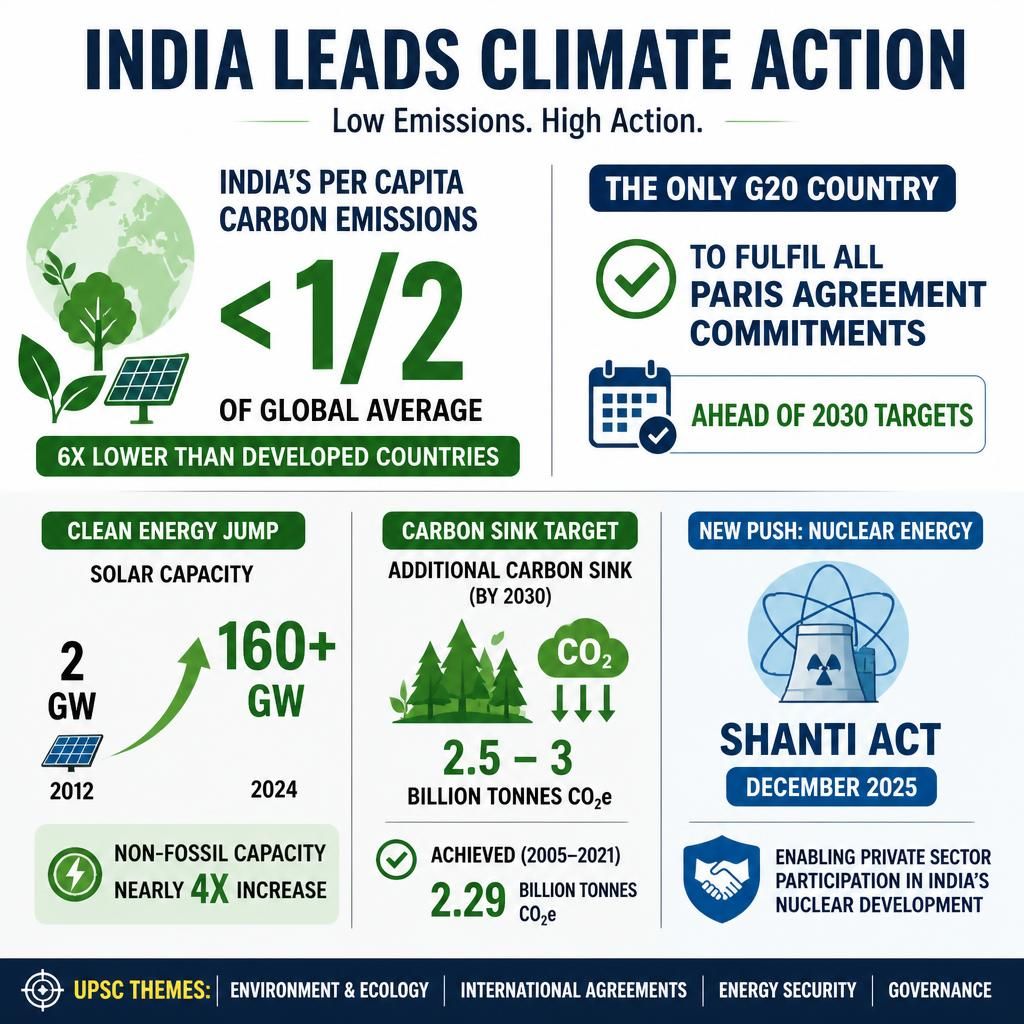
- Prime Minister Narendra Modi stated that developing nations are often wrongly blamed for carbon emissions, emphasizing that India's per capita emissions are less than half the global average.
- India is the only G20 country to have fulfilled all its commitments under the Paris Agreement ahead of schedule.
- The Prime Minister made these remarks at an international conference on "The Future of Environment and Climate Dynamics," organized by the National Green Tribunal (NGT).
- India has significantly increased its solar capacity from 2 GW to over 160 GW in 12 years, and its non-fossil capacity has nearly quadrupled.
- The SHANTI Act from December 2025 aims to enable private sector participation in India's nuclear energy development.
Climate Action.jpg
Detailed Insights:
- The conference, hosted by the National Green Tribunal (NGT), brought together global jurists, academics, policymakers, scientists, and experts to address gaps in environmental policymaking and foster international cooperation.
- India's per capita carbon emissions are six times lower than those in developed countries, a fact consistently highlighted by India on global platforms.
- India's first Nationally Determined Contribution (NDC) targets for emissions intensity and non-fossil capacity were met years ahead of the 2030 deadline.
- The third NDC target, creating an additional carbon sink of 2.5-3 billion tonnes of CO2 equivalent by 2030 through afforestation, is on track, with 2.29 billion tonnes achieved between 2005 and 2021.
- Globally, the United Nations Environment Programme (UNEP) estimates that even with full NDC implementation, warming could reach 2.3-2.5 degrees Celsius, falling short of the Paris Agreement goal of limiting warming to "well below" 2 degrees Celsius, ideally 1.5 degrees Celsius.
- The Prime Minister also highlighted the importance of nuclear energy, noting potential opposition from environmental groups, while the SHANTI Act facilitates private investment in this sector.
Key Concepts Involved:
- Paris Agreement: A legally binding international treaty adopted in 2015, aiming to limit global temperature rise to "well below 2 degrees Celsius" and pursue efforts for 1.5 degrees Celsius above pre-industrial levels.
- Nationally Determined Contributions (NDCs): National climate action plans under the Paris Agreement, detailing each country's efforts to reduce greenhouse gas emissions and adapt to climate impacts.
- National Green Tribunal (NGT): A statutory body established in India in 2010 under the National Green Tribunal Act, 2010, for the expeditious disposal of environmental cases.
- Global South: A term referring to developing countries, primarily in Africa, Asia, and Latin America, which often face significant climate impacts despite historically contributing least to global emissions.
- SHANTI Act: The Sustainable Harnessing and Advancement of Nuclear Energy for Transforming India (SHANTI) Act, 2025, a legislation aimed at expanding India's nuclear energy capacity by allowing private and foreign investment.

SuperKalam is your personal mentor for UPSC preparation, guiding you at every step of the exam journey.
Download the App


STUDY RESOURCES
CONTACT US
ⓒ Snapstack Technologies Private Limited