The myth called ‘perfect victim’, Pg8
Goa High Court overturns Tejpal acquittal, condemning the 'perfect victim' myth and judicial bias against sexual assault survivors.
Practice MCQs
739 Students attempted
Key Highlights:
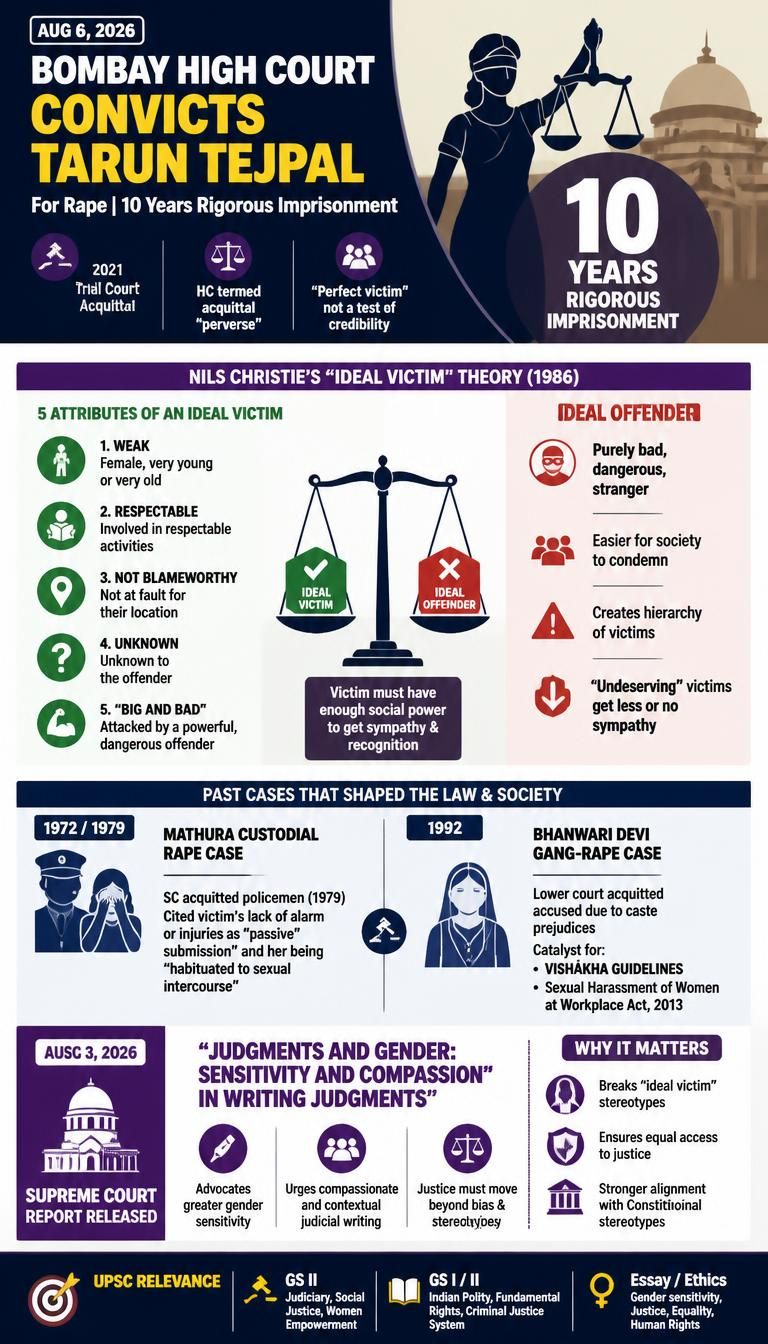
- On August 6, 2026, the Goa Division Bench of the Bombay High Court convicted Tarun Tejpal, former editor of Tehelka magazine, for rape and sentenced him to 10 years of rigorous imprisonment.
- The High Court overturned the 2021 acquittal by the trial court, terming its ruling "perverse" and criticizing its reliance on the notion of a "perfect victim."
- The court emphasized that a sexual assault complainant does not need to behave in a certain way to appear credible.
- The concept of the "ideal victim" was theorized by Norwegian criminologist Nils Christie in 1986.
Ideal Victim.jpg
Detailed Insights:
- Nils Christie's "ideal victim" theory outlines five attributes: being weak (female, very young, or very old), involved in respectable activities, not blameworthy for their location, unknown to the offender, and attacked by a "big and bad" perpetrator.
- Christie also noted that an ideal victim must possess enough social power to garner sympathy and have their victim status recognized.
- The contrasting "ideal offender" is portrayed as purely bad, dangerous, and a stranger, making it easier for society to condemn them.
- This narrow perception of victimhood creates a hierarchy, often leading to "undeserving" victims receiving less or no sympathy.
- The 1972 Mathura custodial rape case saw the Supreme Court acquit accused policemen in 1979, citing the victim's lack of alarm or injuries as "passive submission" and her being "habituated to sexual intercourse."
- The 1992 Bhanwari Devi gang-rape case, where the accused were acquitted by a lower court due to caste prejudices, became a catalyst for the Vishakha Guidelines and the Sexual Harassment of Women at Workplace (Prevention, Prohibition and Redressal) Act, 2013.
- On August 3, 2026, the Supreme Court released a report titled "Judgments and Gender: Sensitivity and Compassion in Writing Judgments," advocating for greater gender sensitivity in judicial writing.
- This report cautions judges against drawing adverse conclusions from factors like delayed reporting, absence of physical injuries, or inconsistencies in a survivor's testimony, acknowledging that trauma affects individuals differently.
Key Concepts Involved:
- Perfect Victim (Nils Christie): A sociological concept describing a victim who conforms to societal expectations of vulnerability and blamelessness, thereby eliciting greater public sympathy.
- Vishakha Guidelines (1997): A set of directives issued by the Supreme Court of India to prevent sexual harassment of women at the workplace, which served as a precursor to formal legislation.
- Sexual Harassment of Women at Workplace (Prevention, Prohibition and Redressal) Act, 2013: An Indian law that superseded the Vishakha Guidelines, establishing a comprehensive legal framework to address and prevent sexual harassment in workplaces.

SuperKalam is your personal mentor for UPSC preparation, guiding you at every step of the exam journey.
Download the App


STUDY RESOURCES
CONTACT US
ⓒ Snapstack Technologies Private Limited