If solar irrigation is over-drawing groundwater, it’s being done wrong, Pg II
Critiques simplistic views on solar irrigation, advocating diverse models and regional policies to prevent groundwater over-exploitation, reduce emissions, and cut subsidies, urging PM-KUSUM 2.0 refinement.
Practice MCQs
739 Students attempted
Key Highlights:
- The debate on solar irrigation's impact on groundwater often oversimplifies, treating it as a single model with inherent risks of over-abstraction.
- Different solar irrigation models, such as grid-connected systems and fee-for-service centralized models, offer incentives for efficient water use.
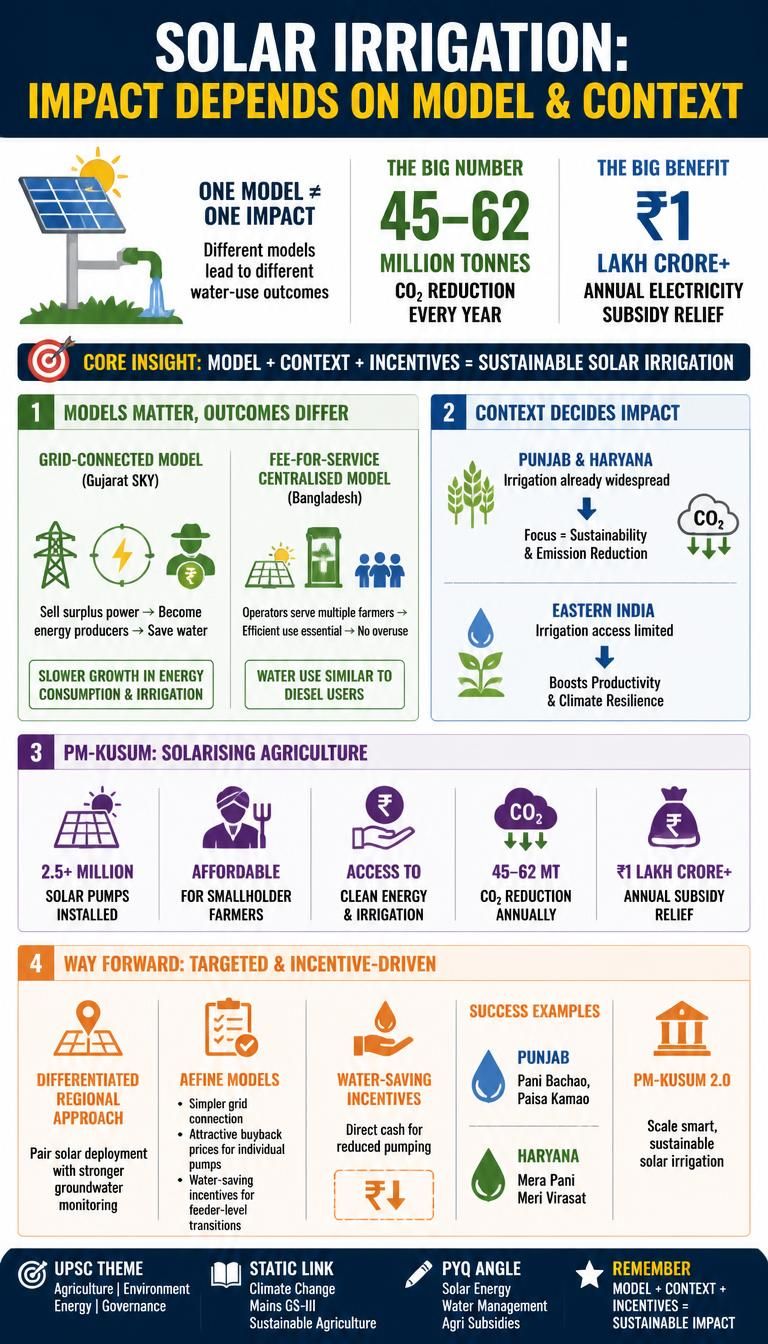
- Gujarat's Suryashakti Kisan Yojana (SKY) demonstrated that grid-connected solar farmers had slower growth in energy consumption and irrigation.
- The Pradhan Mantri Kisan Urja Suraksha evam Utthan Mahabhiyan (PM-KUSUM) scheme has installed over 2.5 million solar pumps, making them affordable for smallholder farmers.
- Solar irrigation can significantly reduce carbon emissions from groundwater pumping and alleviate agricultural electricity subsidy burdens.
Solar Irrigation.jpg
Detailed Insights:
- The impact of solar irrigation on groundwater is highly dependent on the specific model deployed, local hydrogeology, and economic incentives.
- Grid-connected solar models, like those under SKY, allow farmers to sell surplus electricity, transforming them into energy producers and incentivizing water conservation.
- In Bangladesh, a fee-for-service centralized solar model showed that farmers did not use more water than diesel users, as operators needed efficient use to serve multiple clients.
- Local factors such as hydrogeology, cropping patterns, and soil type significantly influence how solar irrigation affects farmers' water use behavior.
- In regions like Punjab and Haryana, where irrigation is already widespread, solar irrigation's role is more about sustainability and reducing emissions than expanding irrigated areas.
- For Eastern India, where irrigation access is limited, solar pumps can boost agricultural productivity and climate resilience.
- Solar irrigation can reduce an estimated 45-62 million tonnes of carbon dioxide annually from groundwater irrigation and alleviate over ₹1 lakh crore in annual electricity subsidies.
- Future policies, including PM-KUSUM 2.0, should adopt a differentiated regional approach, pairing solar deployment with stronger groundwater monitoring.
- Refining models requires simpler grid connection procedures and attractive buyback prices for individual pumps, and water-saving incentives for feeder-level transitions.
- Schemes like Punjab’s Pani Bachao, Paisa Kamao and Haryana’s Mera Pani Meri Virasat offer examples of direct cash payments for reduced pumping.
- In irrigation-deprived areas with low groundwater risk, standalone solar pumps should prioritize expanding access, potentially through water-user associations and cooperatives.
Key Concepts Involved:
- Groundwater abstraction: The process of extracting water from underground aquifers for various uses.
- Aquifers: Underground layers of permeable rock or sediment that hold and transmit groundwater.
- Feed-in-tariff: A policy mechanism that offers long-term contracts to renewable energy producers, often at above-market rates.
- DISCOMs: Electricity Distribution Companies responsible for supplying electricity to consumers.
- Micro-irrigation: Efficient irrigation methods such as drip or sprinkler systems that deliver water directly to plant roots.

SuperKalam is your personal mentor for UPSC preparation, guiding you at every step of the exam journey.
Download the App


STUDY RESOURCES
CONTACT US
ⓒ Snapstack Technologies Private Limited