GS 2: GovernanceGS 1: Indian SocietyGS 2: Social JusticeGS 3: EconomyPrelims
The stark reality of the missing jobs for India’s Gen Z, Pg8
Alarming data reveals India's Gen Z confronts a stark jobs crisis, with high unemployment and informal work, jeopardizing the nation's demographic dividend.
Practice MCQs
731 Students attempted
Key Highlights:
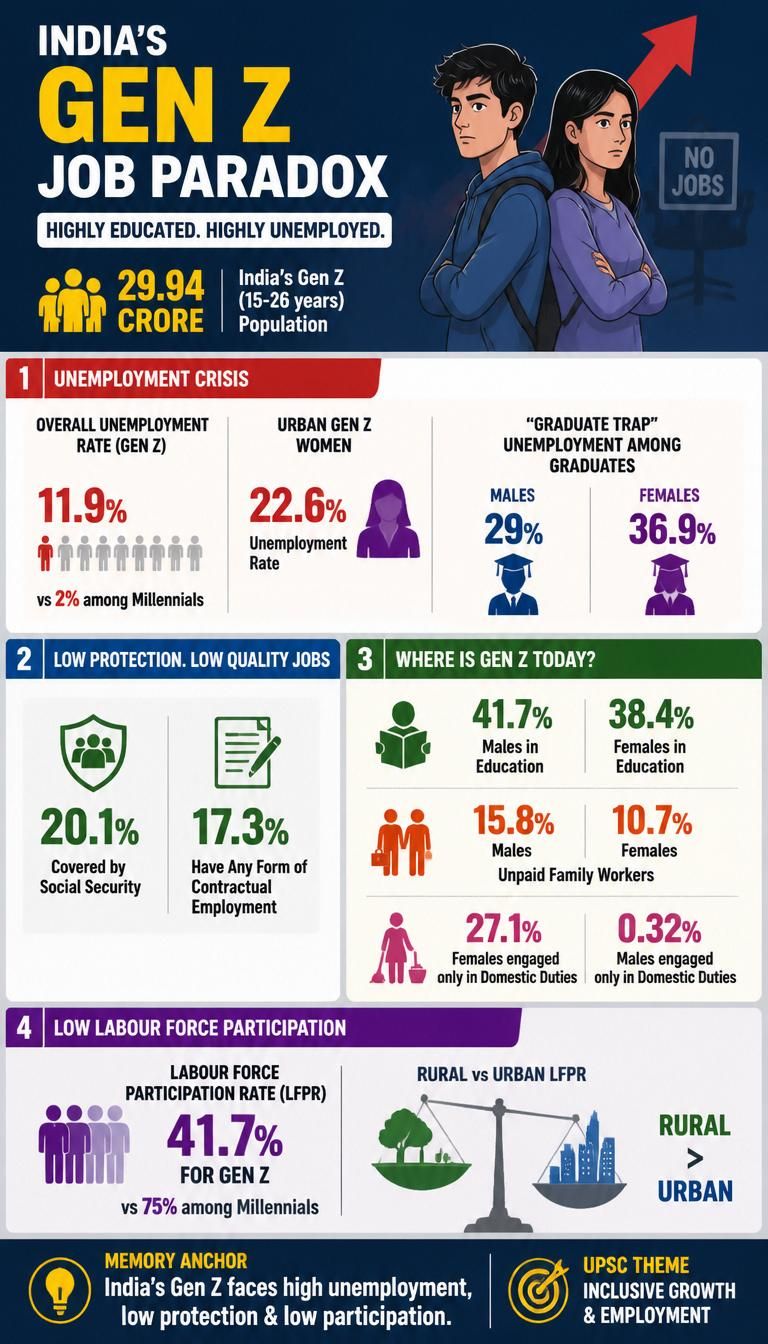
- India's Gen Z population (aged 15-26 years) is estimated at 29.94 crore, according to the Periodic Labour Force Survey (PLFS) 2023-24.
- The overall unemployment rate for Gen Z is 11.9%, significantly higher than the 2% observed among Millennials.
- Urban Gen Z women face a particularly high unemployment rate, reaching 22.6%.
- Among Gen Z graduates, unemployment stands at 29% for males and 36.9% for females, indicating a "graduate trap."
- Only 20.1% of Gen Z individuals are covered by social security, and a mere 17.3% have any form of contractual employment.
Gen Z.jpg
Detailed Insights:
- A substantial portion of Gen Z, 41.7% of males and 38.4% of females, remains engaged in education, contributing to their delayed entry into the labor market.
- Many young people entering the workforce are absorbed into non-salaried roles, with 15.8% of males and 10.7% of females working as unpaid family workers.
- Women disproportionately bear the burden of domestic duties, with 27.1% of Gen Z females engaged solely in such roles, compared to 0.32% of males.
- The labor force participation rate for Gen Z is 41.7%, considerably lower than the 75% for Millennials, with rural participation exceeding urban.
- High unemployment among educated youth suggests a significant mismatch between the education system and evolving labor market demands, partly due to automation and AI.
- The widespread prevalence of informal, insecure, and weakly protected work among Gen Z highlights a challenge beyond mere unemployment.
- The article emphasizes that India's demographic dividend remains a "promise deferred" as the economy struggles to adequately absorb its young workforce.
- Proposed solutions include expanding labor-intensive sectors, strengthening school-to-work pathways, and enhancing support for women's participation in paid work.
Key Concepts Involved:
- Demographic Dividend: The economic growth potential that can result from shifts in a population’s age structure, mainly when the share of the working-age population is larger than the non-working-age share.
- Periodic Labour Force Survey (PLFS): A large-scale household survey conducted by the National Sample Survey Office (NSSO) in India to estimate employment and unemployment indicators.
- Labour Force Participation Rate (LFPR): The percentage of the population that is either employed or actively looking for work.
- Social Security: Government programs providing protection against economic risks like old age, unemployment, illness, and disability.

SuperKalam is your personal mentor for UPSC preparation, guiding you at every step of the exam journey.
Download the App


STUDY RESOURCES
CONTACT US
ⓒ Snapstack Technologies Private Limited