GS 1: Indian GeographyGS 3: Environment & EcologyGS 3: EconomyPrelims
Poor monsoon's impact on India's agri import bill, Pg15
El Niño-induced poor monsoon threatens record agri imports, potentially increasing India's vegetable oil, pulses, and cotton bill, prompting policy interventions.
Practice MCQs
731 Students attempted
Key Highlights:
- India recorded significant agricultural imports in 2025-26, including 16.9 million tonnes of vegetable oils, 1.1 million tonnes of raw cotton, and nearly 6 million tonnes of pulses.
- The current fiscal year (2026-27) is projected to see even higher imports due to the impact of El Niño, a climate phenomenon causing dry weather.
- Monsoon rainfall in June was 38% below the normal long-period average, with a cumulative deficiency of 23.8% by July 19.
- Kharif crop sowing has been significantly affected, with overall sown area down 16% compared to the previous year, and pulses and oilseeds showing even steeper declines.
- The National Oceanic and Atmospheric Administration (NOAA) forecasts an 81% probability of the current El Niño intensifying into a "very strong" event during October-December.
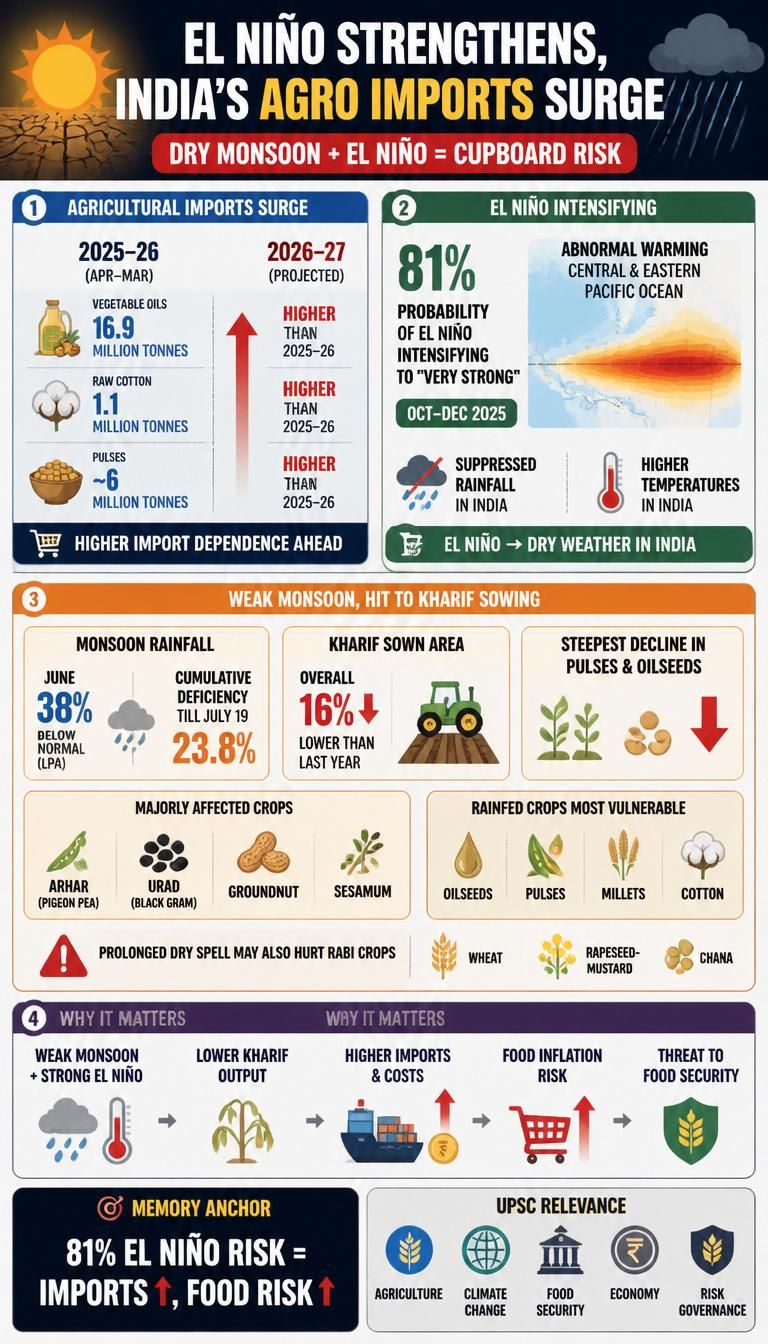
Ago Imports.jpg
Detailed Insights:
- The abnormal warming of central and eastern Pacific Ocean waters, known as El Niño, is directly linked to suppressed rainfall and higher temperatures in India.
- The lag in Kharif sowing is particularly pronounced in crops like arhar (pigeon pea) and urad (black gram), as well as groundnut and sesamum.
- A prolonged dry spell, exacerbated by El Niño, could also negatively impact Rabi season crops such as wheat, rapeseed-mustard, and chana.
- Rainfed crops like oilseeds, pulses, millets, and cotton are most vulnerable to the adverse effects of a weak monsoon and strengthening El Niño.
- India maintains substantial buffer stocks of rice and wheat, well above minimum required levels, providing a comfort factor against potential food shortages.
- Government agencies also hold over 4 million tonnes of pulses, including chana and arhar, which can be released in a worst-case scenario.
- Global food stocks are currently ample, with record harvests of various commodities in 2025-26, except for vegetable oils, which have seen a 23.3% price increase.
- The government may consider measures such as slashing import duties on essential agricultural commodities and potentially slowing down the Ethanol Blended Petrol (EBP) Programme to manage supply and prices.
Key Concepts Involved:
- El Niño: A climate pattern characterized by the abnormal warming of ocean surface waters in the central and eastern tropical Pacific Ocean, leading to global weather disruptions.
- Kharif Crops: Crops sown during the monsoon season (June-July) and harvested in autumn (September-October), such as rice, maize, and cotton.
- Rabi Crops: Crops sown in winter (October-November) and harvested in spring (March-April), including wheat, barley, and mustard.
- Ethanol Blended Petrol (EBP) Programme: A government initiative to blend ethanol, primarily derived from sugarcane, with petrol to reduce crude oil imports and promote cleaner fuel.

SuperKalam is your personal mentor for UPSC preparation, guiding you at every step of the exam journey.
Download the App


STUDY RESOURCES
CONTACT US
ⓒ Snapstack Technologies Private Limited