GS 2: PolityGS 2: Social JusticeGS 2: International RelationsGS 3: EconomyPrelims
Patents should not put cancer care out of reach, Pg11
Global cancer crisis deepens as patents make life-saving drugs unaffordable, challenging India's constitutional right to health.
Practice MCQs
731 Students attempted
Key Highlights:
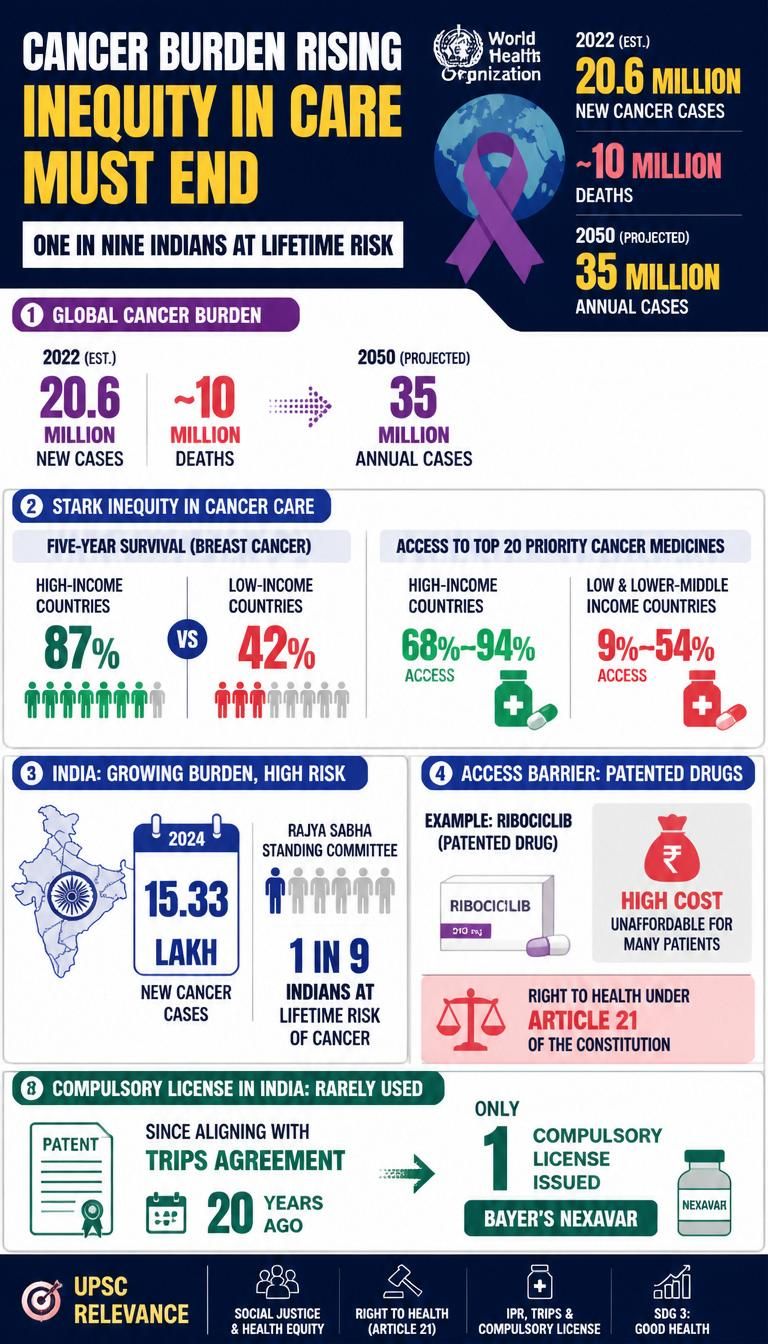
- The World Health Organization (WHO) reported an estimated 20.6 million new cancer cases and nearly 10 million deaths annually worldwide, projected to reach 35 million annual cases by 2050.
- Significant inequity exists in cancer care, with high-income countries having much higher survival rates and access to essential medicines compared to low-income nations.
- India is expected to see 15.33 lakh new cancer cases in 2024, with a Rajya Sabha standing committee noting that roughly one in nine Indians faces a lifetime risk of cancer.
- The high cost of patented cancer drugs, such as Ribociclib, makes treatment unaffordable for many, raising concerns about the Right to Health under Article 21 of the Constitution.
- India has issued only one compulsory license for a patented drug, Bayer’s Nexavar, since aligning its patent regime with the TRIPS Agreement 20 years ago.
Cancer.jpg
Detailed Insights:
- The WHO Global Status Report on Cancer highlights a stark disparity in cancer survival rates, with an 87% five-year survival for breast cancer in high-income countries versus 42% in low-income countries.
- Access to the top 20 priority cancer medicines ranges from 68-94% in wealthier nations but only 9-54% in low and lower-middle-income countries.
- In India, over 1.92 lakh new breast cancer cases and over 98,000 deaths were recorded in 2022, with more than half detected at advanced stages, increasing treatment costs and reducing effectiveness.
- The Supreme Court has affirmed that the Right to Health is integral to the Right to Life under Article 21, mandating the state to ensure affordable medical care and essential medicines.
- A case involving a patient seeking compulsory licensing for Ribociclib under Sections 92 and 100 of the Patents Act, 1970, is pending before the Kerala High Court, highlighting the legal challenges in accessing affordable drugs.
- The Doha Declaration on the TRIPS Agreement and Public Health, which India helped shape, emphasizes that intellectual property protection should not compromise public health.
Key Concepts Involved:
- Right to Health (Article 21): A fundamental right in India, interpreted by the Supreme Court to include access to medical care and essential medicines.
- Compulsory Licensing: A provision under the Patents Act, 1970, allowing a government to permit a third party to produce a patented product without the patent holder's consent, typically for public health emergencies.
- Patents Act, 1970: Indian legislation governing patents, including provisions for compulsory licensing under specific circumstances to ensure public access to essential goods.
- TRIPS Agreement: The Agreement on Trade-Related Aspects of Intellectual Property Rights, an international legal agreement administered by the World Trade Organization (WTO), setting minimum standards for intellectual property regulation.
- Doha Declaration on TRIPS Agreement and Public Health: A 2001 WTO declaration affirming that the TRIPS Agreement should be interpreted and implemented in a way that supports the right of members to protect public health and promote access to medicines for all.

SuperKalam is your personal mentor for UPSC preparation, guiding you at every step of the exam journey.
Download the App


STUDY RESOURCES
CONTACT US
ⓒ Snapstack Technologies Private Limited