GS 2: GovernanceGS 2: International RelationsGS 3: EconomyPrelims
Maturing approach, Pg8
India-U.K. CETA signals New Delhi's mature trade approach, balancing liberalisation with domestic sensitivities, yet MSMEs face significant compliance and non-tariff challenges.
Practice MCQs
731 Students attempted
Key Highlights:
- The India-U.K. Comprehensive Economic and Trade Agreement (CETA) signifies India's evolving and more balanced approach to free trade negotiations.
- The agreement aims to balance trade liberalization with domestic sensitivities, a shift from India's earlier Free Trade Agreement (FTA) with ASEAN.
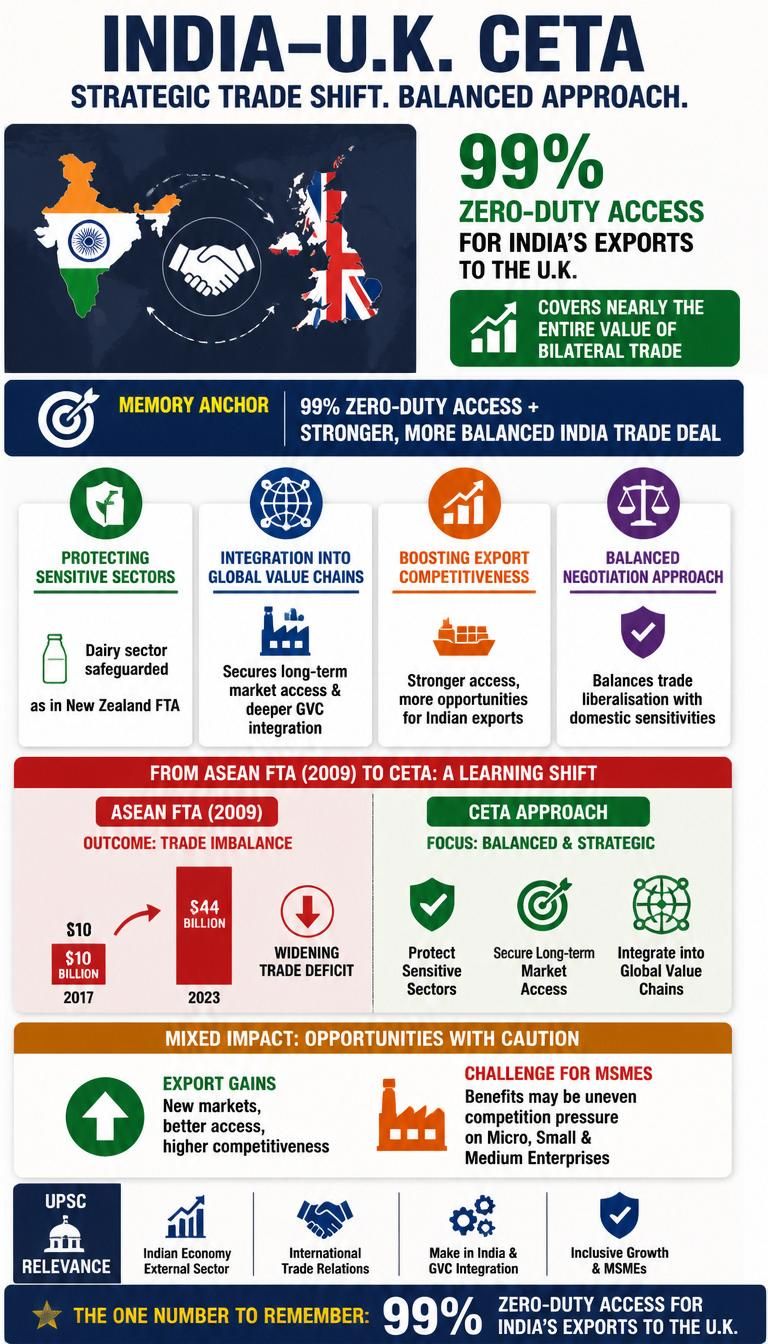
- CETA offers zero-duty access on 99% of India’s exports to the U.K., covering nearly the entire value of bilateral trade.
- India successfully protected its sensitive dairy sector in the New Zealand FTA, demonstrating its new negotiation strategy.
- The pact seeks to secure long-term market access and integrate India further into Global Value Chains (GVCs).
India-UK.jpg
Detailed Insights:
- India's previous FTA with ASEAN in 2009 led to a trade imbalance, with the trade deficit widening from $10 billion in 2017 to nearly $44 billion in 2023.
- While CETA is expected to boost India's export competitiveness, its benefits may be uneven and could pressure Micro, Small, and Medium Enterprises (MSMEs).
- MSMEs often struggle with documentation and compliance, making it difficult for them to fully utilize the benefits of such agreements.
- Compliance with the U.K.'s stringent Sanitary and Phytosanitary (SPS) standards, Technical Barriers to Trade (TBT), and sustainability standards poses a significant challenge for Indian MSMEs.
- Historically, India has underutilized several trade agreements due to low awareness, cumbersome administration, and high compliance costs.
- The success of CETA hinges on India strengthening regulatory administration, Intellectual Property (IP) protection, and dispute resolution mechanisms.
- The Double Contribution Convention within the pact benefits Indian IT and professional services firms, though its overall economic impact may be modest.
- Non-tariff measures, such as the U.K.'s steel safeguard quotas, can dilute market access despite tariff reductions.
- India's carbon-intensive exports may face increasing challenges due to stricter climate-related trade regulations globally.
Key Concepts Involved:
- Comprehensive Economic and Trade Agreement (CETA): A broad trade pact covering goods, services, investment, and other areas to deepen economic ties between countries.
- Free Trade Agreement (FTA): A treaty between two or more countries to reduce or eliminate certain barriers to trade, such as tariffs and quotas.
- Micro, Small, and Medium Enterprises (MSMEs): Businesses categorized by their size, typically based on investment in plant and machinery or turnover, crucial for employment and economic growth.
- Sanitary and Phytosanitary (SPS) standards: Measures to protect human, animal, or plant life or health from risks arising from food additives, contaminants, toxins, or disease-carrying organisms.
- Technical Barriers to Trade (TBT): Non-tariff barriers to trade that include technical regulations, standards, and conformity assessment procedures.

SuperKalam is your personal mentor for UPSC preparation, guiding you at every step of the exam journey.
Download the App


STUDY RESOURCES
CONTACT US
ⓒ Snapstack Technologies Private Limited