GS 2: GovernanceGS 3: Science & TechnologyPrelims
Making sense of embodied AI: the next frontier in robotics, Pg11
Boston Dynamics' Spot robot integrates AI brain, advancing embodied AI's frontier where intelligence is distributed across body and environment, despite real-world deployment hurdles.
Practice MCQs
731 Students attempted
Key Highlights:
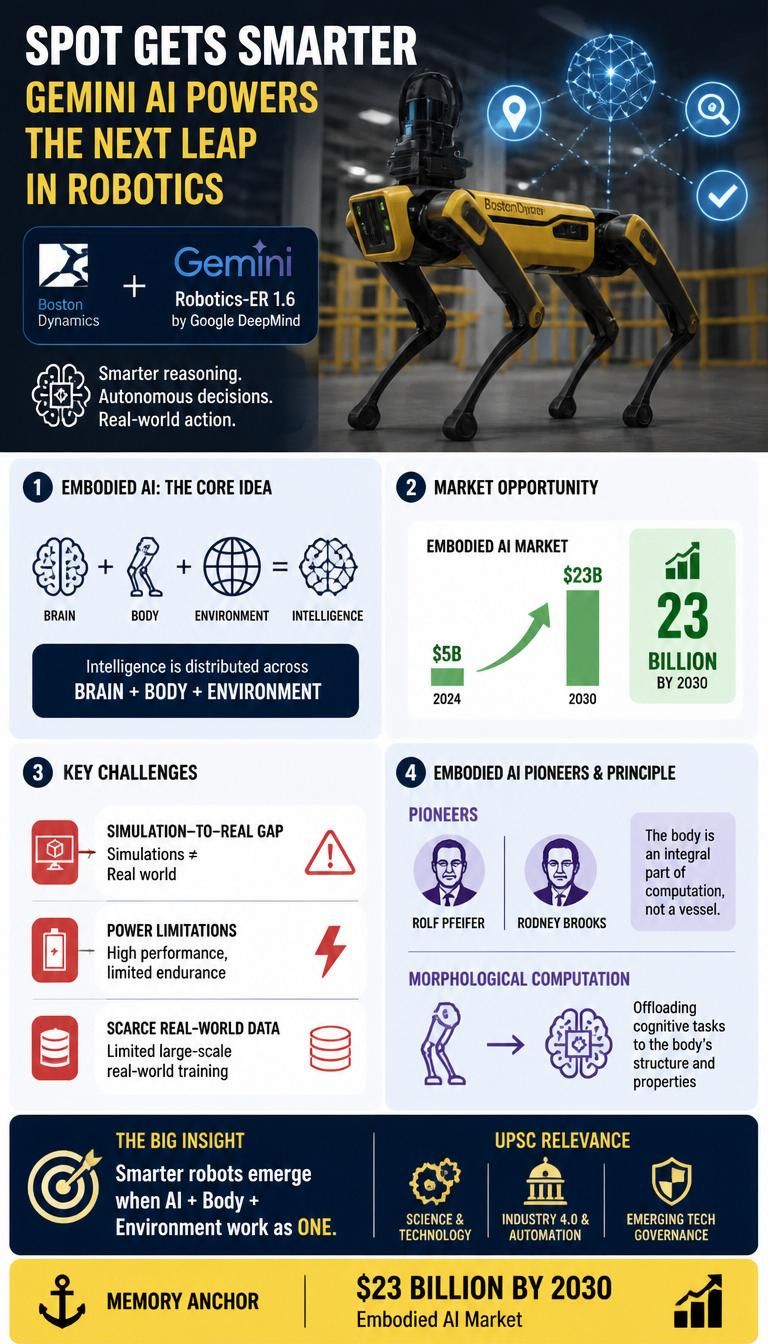
- Boston Dynamics' Spot robot is being integrated with Gemini Robotics-ER 1.6 from Google DeepMind, enhancing its spatial reasoning and autonomous decision-making.
- Embodied AI posits that intelligence is distributed across the brain, body, and environment, rather than being confined solely to the brain.
- The embodied AI market is projected to reach $23 billion by 2030, despite significant challenges in real-world deployment.
- Key challenges include the "simulation-to-real gap," power limitations, and a scarcity of extensive real-world training data for these systems.
Robotics.jpg
Detailed Insights:
- The integration of Gemini Robotics-ER 1.6 aims to enable robots like Spot to navigate and operate autonomously in complex industrial environments.
- Pioneers such as Rolf Pfeifer and Rodney Brooks have long argued that the physical body is an integral part of computation, not merely a vessel for intelligence.
- Morphological computation refers to the concept of offloading cognitive tasks onto the physical structure and properties of a robot's body.
- Unlike AI chatbots, embodied AI systems must master physical challenges like gravity and balance, which are profoundly difficult to scale in diverse real-world scenarios.
- Policies and behaviors that perform well in simulated environments often degrade significantly when deployed on actual hardware due to the "simulation-to-real gap."
- Neuromorphic AI focuses on hardware design that mimics biological neurons, often utilizing Spiking Neural Networks (SNNs) for energy efficiency and time-sensitive processing.
- Evolutionary computation, championed by researchers like Yaochu Jin, proposes co-evolving robot nervous systems and physical forms to optimize designs for specific tasks.
- Embodied AI systems face a data scarcity problem, lacking the vast internet-scale datasets available to text and image-based AI models.
- The successful deployment of embodied AI is a complex systems challenge, encompassing hardware robustness, sensor integration, operational design, and human interaction, beyond just algorithms.
Scientific/Technical Concepts Involved:
- Embodied AI: A field asserting that intelligence is distributed across the brain, body, and environment, with the body being part of the computation itself.
- Neuromorphic AI: A hardware and algorithm paradigm that mimics the physical mechanics of biological neurons, often using Spiking Neural Networks (SNNs).
- Spiking Neural Networks (SNNs): Neural networks that operate through discrete spikes, firing only when a threshold is exceeded, suitable for time-sensitive tasks.
- Morphological Computation: The process of offloading computational work onto the physical structure and properties of a robot's body.
- Evolutionary Computation: An optimization technique inspired by biological evolution, used to co-evolve robot designs (body and brain) for specific tasks.
- Simulation-to-real gap: The discrepancy between a robot's performance in a simulated environment and its performance in the real world.

SuperKalam is your personal mentor for UPSC preparation, guiding you at every step of the exam journey.
Download the App


STUDY RESOURCES
CONTACT US
ⓒ Snapstack Technologies Private Limited