GS 2: GovernanceGS 2: PolityGS 2: Social JusticeGS 3: Internal SecurityGS 4: Accountability and Ethical Governance
Turning police reform into practice, Pg7
Indian Police Foundation unveils 'change manual' for internal police reforms, targeting improved citizen interaction, working conditions, and accountability at police stations.
Practice MCQs
753 Students attempted
Key Highlights:
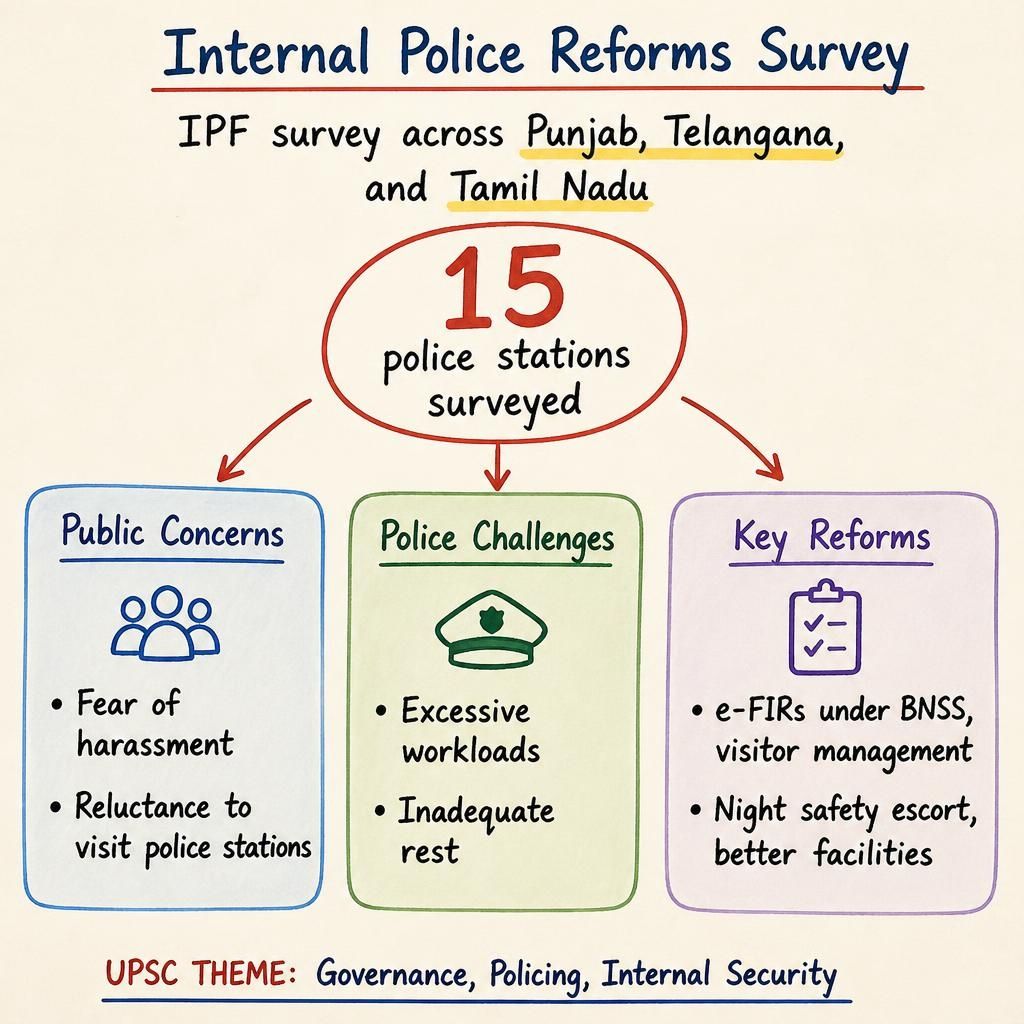
- The Indian Police Foundation (IPF), supported by the Azim Premji Foundation, conducted a survey on 'internal police reforms' across 15 police stations in Punjab, Telangana, and Tamil Nadu.
- The survey revealed public reluctance to visit police stations due to fear of harassment and police concerns regarding excessive workloads and inadequate rest.
- The IPF identified four key focus areas: improving police response, enhancing crime prevention and community outreach, preventing police misconduct, and improving police working conditions.
- Recommendations include implementing e-FIRs under the Bharatiya Nagarik Suraksha Sanhita (BNSS), establishing visitor management systems, introducing night safety escort schemes, and providing better facilities for police personnel.
- A 'change manual' has been prepared by the IPF for a phased rollout, starting with Punjab, followed by Telangana and Tamil Nadu, before wider implementation.
Police Reforms Survey.jpg
Detailed Insights:
- The research methodology involved questionnaire surveys, focus group discussions, and in-depth interviews to gather comprehensive insights.
- Challenges in improving police response include the process of converting e-complaints into regular FIRs, which still requires complainants' signatures.
- Proposed solutions for better complaint registration include digital record-keeping via visitor management systems, dedicated help desks, and QR codes at police stations.
- For crime prevention, recommendations include mandatory QR codes and panic buttons in taxis linked to control rooms, increased CCTV coverage, and community engagement at the beat level.
- To prevent misconduct, suggestions include scrutiny of arrest reasons at the DySP level, allowing phone calls post-arrest, and remote online monitoring of lock-ups by senior officers.
- Improving police working conditions involves ensuring basic facilities like rest rooms, weekly-offs, adequate transport, contingency funds, and providing devices for the e-Sakshya app.
- The e-Sakshya app is designed to assist police in digitally recording crime scenes and evidence, ensuring uniformity in investigations and compliance with new criminal laws.
- Most of the proposed reforms are designed for implementation at the police station level and do not necessitate significant additional budgetary allocation from the government.
Key Concepts Involved:
- Indian Police Foundation (IPF): A multidisciplinary think tank dedicated to police reforms through research, capacity building, and policy advocacy.
- Bharatiya Nagarik Suraksha Sanhita (BNSS): The new criminal procedure law that replaced the Code of Criminal Procedure, formalizing e-FIRs and other procedural aspects.
- e-FIR: An electronic First Information Report, allowing citizens to file complaints online, which typically requires a physical signature within three days for official registration.
- e-Sakshya App: A mobile application for police officers to digitally record crime scenes, search and seizure activities, and manage evidence, aligning with new criminal law requirements.

SuperKalam is your personal mentor for UPSC preparation, guiding you at every step of the exam journey.
Download the App


STUDY RESOURCES
CONTACT US
ⓒ Snapstack Technologies Private Limited