GS 2: GovernanceGS 2: Social JusticePrelimsGS 2: Government policies and interventions for development in various sectorsGS 2: Important Aspects of Governance, Transparency and Accountability
The Need to Expand Jan Aushadhi, Pg8
Jan Aushadhi scheme slashes medicine costs by 77%, but faces critical challenges in awareness, trust, and availability, demanding urgent expansion and reforms.
Practice MCQs
753 Students attempted
Key Highlights:
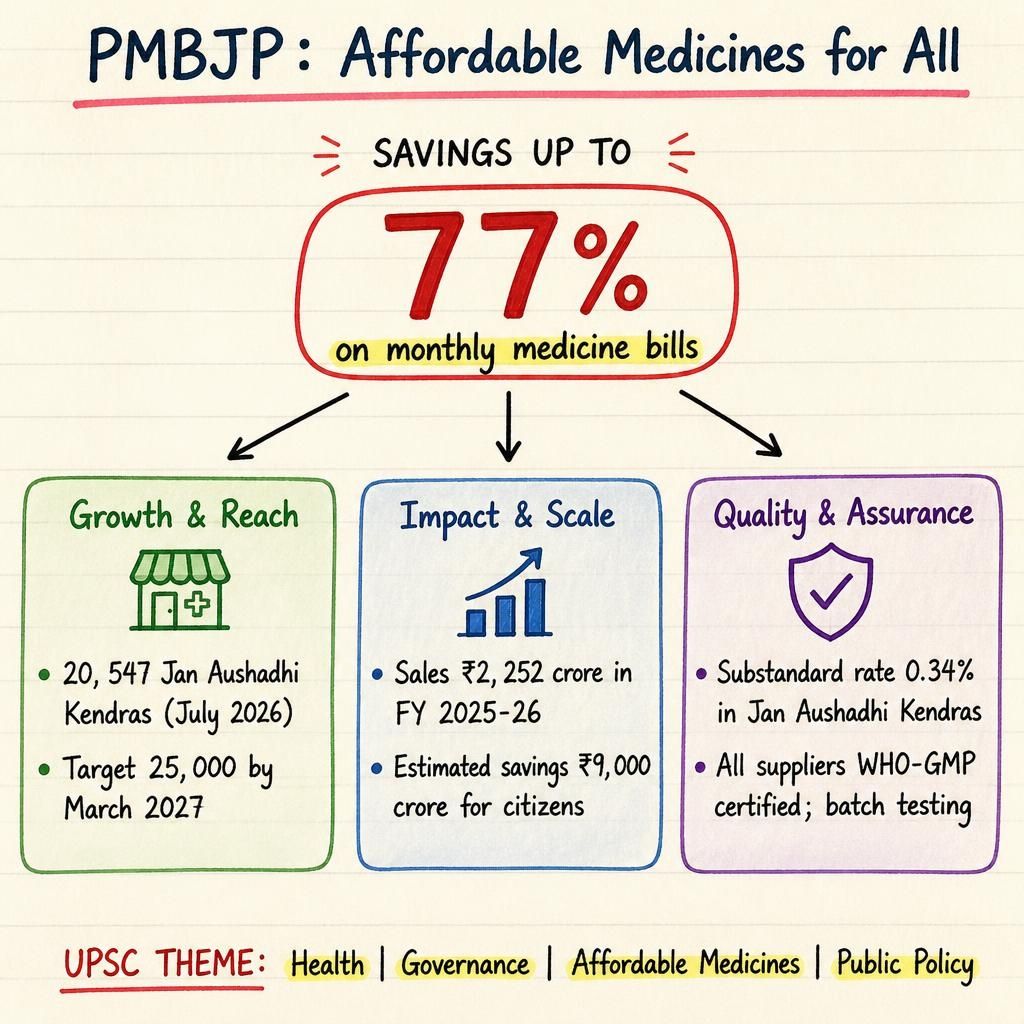
- The Pradhan Mantri Bhartiya Janaushadhi Pariyojana (PMBJP) significantly reduces medicine costs, with consumers potentially saving up to 77% on their monthly bills.
- Launched in 2008 and revamped in 2015, the scheme aims to provide affordable generic medicines to the public.
- As of July 2026, there are 20,547 Jan Aushadhi Kendras operating across India, with a target to reach 25,000 by March 2027.
- In the fiscal year 2025-26, the scheme recorded sales of ₹2,252 crore, leading to an estimated ₹9,000 crore in savings for citizens.
- The PMBJP offers a wide range of products, including 2,110 medicines and 315 surgical items.
PMBJP.jpg
Detailed Insights:
- The PMBJP is implemented and managed by the Pharmaceuticals & Medical Devices Bureau of India.
- India's position as the largest global supplier of generic medicines provides a robust manufacturing base for the scheme.
- Despite its clear benefits, the scheme faces challenges related to public awareness, limited reach compared to private pharmacies, and doctor prescribing habits.
- A study in Port Blair revealed low public awareness, with only one-third of outpatients familiar with the scheme.
- Doctors' bodies previously raised concerns regarding autonomy, accountability, and quality when the National Medical Commission mandated generic prescriptions.
- The government states that the rate of substandard medicines in Jan Aushadhi Kendras is 0.34%, significantly lower than the 3.70% reported in the open market.
- All suppliers to PMBJP are required to hold WHO-GMP certification, and every batch of medicine undergoes testing.
- Issues such as frequent stock-outs and inconsistent availability of medicines at Jan Aushadhi Kendras can erode consumer trust.
- Medicines account for a substantial 60-70% of household out-of-pocket expenditure on health in India.
- Government health expenditure stood at 1.43% of GDP in 2023-24, falling short of the National Health Policy's target of 2.5% by 2025.
- The article suggests commissioning a national-level survey to gather data on public perception, doctor prescribing patterns, and stock availability to inform future expansion.
- Recommendations include transparent publication of testing results by the Indian Pharmacopoeia Commission and implementing an online stock-tracking system.
- Promoting Jan Aushadhi Kendras as accessible to all, rather than just for the poor, through social media and the Jan Aushadhi Sugam app, is crucial.
- Standard health insurance schemes like Ayushman Bharat Pradhan Mantri Jan Arogya Yojana (AB PM-JAY) typically do not cover outpatient drug costs.
Key Concepts Involved:
- Generic Medicines: Drugs identical in dosage, safety, strength, route of administration, quality, performance, and intended use to their brand-name counterparts.
- Out-of-Pocket Expenditure (OOPE): Direct payments made by individuals for healthcare services at the time of use, not reimbursed by any third party.
- WHO-GMP Certification: A system ensuring that pharmaceutical products are consistently produced and controlled according to quality standards appropriate for their intended use.
- Bioequivalence: The property where two drugs with the same active ingredient are absorbed into the body at the same rate and to the same extent.

SuperKalam is your personal mentor for UPSC preparation, guiding you at every step of the exam journey.
Download the App


STUDY RESOURCES
CONTACT US
ⓒ Snapstack Technologies Private Limited