GS 3: Science & TechnologyPrelimsGS 2: Government policies and interventions for development in various sectorsGS 3: Space Technology
Satellite Radiation: Blocking Views, Pg II
New study reveals communications satellites emit radiation, severely interfering with astronomical observations across various frequencies, impacting critical research.
Practice MCQs
746 Students attempted
Key Highlights:
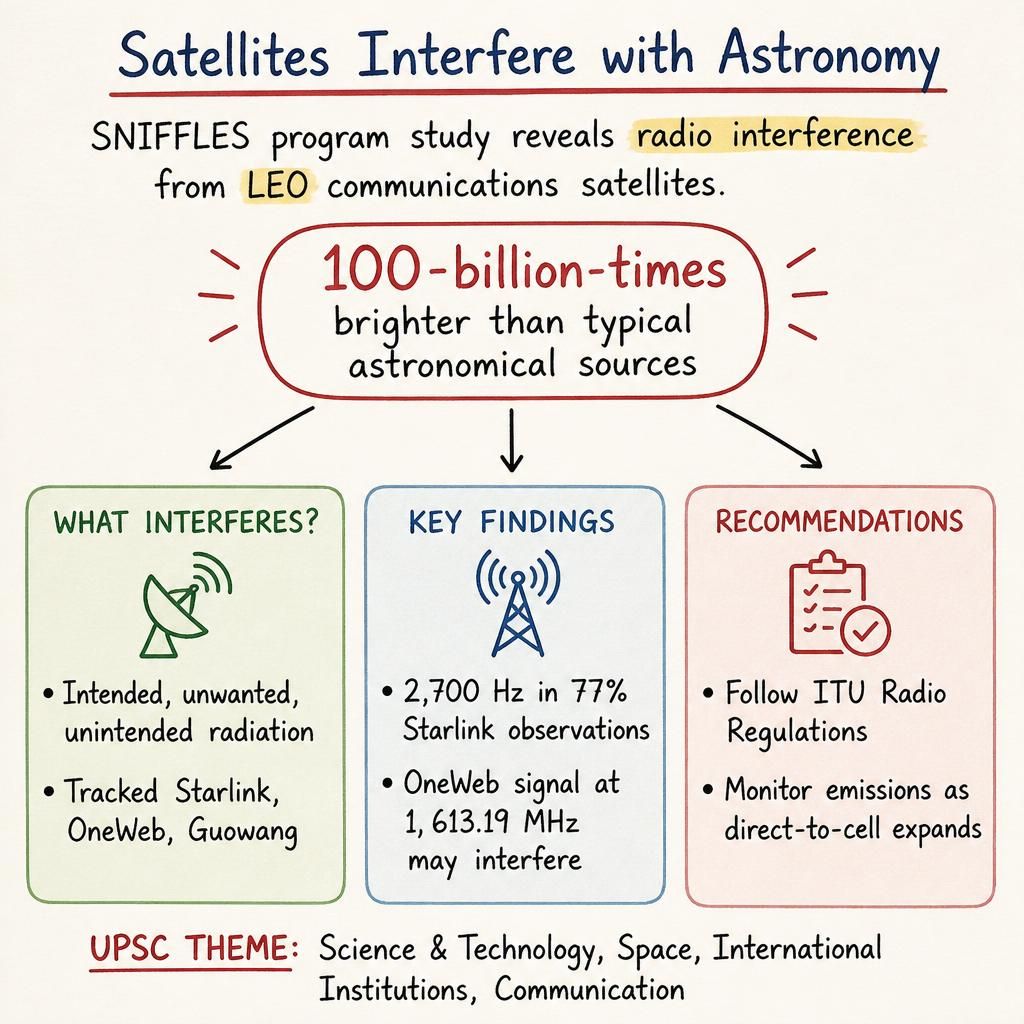
- A study published in Monthly Notices of the Royal Astronomical Society under the SNIFFLES program revealed that communications satellites in Low-Earth Orbit (LEO) are emitting radio signals that interfere with astronomical observations.
- The research, conducted using the Mopra radio telescope and the Australia Telescope Compact Array, tracked satellites from constellations including Starlink, OneWeb, and China’s Guowang.
- Researchers classified the interfering radiation into intended, unwanted (e.g., harmonics), and unintended (stray emissions from electronics) categories.
- Some satellite signals were found to be up to 100-billion-times brighter than typical astronomical sources, posing a significant threat to telescope sensitivity.
- A specific signal from the OneWeb constellation at 1,613.19 megahertz (MHz) was identified as potentially interfering with studies of hydroxyl ions in space.
Radio Interference.jpg
Detailed Insights:
- The SNIFFLES program aims to systematically characterize the electromagnetic environment created by non-geostationary satellite orbit (NGSO) constellations across radio astronomy receiver bands.
- Intended transmissions include direct-to-cell signals from Starlink satellites, which aim to provide mobile connectivity in remote areas.
- Unwanted transmissions are emissions from transmitters, often at multiples of the fundamental transmission frequency, known as harmonics.
- Unintended radiation refers to stray emissions from onboard electronic components like power converters and computers.
- Radiation at 2,700 Hz was detected in nearly 77% of observations from a specific version of Starlink satellites.
- The study recommends that satellite operators adopt existing international rules for radio transmissions and continuously monitor emissions, especially as direct-to-cell services expand.
- The International Telecommunication Union (ITU) provides the international framework for radio-frequency spectrum use and aims to prevent harmful interference through its Radio Regulations.
Scientific/Technical Concepts Involved:
- Low-Earth Orbit (LEO) satellites: Satellites orbiting Earth at altitudes typically between 160 and 2,000 km, used for communication and Earth observation.
- Radio Astronomy: A branch of astronomy that studies celestial objects by detecting and analyzing the radio waves they naturally emit.
- Electromagnetic Interference (EMI): Disruption of electronic device operation or signal transmission caused by unwanted electromagnetic radiation from external sources.
- Hydroxyl Ions (–OH-): A molecule of significant interest in astrophysics, whose radio frequency lines provide evidence of its existence in the interstellar medium.
- Harmonics: Frequencies that are integer multiples of a fundamental signal frequency, often generated by non-linearities in electronic systems.

SuperKalam is your personal mentor for UPSC preparation, guiding you at every step of the exam journey.
Download the App


STUDY RESOURCES
CONTACT US
ⓒ Snapstack Technologies Private Limited