GS 1: Indian SocietyGS 2: Social JusticeGS 3: EconomyPrelimsGS 3: Indian Economy, Planning, Mobilization of Resources, Growth, Development and Employment
Analysing Female Labour of the North East States and UTs, Pg7
PLFS 2025 reveals female labour force participation surged, particularly in rural North East, exposing significant state-level and urban-rural disparities.
Practice MCQs
746 Students attempted
Key Highlights:
- The Periodic Labour Force Survey (PLFS) 2025 report indicates a notable increase in Female Labour Force Participation Rate (FLFPR) across India since 2019–20.
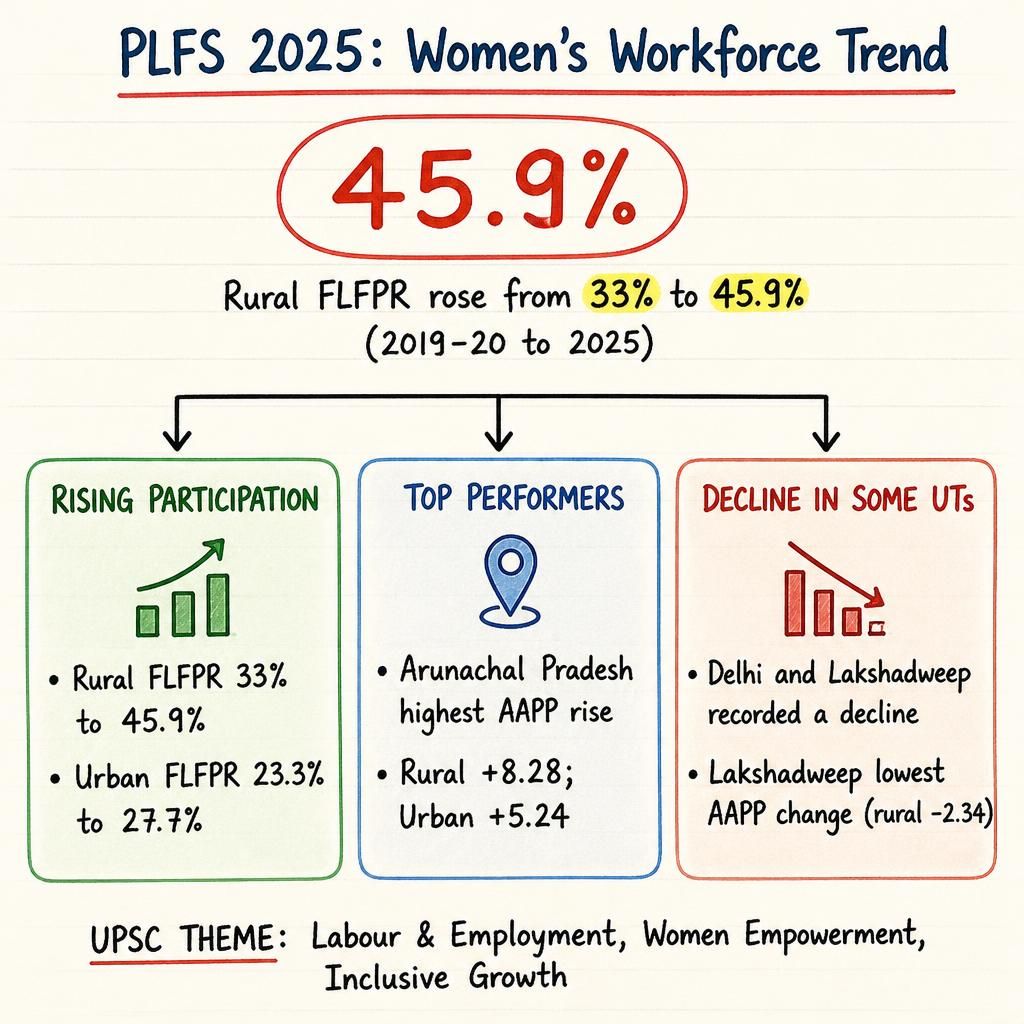
- Rural FLFPR rose from 33% to 45.9%, while urban FLFPR increased from 23.3% to 27.7%.
- North Eastern States and Union Territories (UTs) generally exhibit higher FLFPR, with Arunachal Pradesh showing the highest Average Annual Percentage Point (AAPP) increase in both rural (+8.28) and urban (+5.24) areas.
- Delhi and Lakshadweep recorded a decline in FLFPR, with Lakshadweep experiencing the lowest AAPP change in rural areas (-2.34).
- The national average AAPP of 2.58 for rural areas and 0.88 for urban areas masks significant state-level variations.
Women Workforce.jpg
Detailed Insights:
- The PLFS 2025 report underscores a positive trend in women's economic engagement, particularly in India's rural sectors.
- Higher FLFPR in North Eastern states is often linked to tribal societies, greater female involvement in agriculture, and traditional roles in trade and commerce.
- Arunachal Pradesh's substantial growth in FLFPR, significantly exceeding the all-India benchmark, suggests effective regional dynamics or policy influences.
- The decline in FLFPR in certain UTs like Delhi and Lakshadweep highlights diverse regional performances that necessitate specific analysis.
- A combined assessment of baseline FLFPR and AAPP reveals that states like Nagaland and Meghalaya maintained high participation levels, while others such as Assam and Tripura demonstrated faster improvement from lower starting points.
- Enhancing FLFPR is vital for India's economic growth, poverty reduction, and the achievement of global sustainability goals.
- Despite recent improvements, India's FLFPR remains comparatively low by global standards, with persistent challenges including informal sector employment and the gender pay gap.
Key Concepts Involved:
- Periodic Labour Force Survey (PLFS): A nationwide survey conducted by the National Statistical Office (NSO) under the Ministry of Statistics and Programme Implementation (MoSPI) to estimate employment and unemployment indicators.
- Female Labour Force Participation Rate (FLFPR): The percentage of women aged 15 years and above who are either employed or actively seeking employment.
- Average Annual Percentage Point (AAPP): The arithmetic difference between two percentages over a year, indicating the pace of change in an indicator.

SuperKalam is your personal mentor for UPSC preparation, guiding you at every step of the exam journey.
Download the App


STUDY RESOURCES
CONTACT US
ⓒ Snapstack Technologies Private Limited