GS 2: International RelationsPrelimsGS2: India and its Neighbourhood RelationsGS2: Bilateral, Regional and Global Groupings and AgreementsGS2: Effect of Policies and Politics of Developed and Developing Countries on India's Interests
A Changing Asia Demands More From Delhi And Tokyo, Together, Pg15
India and Japan urged to deepen defense cooperation amidst China's rise and US policy shifts, as Tokyo adopts vigorous security posture in Indo-Pacific.
Practice MCQs
731 Students attempted
Key Highlights:
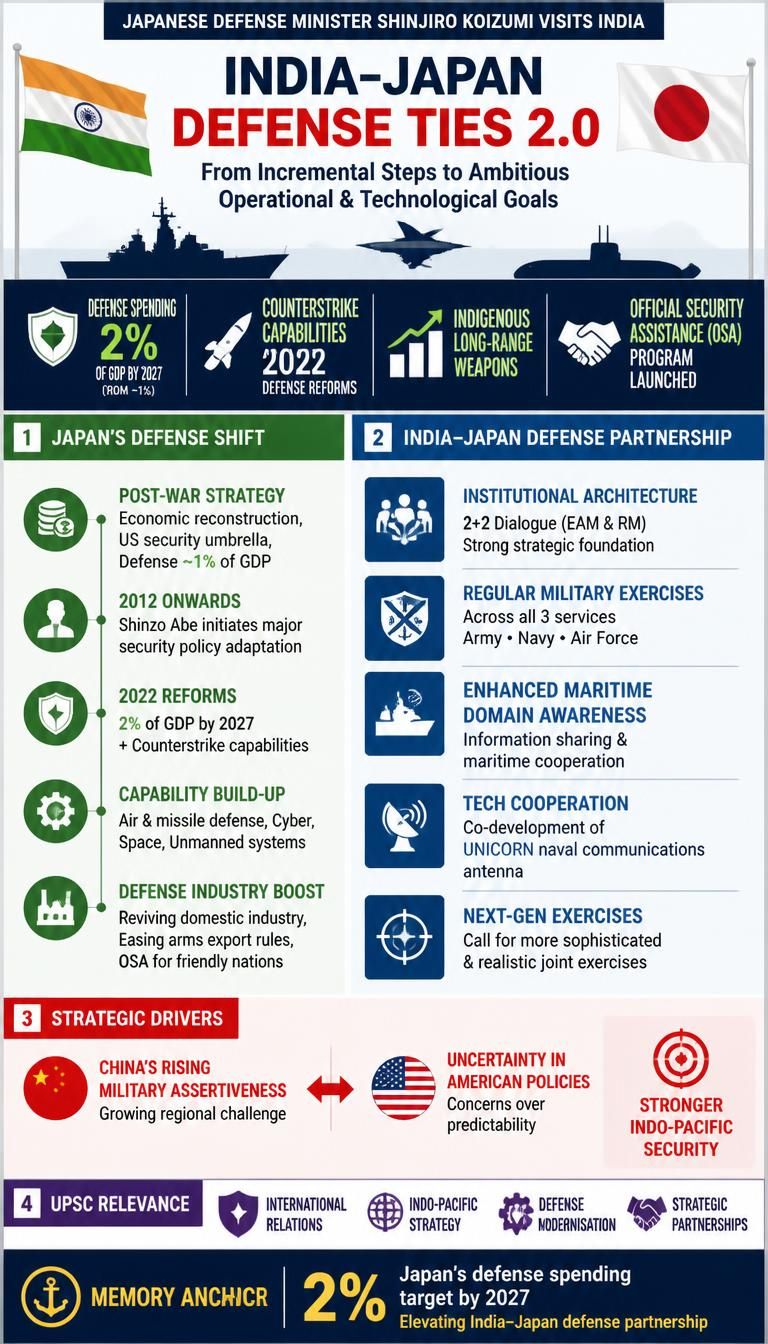
- Japanese Defense Minister Shinjiro Koizumi visited India to discuss enhanced defense cooperation amid Japan's evolving security policies.
- Japan is shifting from self-imposed military restraint to a more vigorous national defense policy and active regional military diplomacy.
- This transformation is primarily driven by China's growing military assertiveness and concerns regarding the predictability of American policies.
- The visit aims to elevate the India-Japan defense partnership beyond incremental steps towards more ambitious operational and technological goals.
India-Japan.jpg
Detailed Insights:
- Japan's post-war strategy historically focused on economic reconstruction, relying on the United States for security, with defense expenditure around 1% of GDP.
- Former Prime Minister Shinzo Abe initiated significant efforts to adapt Japan's security policy after 2012, responding to China's rise and questions about US reliability.
- Japan's 2022 defense reforms include a target to raise defense spending to 2% of GDP by 2027 and the acquisition of counterstrike capabilities.
- These reforms also encompass developing indigenous long-range weapons, strengthening air and missile defense, cyber, space, and unmanned systems.
- Japan is revitalizing its defense industrial base, easing arms export restrictions, and has launched the Official Security Assistance program for friendly nations.
- India and Japan already possess institutional architecture for cooperation, including a 2+2 dialogue and regular military exercises across all three services.
- Recent discussions, including Prime Minister Sanae Takaichi's visit, called for more sophisticated exercises, enhanced maritime domain awareness, and the co-development of the UNICORN naval communications antenna.
- Despite existing frameworks, defense industrial cooperation between Delhi and Tokyo has been slow, necessitating greater ambition in joint research, development, and co-production.
Key Concepts Involved:
- Indo-Pacific: A geopolitical region encompassing the Indian and Pacific Oceans, crucial for global trade and security.
- Counterstrike capabilities: The ability to launch pre-emptive strikes against an adversary's missile launch sites or command centers.
- 2+2 Dialogue: A format of diplomatic meeting between two countries' foreign and defense ministers.
- Maritime Domain Awareness (MDA): The effective understanding of anything associated with the maritime environment that could impact security, safety, or the economy.
- Official Security Assistance (OSA): A Japanese program to provide military equipment and infrastructure development to like-minded countries to enhance their security capabilities.

SuperKalam is your personal mentor for UPSC preparation, guiding you at every step of the exam journey.
Download the App


STUDY RESOURCES
CONTACT US
ⓒ Snapstack Technologies Private Limited