GS 2: GovernanceGS 3: Science & TechnologyGS 3: EconomyPrelims
What goals does Semicon 2.0 aim to achieve?, Pg14
India unveils ₹1.27 lakh crore Semicon 2.0 and ₹62,500 crore MPMS, aiming to attract ₹4 lakh crore investment in domestic chip and mobile manufacturing.
Practice MCQs
724 Students attempted
Key Highlights:
- The Union Cabinet approved the second phase of the India Semiconductor Mission (ISM) and the Mobile Phone Manufacturing Scheme (MPMS) on July 15.
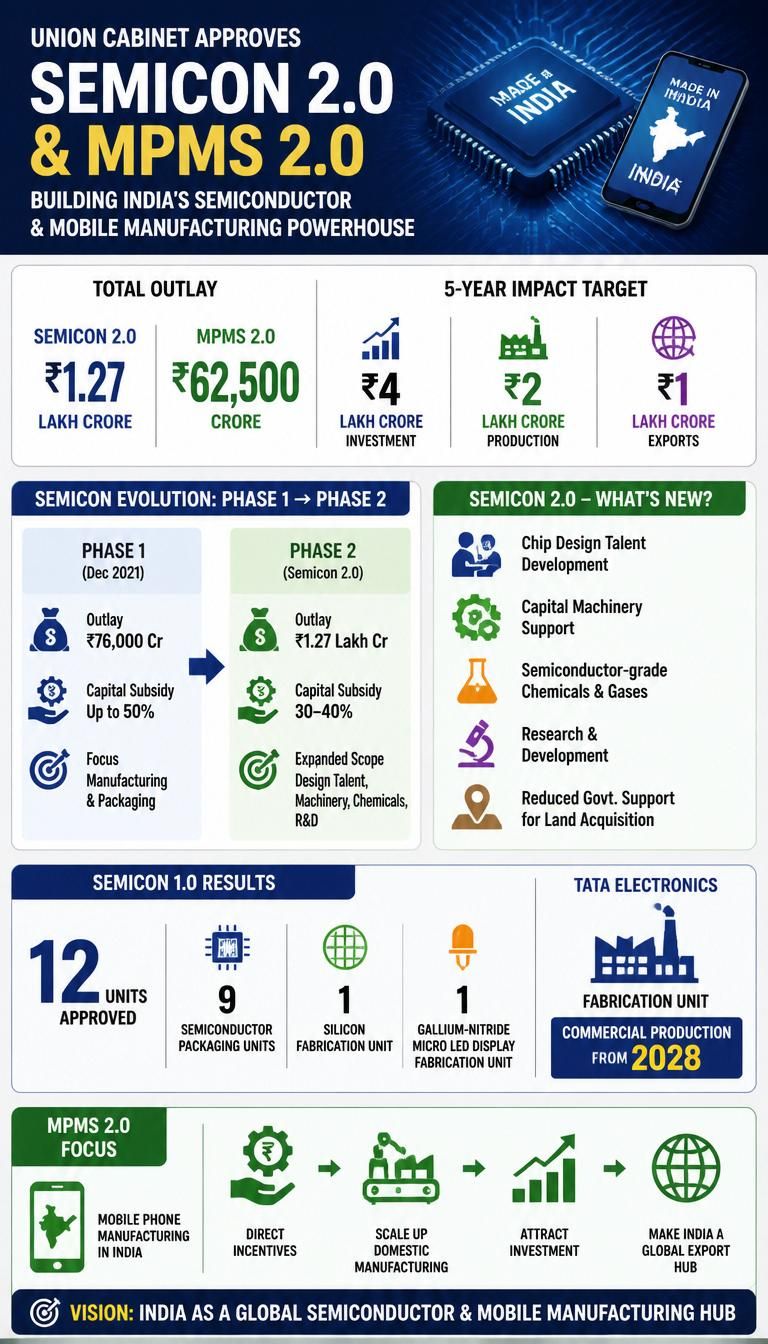
- Semicon 2.0 has an outlay of ₹1.27 lakh crore, while MPMS has an outlay of ₹62,500 crore.
- The schemes aim to encourage semiconductor fabrication, assembly, packaging, and mobile phone manufacturing in India.
- Over five years, the government expects ₹4 lakh crore in investment, ₹2 lakh crore in production, and ₹1 lakh crore in exports.
Semicon 2.0.jpg
Detailed Insights:
- The first phase of ISM was approved in December 2021 with an outlay of ₹76,000 crore.
- Phase 1 offered up to 50% capital subsidy for large projects, such as Micron's memory chip facility in Sanand, Gujarat.
- Semicon 2.0 expands its scope to include chip design talent, capital machinery, semiconductor-grade chemicals and gases, and research and development.
- Capital subsidies under Semicon 2.0 will be reduced to 30-40%, with less government support for land acquisition.
- Phase 1 resulted in the approval of 12 manufacturing and packaging units, including nine semiconductor packaging units, one silicon fabrication unit, and one gallium-nitride Micro LED display fabrication unit.
- Tata Electronics is set to commence commercial production from its fabrication unit in 2028.
- A Design-Linked Incentive (DLI) program under Phase 1 approved 24 projects and provided free semiconductor design software to universities and startups.
- India's focus on semiconductor manufacturing is driven by the need for supply chain resilience, highlighted by COVID-19 disruptions and global trade tensions.
- The current focus is on 28nm "legacy" process node chips, with an aim to advance to "frontier" nodes through domestic IP and research.
- MPMS seeks to incentivize domestic phone assembly, component manufacturing, and the development of Indian-designed handsets.
Key Concepts Involved:
- India Semiconductor Mission (ISM): A government initiative to foster a robust semiconductor manufacturing and design ecosystem within India.
- Mobile Phone Manufacturing Scheme (MPMS): A scheme designed to boost domestic mobile phone assembly, component production, and indigenous design capabilities.
- Process Node: Refers to the manufacturing technology size of transistors on an integrated circuit, indicating its performance and power efficiency.
- Design-Linked Incentive (DLI): A government scheme offering financial incentives to companies for designing and manufacturing electronic products in India.

SuperKalam is your personal mentor for UPSC preparation, guiding you at every step of the exam journey.
Download the App


STUDY RESOURCES
CONTACT US
ⓒ Snapstack Technologies Private Limited