GS 2: GovernanceGS 3: Science & TechnologyPrelims
Vikram-1 India's first private orbital rocket mission; defining moment, says PM, Pg1
Skyroot Aerospace's Vikram-1 achieves India's first private orbital rocket launch, deploying satellites and marking a new era in space technology.
Practice MCQs
724 Students attempted
Key Highlights:
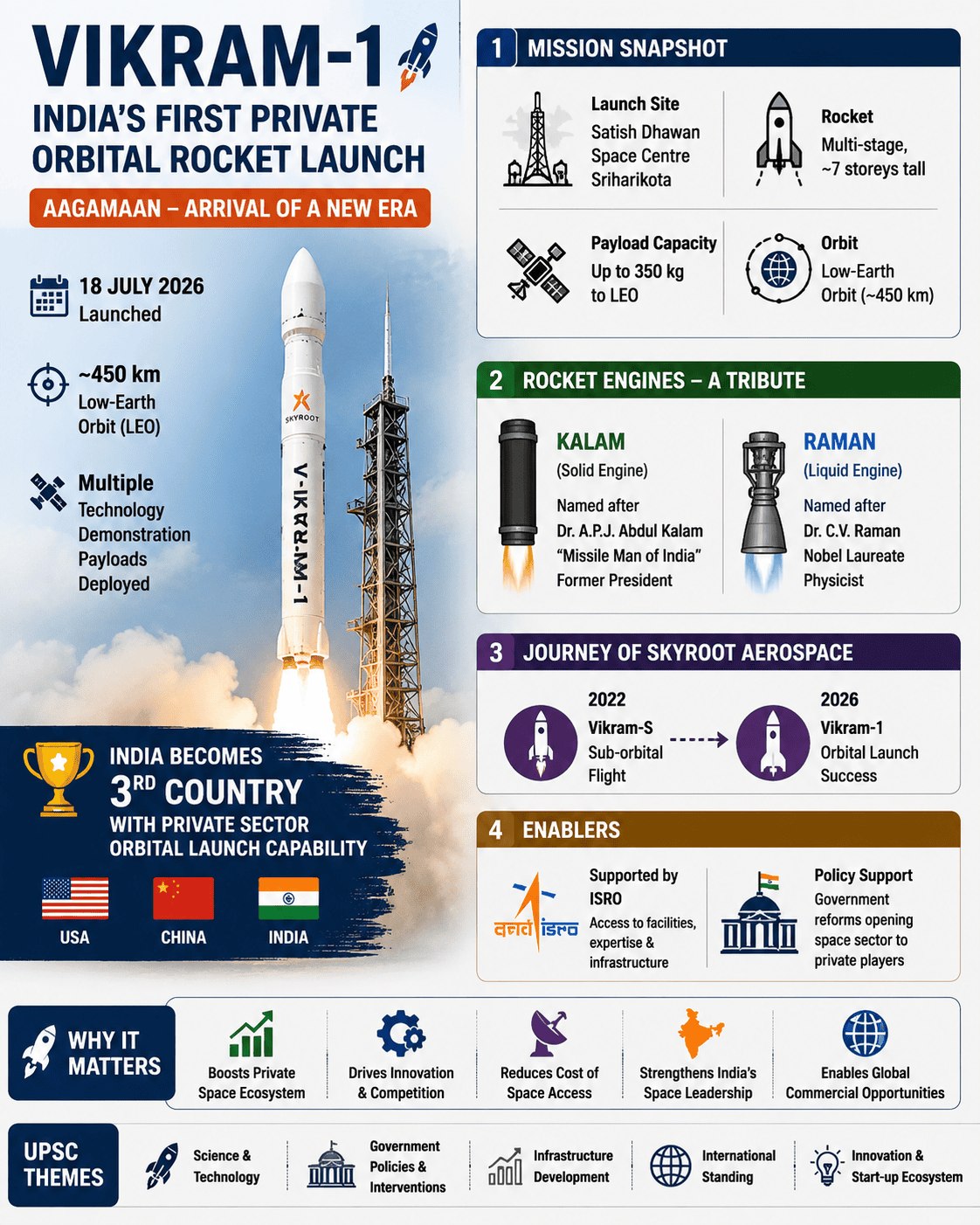
- Vikram-1, India's first privately-built orbital rocket, successfully launched and deployed multiple technology demonstration payloads into a Low-Earth Orbit (LEO) at approximately 450 km altitude on July 18, 2026.
- Developed by Hyderabad-based Skyroot Aerospace, the mission, named 'Aagamaan' (arrival), signifies a new era for India's private space sector.
- With this launch, India became the third country globally, after the United States and China, to achieve private sector orbital launch capabilities.
- The rocket is named after Vikram Sarabhai, widely regarded as the father of India's space program.
- The launch was actively supported by the Indian Space Research Organisation (ISRO) and the government's policy to open the space sector to private players.
Vikram.png
Detailed Insights:
- The launch of Vikram-1 took place from ISRO's Satish Dhawan Space Centre at Sriharikota.
- Vikram-1 is a multi-stage rocket, approximately seven storeys tall, designed to carry small satellites weighing up to 350 kg to Low-Earth Orbit.
- The rocket's solid engines are named 'Kalam' after Dr. A.P.J. Abdul Kalam, known as the "Missile Man of India" and a former President, and its liquid engine 'Raman' after physicist Dr. C.V. Raman, a Nobel laureate.
- This achievement follows Skyroot Aerospace's earlier sub-orbital flight of its Vikram-S rocket in 2022, which was India's first private rocket launch.
- The government's decision to liberalize the space sector in June 2020 and the establishment of bodies like the Indian National Space Promotion and Authorisation Centre (IN-SPACe) have been instrumental in fostering private participation.
- This successful orbital mission positions India as a significant player in the global space industry, encouraging innovation and engagement from young entrepreneurs.
Scientific/Technical Concepts Involved:
- Orbital Flight: A trajectory where a spacecraft achieves sufficient velocity to continuously circle a celestial body without falling back to its surface.
- Sub-orbital Flight: A trajectory where a spacecraft enters space but does not attain the velocity required to orbit, returning to Earth under the influence of gravity.
- Low-Earth Orbit (LEO): An orbit around Earth with an altitude typically between 160 km and 2,000 km, commonly used for Earth observation and communication satellites.
- Multi-stage Rocket: A rocket composed of two or more sections, each with its own engines and propellant, which are jettisoned sequentially after their fuel is expended to reduce mass and increase efficiency.

SuperKalam is your personal mentor for UPSC preparation, guiding you at every step of the exam journey.
Download the App


STUDY RESOURCES
CONTACT US
ⓒ Snapstack Technologies Private Limited