GS 3: Science & TechnologyGS 3: Disaster ManagementPrelims
Power grids face unexpected slow-burn threat from solar storms, Pg13
Scientists uncover a new, slow-burn threat from solar storms to power grids, causing prolonged currents that damage transformers, requiring updated protective measures.
Practice MCQs
724 Students attempted
Key Highlights:
- A new study reveals that geomagnetic storms pose an unexpected "slow-burn" threat to interconnected power grids.
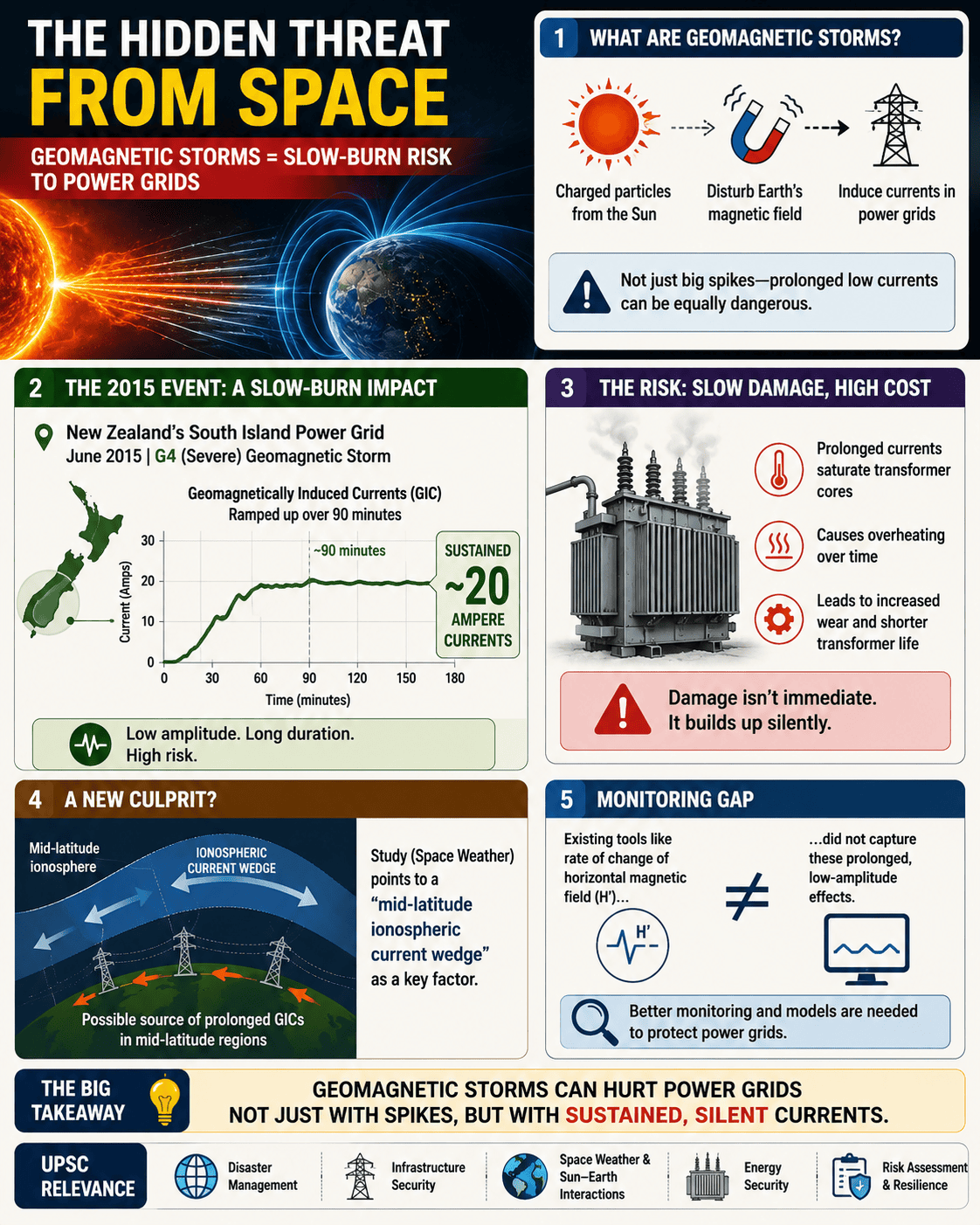
- A G4 (severe) geomagnetic storm in June 2015 caused prolonged, low-amplitude currents in New Zealand's South Island power grid.
- These sustained 20-ampere currents, though not spiking, can lead to transformer overheating and wear over time.
- The study, published in Space Weather, suggests a "mid-latitude ionospheric current wedge" as a possible cause for this phenomenon.
- Existing monitoring tools, such as the rate of change of Earth's horizontal magnetic field (H'), did not adequately capture these prolonged effects.
Geo Storm.png
Detailed Insights:
- Geomagnetic storms are temporary disturbances in Earth’s magnetic field caused by charged particles from the sun.
- The 2015 event saw geomagnetically induced currents ramp up over 90 minutes, rather than intensely spiking.
- Prolonged current flow can saturate the magnetic cores of transformers, causing them to overheat and suffer increased wear.
- Researchers from the University of Gothenburg utilized multiple datasets, including measurements from Transpower New Zealand.
- The "mid-latitude ionospheric current wedge" is believed to have diverted part of the ring current into the ionosphere.
- The risk of such unusual events is influenced by local ground conductivity and the specific layout of power lines.
- Experts need to update their understanding of space weather dangers and protective measures beyond focusing solely on current spikes.
Scientific/Technical Concepts Involved:
- Geomagnetic Storm: A temporary disturbance of the Earth's magnetosphere caused by solar wind shock waves or magnetic clouds interacting with Earth's magnetic field.
- Geomagnetically Induced Currents (GICs): Electric currents induced in long conductors like power lines due to rapid changes in Earth's magnetic field during geomagnetic storms.
- Ring Current: A toroidal current of energetic charged particles trapped in Earth's magnetic field, encircling the Earth at equatorial latitudes.
- Ionosphere: A region of Earth's upper atmosphere where atoms and molecules are ionized by solar radiation, affecting radio wave propagation.

SuperKalam is your personal mentor for UPSC preparation, guiding you at every step of the exam journey.
Download the App


STUDY RESOURCES
CONTACT US
ⓒ Snapstack Technologies Private Limited