EthicsGS 2: GovernanceGS 3: Science & TechnologyGS 3: EconomyPrelims
Non-animal testing is key to next phase of pharma growth, Pg13
India urged to embrace non-animal testing models for drug discovery, boosting pharma innovation and global competitiveness, reducing reliance on traditional animal trials.
Practice MCQs
724 Students attempted
Key Highlights:
- Non-Animal Testing Models (NAMs) are crucial for India's pharmaceutical sector to transition towards original drug discovery, complex biologics, and stronger domestic innovation.
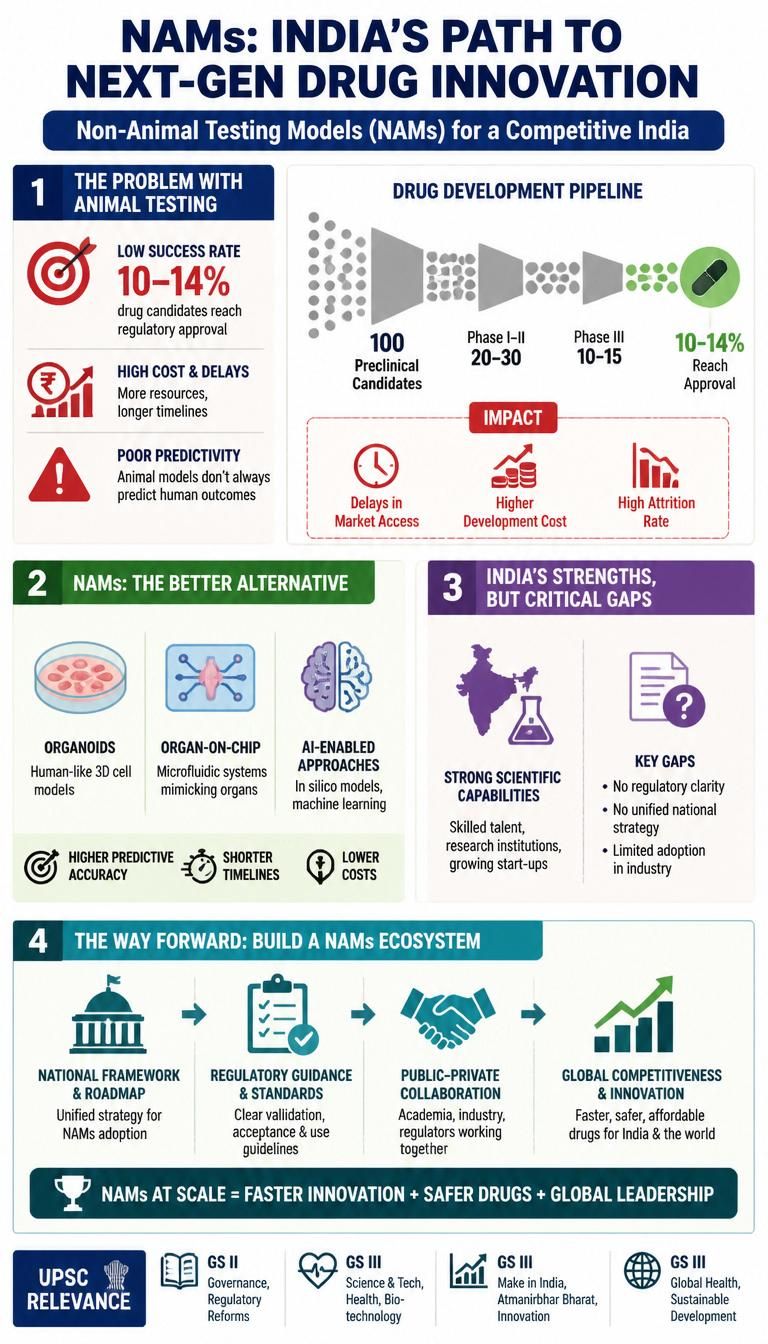
- Animal testing's limitations contribute to high attrition rates, increased costs, and delays in drug development, with only 10-14% of drug candidates reaching regulatory approval.
- NAMs, including organoids, organ-on-chip platforms, and AI-enabled approaches, offer improved predictive accuracy and shorter development timelines.
- India possesses significant scientific capabilities but lacks regulatory clarity and a unified national strategy for integrating NAMs into drug development.
- A national framework and clear regulatory guidance are essential for India to adopt NAMs at scale and remain competitive globally.
NAM.jpg
Detailed Insights:
- The global drug development challenge stems from testing models that do not always accurately predict how medicines will behave in the human body.
- India's engagement with NAMs has evolved, driven by laboratory animal ethics and institutional oversight, leading to the adoption of various alternative platforms.
- Countries like the U.S., European Union, U.K., and Japan have already established national centers, funding, and validation programs for NAMs.
- Integrating NAMs into research and development pipelines can enable more reliable science and faster development cycles, positioning India as a hub for drug discovery.
- NAMs can enhance efficiency in quality testing for generics and biosimilars, with validated non-animal alternatives already available for pyrogen and endotoxin testing.
- The relevance of NAMs extends beyond pharmaceuticals to sectors like cosmetics and personal care, where they provide robust safety data.
- While India's regulatory system permits NAMs for proof-of-concept studies, target identification, drug screening, and toxicology, formal integration is lacking.
- The adoption of NAMs aims to progressively reduce dependence on laboratory animals, though animal studies still play an important role.
Key Concepts Involved:
- Non-Animal Testing Models (NAMs): In-vitro and in-silico methods using human biology-based systems to predict drug behavior and safety.
- Organoids: 3D cell cultures that mimic the structure and function of human organs for drug testing and disease modeling.
- Organ-on-chip: Microfluidic devices engineered to simulate human organ physiology and function for drug development and toxicity testing.
- Biosimilars: Biologic medical products that are highly similar to an already approved reference biologic drug.

SuperKalam is your personal mentor for UPSC preparation, guiding you at every step of the exam journey.
Download the App


STUDY RESOURCES
CONTACT US
ⓒ Snapstack Technologies Private Limited