GS 2: GovernanceGS 2: International RelationsGS 3: EconomyPrelims
India amends tax treaty with Sri Lanka to plug avoidance, Pg15
India amends tax treaty with Sri Lanka, integrating Principal Purpose Test to curb revenue leakage and prevent treaty shopping from April 2027.
Practice MCQs
724 Students attempted
Key Highlights:
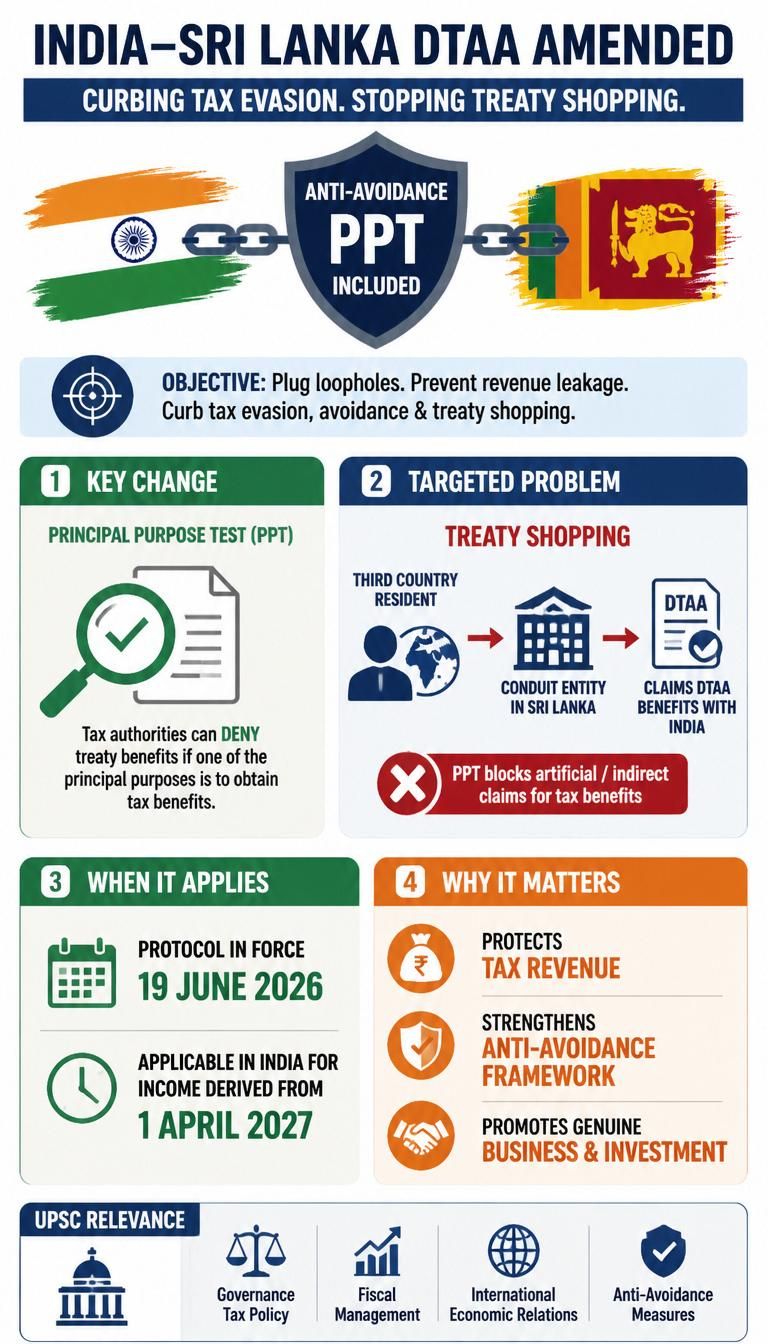
- India has amended its Double Taxation Avoidance Agreement (DTAA) with Sri Lanka to address loopholes and prevent revenue leakage.
- The primary objective of the amendment is to curb tax evasion, avoidance, and treaty shopping practices.
- The amended protocol incorporates the Principal Purpose Test (PPT), an anti-avoidance tool.
- The protocol officially came into force on June 19, 2026.
- Its provisions will be applicable in India for income derived starting from April 1, 2027.
India-SL.jpg
Detailed Insights:
- The amendment specifically targets arrangements where benefits under the DTAA are sought indirectly by residents of third countries through treaty shopping.
- The PPT empowers tax authorities to deny treaty benefits if it is reasonably concluded that obtaining such benefits was one of the principal purposes of a transaction or arrangement, rather than genuine commercial reasons.
- This update aligns the India-Sri Lanka tax treaty with modern international tax standards, particularly those developed under the Organisation for Economic Co-operation and Development's (OECD) Base Erosion and Profit Shifting (BEPS) framework.
- The revised preamble of the treaty now explicitly states its objective is to eliminate double taxation without creating opportunities for non-taxation or reduced taxation through tax evasion or avoidance.
- India has been systematically updating its network of DTAAs to incorporate such anti-abuse provisions, reflecting a broader global shift towards greater tax transparency.
Key Concepts Involved:
- Double Taxation Avoidance Agreement (DTAA): A bilateral agreement between two countries to prevent income from being taxed twice in both countries.
- Principal Purpose Test (PPT): An anti-abuse rule in tax treaties that denies benefits if obtaining a tax advantage was a principal purpose of a transaction or arrangement.
- Treaty Shopping: A practice where an entity routes investments through a country with favorable tax treaties to reduce tax liabilities, often without substantial economic activity.
- Base Erosion and Profit Shifting (BEPS): Tax planning strategies used by multinational enterprises to exploit loopholes in tax rules to artificially shift profits to low or no-tax locations.
Previous9/9

SuperKalam is your personal mentor for UPSC preparation, guiding you at every step of the exam journey.
Download the App


STUDY RESOURCES
CONTACT US
ⓒ Snapstack Technologies Private Limited