GS 2: GovernanceGS 2: Social JusticeGS 3: EconomyPrelimsGS 3: Inclusive Growth
The Battle for Responsible Microfinance, Pg10
RBI mandates responsible microfinance, balancing financial inclusion with preventing household over-indebtedness amidst industry recovery and regulatory challenges.
Practice MCQs
746 Students attempted
Key Highlights:
- The Reserve Bank of India (RBI) is emphasizing responsible lending in the microfinance sector to prevent household over-indebtedness.
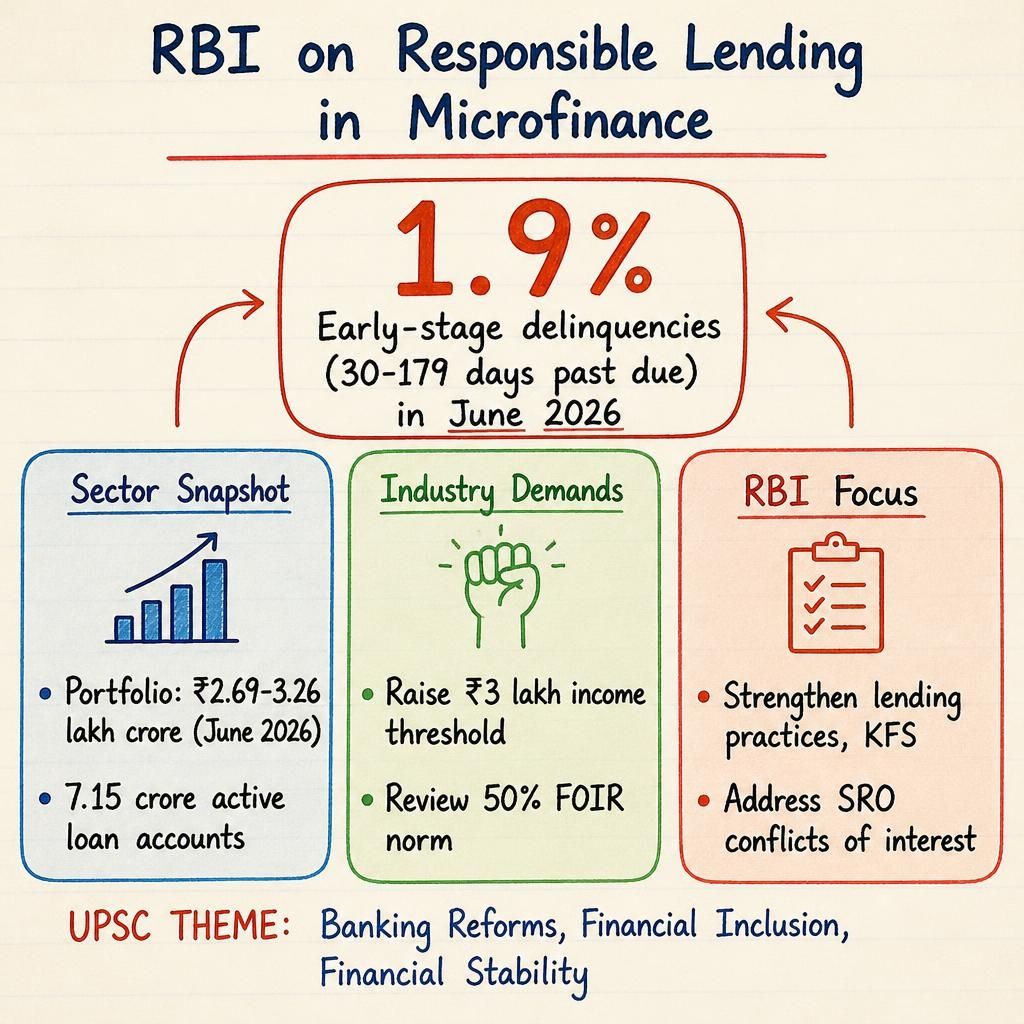
- Early-stage delinquencies (30-179 days past due) in microfinance fell to 1.9% in June 2026, though loans overdue by over 180 days remained high at 17.4%.
- The microfinance sector's outstanding portfolio was between ₹2.69 lakh crore and ₹3.26 lakh crore in June 2026, serving 7.15 crore active loan accounts.
- The industry is demanding an upward revision of the ₹3 lakh annual household income threshold and a review of the 50% Fixed-Obligation-to-Income Ratio (FOIR).
- RBI stresses strengthening lending practices, ensuring mindful consent through the Key Facts Statement (KFS), and addressing potential conflicts of interest in Self-Regulatory Organisations (SROs).
Microfinance Lending.jpg
Detailed Insights:
- The microfinance sector primarily targets unbanked or under-banked individuals, informal workers, and rural households.
- Reports from SIDBI-Equifax and Sa-Dhan provide varying but significant data on the sector's portfolio size and growth.
- Banks' direct microfinance portfolio constitutes about one-fourth of the industry's total, representing less than 0.4% of total scheduled commercial bank credit.
- Microfinance significantly contributes to rural consumption, women's entrepreneurship, and informal businesses, with its GVA contribution projected to reach 2.7% by 2025-26.
- The industry argues that the current ₹3 lakh income threshold, introduced in 2022, does not reflect increases in wages, household incomes, and inflation.
- A uniform 50% FOIR may not adequately capture regional differences in income, expenditure, and repayment capacity, potentially pushing vulnerable households to informal lenders.
- The RBI views excluding principal repayments from FOIR calculations as understating actual household indebtedness.
- RBI Deputy Governor Shirish Chandra Murmu highlighted the distinction between mindful consent and "pseudo-consent," emphasizing the need for borrowers to understand loan commitments.
- The Key Facts Statement (KFS) is crucial for ensuring transparency and informed consent from borrowers.
- Potential conflicts of interest exist within Self-Regulatory Organisations (SROs) like MFIN and Sa-Dhan, as they monitor their own member institutions.
- New RBI directions on advertising, marketing, and sale of financial products, effective January 1, 2027, aim to prohibit deceptive practices and ensure explicit customer consent.
Key Concepts Involved:
- Microfinance: Provision of small loans and other financial services to low-income individuals or groups lacking access to conventional banking.
- Fixed-Obligation-to-Income Ratio (FOIR): A ratio that measures a borrower's total fixed monthly financial obligations against their net monthly income.
- Key Facts Statement (KFS): A standardized document providing essential information about a loan product in a simple, transparent manner to borrowers.
- Self-Regulatory Organisations (SROs): Industry bodies that set and enforce rules and standards for their members, often recognized by a regulator.

SuperKalam is your personal mentor for UPSC preparation, guiding you at every step of the exam journey.
Download the App


STUDY RESOURCES
CONTACT US
ⓒ Snapstack Technologies Private Limited