GS 3: Science & TechnologyGS 2: International RelationsGS 3: EconomyPrelimsGS 2: Bilateral, Regional and Global Groupings and Agreements
Economic Coercion, Says Beijing As 21 Countries Gather For Two-Day APEC Meet In Shenzhen, Pg14
Beijing accuses US of 'economic coercion' over new semiconductor export curbs on five nations ahead of the APEC summit in Shenzhen.
Practice MCQs
746 Students attempted
Key Highlights:
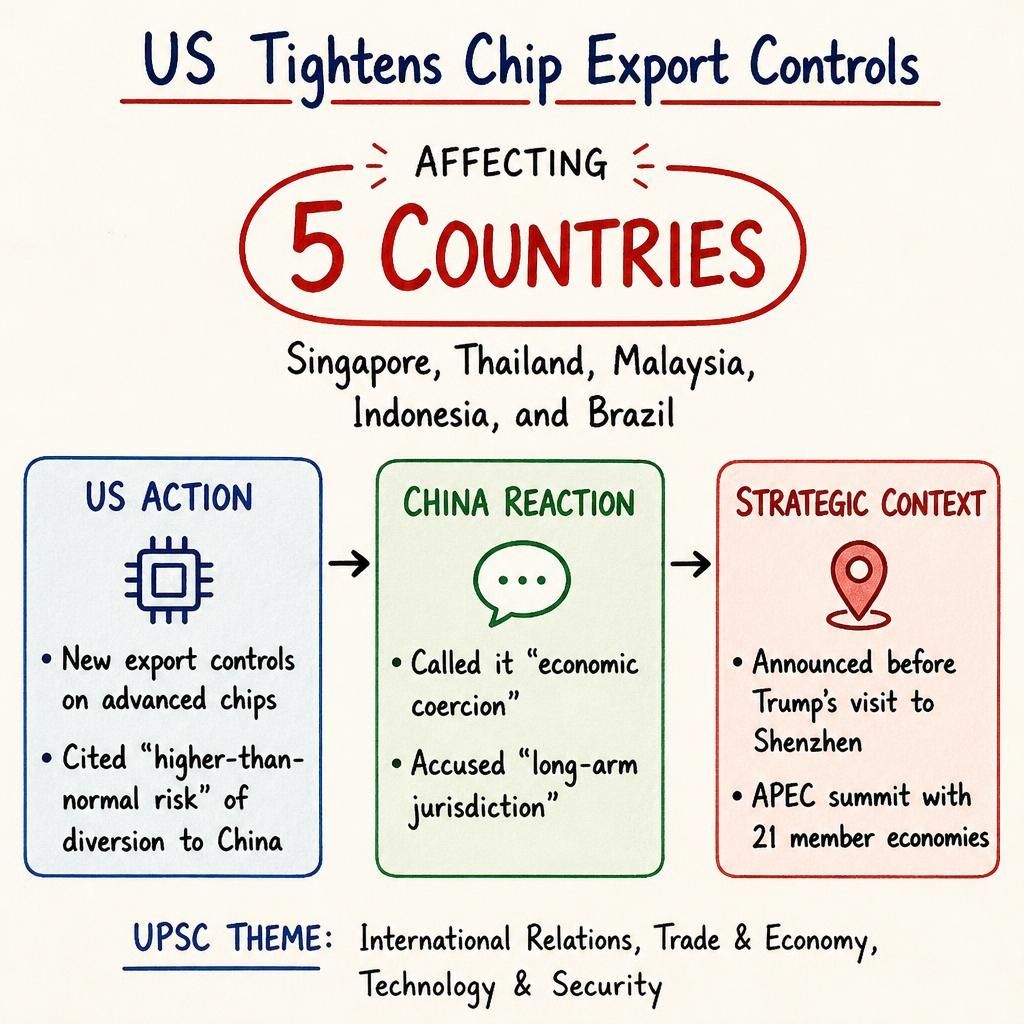
- The US imposed new export controls on advanced semiconductor chips to Singapore, Thailand, Malaysia, Indonesia, and Brazil.
- The US Commerce Department cited a "higher-than-normal risk" of these chips being diverted to China.
- China criticized the US action as "economic coercion" and "long-arm jurisdiction," accusing it of disrupting global supply chains.
- The announcement occurred just before US President Donald Trump's visit to Shenzhen for the 33rd Asia-Pacific Economic Cooperation (APEC) Economic Leader's Meeting.
- The APEC summit was also slated to host a trilateral summit between the US and Russian presidents.
Chip Export Curbs.jpg
Detailed Insights:
- The US Commerce Department issued an interim final rule titled "Addressing Remote Access to Advanced Semiconductors" to implement the new restrictions.
- The US aims to prevent advanced semiconductors from reaching China, impacting its high-tech industry development.
- China views these export controls as an overreach of national security concepts and interference in normal trade relations.
- This move further escalates the ongoing technological and trade rivalry between the United States and China.
- The APEC summit in Shenzhen brought together 21 member economies to discuss regional economic cooperation and trade.
- US President Trump's participation in APEC followed his attendance at the ASEAN Summit and a Quad leaders' meeting.
Key Concepts Involved:
- Economic Coercion: The use of economic measures by one country to compel another country to change its policies or actions.
- Export Controls: Government regulations restricting the export of certain goods, technologies, or services for national security or foreign policy reasons.
- Long-arm Jurisdiction: The legal authority of a court to exercise jurisdiction over a foreign defendant based on their actions having an effect within the court's territory.
- APEC (Asia-Pacific Economic Cooperation): A regional economic forum promoting free trade and economic cooperation across the Asia-Pacific region.

SuperKalam is your personal mentor for UPSC preparation, guiding you at every step of the exam journey.
Download the App


STUDY RESOURCES
CONTACT US
ⓒ Snapstack Technologies Private Limited