GS 2: GovernanceGS 3: Science & TechnologyGS 3: EconomyPrelimsGS 3: Indian Economy, Planning, Mobilization of Resources, Growth, Development and Employment
Balancing AI-driven estimates and ground-level evidence in official statistics, Pg11
India's VISTAR initiative integrates AI into official statistics, sparking debate on balancing AI-driven estimates with ground-level evidence to prevent policy misallocation and public trust erosion.
Practice MCQs
746 Students attempted
Key Highlights:
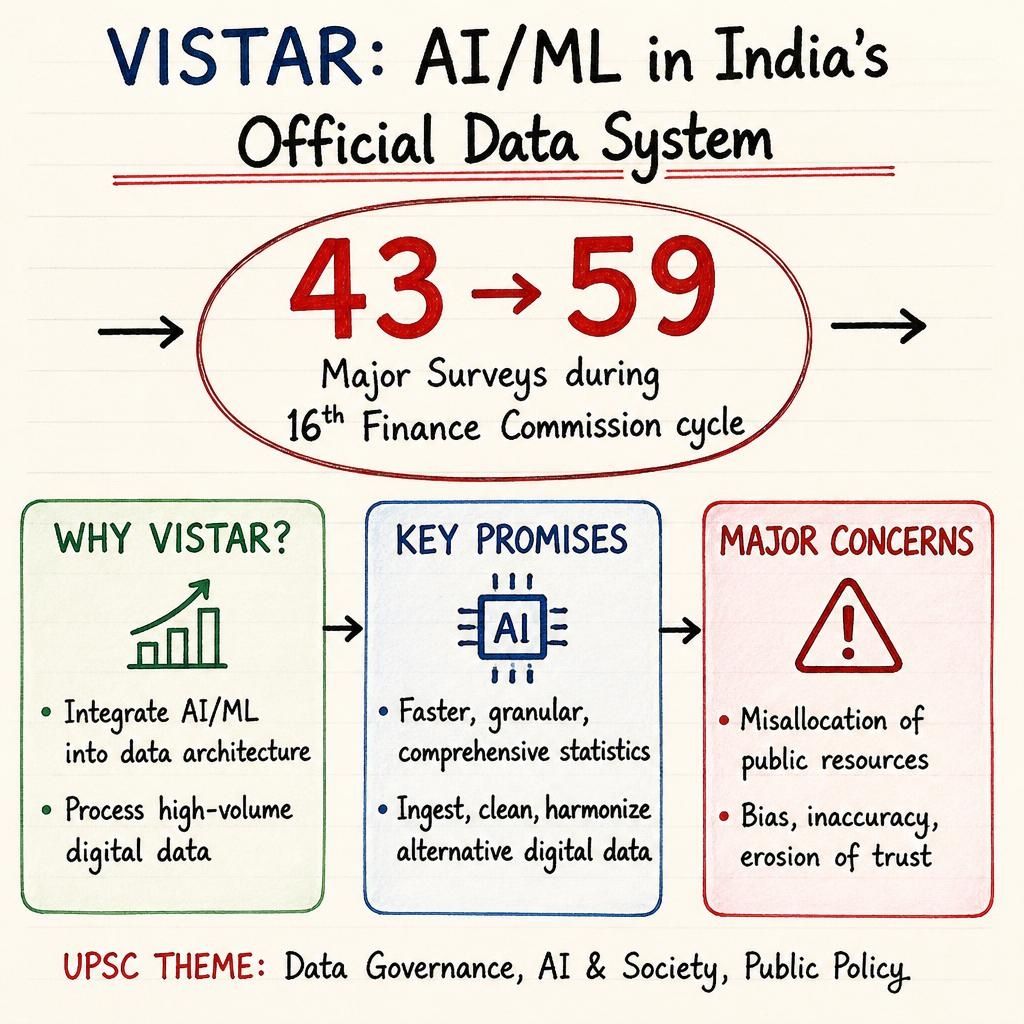
- The Viksit Bharat Initiative for Statistical Transformation, Analytics & Research (VISTAR) aims to integrate Artificial Intelligence (AI) and Machine Learning (ML) into India's official data architecture.
- The initiative, led by the Ministry of Statistics and Programme Implementation (MoSPI), seeks to use AI/ML to process high-volume digital data, potentially increasing reliance on synthetic data.
- Synthetic data is artificially generated information designed to reproduce patterns found in real datasets without using original observations.
- Global tech leaders, including Geoffrey Hinton and Sam Altman, signed a statement highlighting AI's extinction risks, underscoring broader concerns about AI's societal impact.
- Concerns exist that over-reliance on AI-generated estimates could lead to misallocation of public resources, distortion of economic indicators, and erosion of public trust.
- VISTAR also proposes increasing major surveys from 43 to 59 during the 16th Finance Commission cycle, emphasizing the continued importance of primary data collection.
VISTAR.jpg
Detailed Insights:
- The fundamental distinction in statistics is between observation, which is ground-level evidence, and estimation, which is AI/ML-driven.
- AI/ML promises to make official statistics faster, more granular, and comprehensive for both Central and State governments.
- MoSPI aims to address data silos by using AI/ML algorithms to ingest, clean, and harmonize diverse alternative digital data.
- The article cautions against using AI/ML to "manufacture information" for data gaps that stem from inefficiencies in the existing statistical system.
- The World Economic Forum (WEF) has identified synthetic data as an essential tool for addressing data scarcity and privacy limitations of real-world data.
- A significant pitfall is that synthetic data inherits the limitations and biases of the original data it is trained on, potentially perpetuating inaccuracies.
- The increasing demand for granular statistics at micro-levels, coupled with the cost and difficulty of primary data collection, may tempt policymakers to adopt synthetic data.
- Generative AI models, such as Generative Adversarial Networks (GANs), can learn patterns from existing datasets to create new, similar records.
- Poorly governed use of AI/ML in VISTAR could lead to misallocation of public resources, distorted economic indicators, and a decline in public confidence.
- The article stresses the need for human oversight, ground verification, and source transparency, while preserving statistical independence, as per the UNECE 2025 Framework.
- Primary surveys must remain the bedrock of official statistics, with model-generated estimates clearly identified and separated from actual survey-based data.
Key Concepts Involved:
- Viksit Bharat Initiative for Statistical Transformation, Analytics & Research (VISTAR): A new Indian initiative to modernize the official data architecture by integrating AI/ML technologies.
- Synthetic Data: Artificially generated data that mimics the statistical properties and patterns of real datasets without containing actual individual observations.
- Model Collapse: A phenomenon in AI where repeated training on synthetic data leads to a progressive degradation of the diversity and quality of the model's output.
- Liar's Dividend: The erosion of public trust in data authenticity, including real data, due to the widespread proliferation and potential misuse of synthetic content.
- Generative AI: A category of artificial intelligence algorithms that can generate new content, such as text, images, or data, based on patterns learned from existing data.

SuperKalam is your personal mentor for UPSC preparation, guiding you at every step of the exam journey.
Download the App


STUDY RESOURCES
CONTACT US
ⓒ Snapstack Technologies Private Limited