GS 2: GovernanceGS 3: EconomyPrelimsGS 3: Inclusive GrowthGS 3: Indian Economy, Planning, Mobilization of Resources, Growth, Development and Employment
Who has to pay MDR on UPI and who stands to gain the most?, Pg13
NPCI introduces Merchant Discount Rate (MDR) on certain UPI transactions above ₹2,000, impacting specific merchants and benefiting payment ecosystem players.
Practice MCQs
731 Students attempted
Key Highlights:
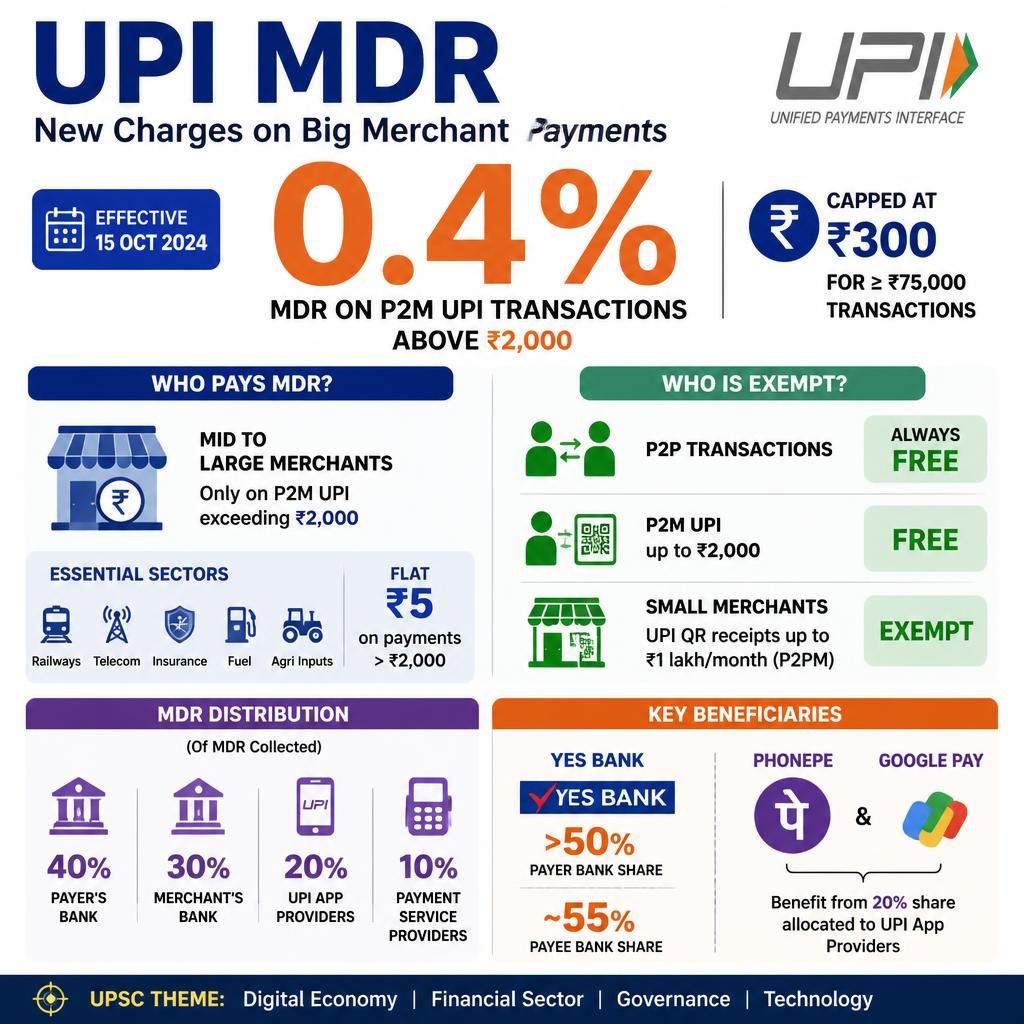
- The National Payments Corporation of India (NPCI) has introduced a Merchant Discount Rate (MDR) on certain Unified Payments Interface (UPI) transactions, effective October 15.
- This MDR will be paid by mid- to large-sized merchants for Person-to-Merchant (P2M) UPI transactions exceeding ₹2,000.
- The standard MDR rate is 0.4% of the transaction value, capped at ₹300 for transactions of ₹75,000 and above.
- Transactions in essential sectors like railways, telecommunications, insurance, fuel, and agricultural inputs will attract a flat MDR of ₹5 for payments over ₹2,000.
- All Person-to-Person (P2P) UPI transactions and P2M transactions up to ₹2,000 will remain free of charge for consumers and merchants.
- Small merchants receiving up to ₹1 lakh per month through UPI QR codes under the Person-to-Person-Merchant (P2PM) category are also exempt from MDR.
UPI MDR.jpg
Detailed Insights:
- The new MDR framework aims to create a sustainable commercial model for the UPI ecosystem, funding investments in payment infrastructure, cybersecurity, and innovation.
- The Ministry of Finance has advised banks to ensure that merchants do not pass MDR charges on to customers, and UPI application providers are prohibited from imposing platform fees.
- While P2M transactions above ₹2,000 constitute only 2.5% of all UPI transactions by volume, they account for 20% of the total transaction value.
- The collected MDR will be distributed among payment ecosystem participants, including the payer's bank (40%), the merchant's bank (30%), UPI app providers (20%), and Payment Service Providers (10%).
- Yes Bank is projected to be a significant beneficiary, being the payer bank in over 50% and payee bank in about 55% of UPI transactions.
- PhonePe and Google Pay are expected to benefit from the portion allocated to UPI app providers, given their large market share.
- A dedicated fund, receiving 5% of total MDR collections, will be established to promote UPI adoption among small merchants.
- The NPCI was established in 2008 as an umbrella organization for retail payments and settlement systems in India, under the guidance of the Reserve Bank of India (RBI) and the Indian Banks' Association (IBA).
Key Concepts Involved:
- Merchant Discount Rate (MDR): A fee charged to a merchant by a bank for accepting digital payments, typically a percentage of the transaction value.
- Unified Payments Interface (UPI): An instant real-time payment system developed by NPCI that facilitates inter-bank transactions through mobile platforms.
- National Payments Corporation of India (NPCI): An umbrella organization for operating retail payments and settlement systems in India, established by the RBI and IBA.
- Person-to-Merchant (P2M) Transaction: A payment made by a customer to a business or service provider.
- Person-to-Person (P2P) Transaction: A payment made between two individuals, such as sending money to family or friends.

SuperKalam is your personal mentor for UPSC preparation, guiding you at every step of the exam journey.
Download the App


STUDY RESOURCES
CONTACT US
ⓒ Snapstack Technologies Private Limited