GS 1: Indian SocietyGS 3: EconomyPrelimsGS 3: Inclusive GrowthGS 3: Indian Economy, Planning, Mobilization of Resources, Growth, Development and Employment
Proof of Growth Lies Beyond GDP Number, Pg14
Article questions India's 7.8% GDP growth, highlighting concerns over methodology, stagnant real wages, declining household savings, and weak private investment.
Practice MCQs
731 Students attempted
Key Highlights:
- Concerns have been raised regarding the methodology, transparency, and veracity of India's recent Gross Domestic Product (GDP) report.
- Experts question whether the reported 7.8% GDP growth truly reflects the economic well-being of citizens.
- Key indicators like household incomes, consumption, and economic security are highlighted as crucial for assessing genuine economic progress.
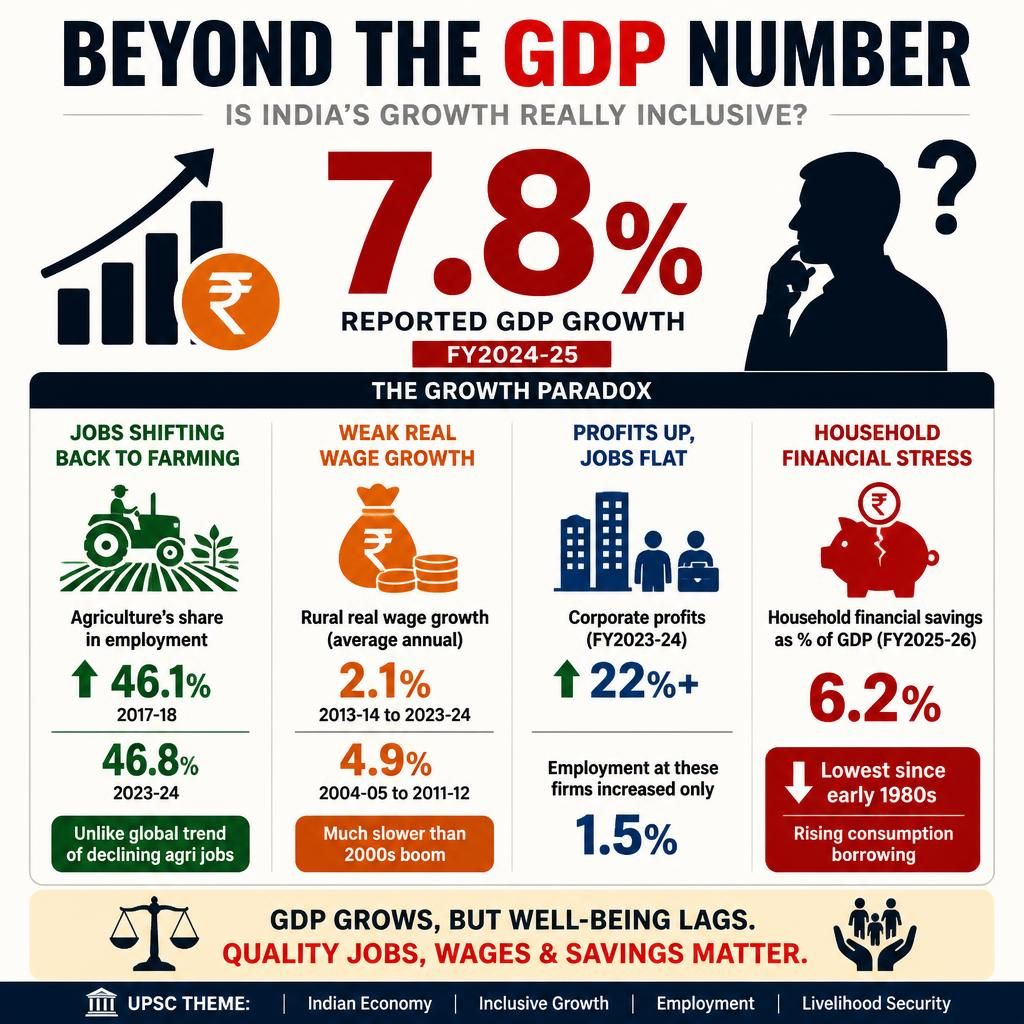
- The article points to a troubling increase in agricultural employment, which deviates from typical development patterns.
- Weak real wage growth, declining household financial savings, and a reliance on public capital expenditure for investment are cited as signs of an uneven economic boom.
GDP Numbers.jpg
Detailed Insights:
- Economist Joseph Stiglitz has long argued that GDP can increase even when many citizens experience a decline in their economic well-being.
- The government cites a rising Labour Force Participation Rate (LFPR) as evidence of employment growth, but a significant portion is in low-productivity agricultural jobs.
- The share of workers in agriculture has risen in recent years, which is concerning for a developing economy that typically sees a shift away from farming.
- Real wages, particularly in rural India, have shown significantly weaker growth in the last decade compared to the high-growth years of the 2000s.
- Corporate profits surged by over 22% in FY2023-24, yet employment at these firms increased by only about 1.5%.
- Household financial savings fell to 6.2% of GDP by 2025-26, a level last observed in the early 1980s, alongside rising consumption borrowing.
- Growth in two-wheeler sales, an indicator of middle-class mobility, slowed to under 2% annually in the decade after 2014, compared to nearly 11% before.
- The overall investment rate, though recovered to about 34% of GDP, remains below the peak of nearly 39% achieved during the UPA era.
- Public capital expenditure has been a primary driver of investment, while private corporate investment and Net Foreign Direct Investment (FDI) have remained subdued.
Key Concepts Involved:
- Gross Domestic Product (GDP): The total monetary value of all finished goods and services produced within a country's borders in a specific time period.
- Labour Force Participation Rate (LFPR): The percentage of the working-age population that is either employed or actively seeking employment.
- Real Wages: Wages adjusted for inflation, reflecting the actual purchasing power of earnings.
- Household Financial Savings: The portion of household income that is not consumed or used for physical investments, typically held in financial assets.
- Capital Expenditure (Capex): Funds used by a company or government to acquire, upgrade, and maintain physical assets such as property or equipment.
- Foreign Direct Investment (FDI): An investment made by a firm or individual in one country into business interests located in another country.

SuperKalam is your personal mentor for UPSC preparation, guiding you at every step of the exam journey.
Download the App


STUDY RESOURCES
CONTACT US
ⓒ Snapstack Technologies Private Limited