GS 3: Disaster ManagementGS 3: Environment & EcologyGS 3: EconomyPrelimsGS 3: Disaster and Disaster Management
How Melting Glaciers Could ‘Put 20% of GDP at Risk’, Pg16
New report warns melting Himalayan glaciers jeopardize 21.5% of India's GDP, highlighting economic dependence and black carbon's accelerating impact on ice loss.
Practice MCQs
731 Students attempted
Key Highlights:
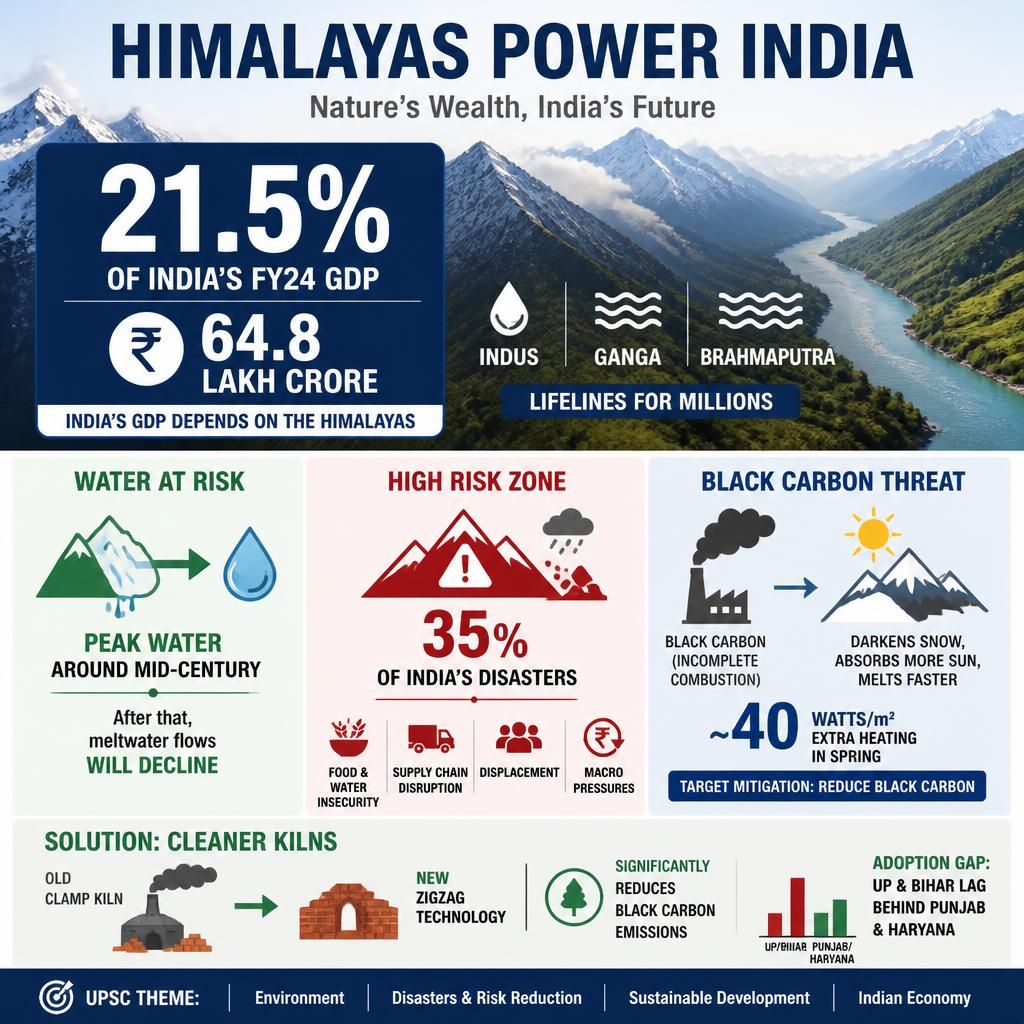
- A new report estimates that 21.5% of India’s FY24 GDP, amounting to Rs 64.8 lakh crore, is dependent on the Himalayas.
- The report, titled ‘A resilient Himalaya: protecting a region at risk and securing future prosperity’, was compiled by Systemiq in partnership with Integrated Mountain Initiative.
- Melting Himalayan glaciers threaten water supplies to major river systems like the Indus, Ganga, and Brahmaputra.
- Himalayan river basins are projected to reach ‘Peak Water’ around mid-century, after which meltwater flows will decline.
- The Himalayas, accounting for 18% of India's land, experience about 35% of the nation's disasters.
- Black carbon, a pollutant from incomplete combustion, significantly accelerates glacier melt and is a key focus for mitigation.
Himalayas.jpg
Detailed Insights:
- The economic dependence includes direct contributions from Himalayan states and indirect reliance of downstream agriculture, industry, and hydropower.
- The report's calculation of GDP dependence considers direct GSDP, indirect reliance on Himalayan-fed rivers, and induced supply-chain and wage-spending effects.
- ‘Peak Water’ signifies the point when glacier meltwater reaches its maximum, followed by a decline as ice reserves shrink.
- Disasters in the Himalayas lead to food and water insecurity, supply chain disruptions, displacement, and macroeconomic pressures.
- Black carbon darkens snow surfaces, causing them to absorb more sunlight and increasing surface heating by about 40 watts/m2 in spring.
- Modernizing the brick kiln industry, particularly by adopting zigzag technology, can significantly reduce black carbon emissions.
- Adoption of zigzag technology is uneven across India, with states like Uttar Pradesh still lagging behind Punjab and Haryana.
- A comprehensive approach to tackle black carbon requires addressing emissions from kilns, cookstoves, transport, and crop-residue burning.
Key Concepts Involved:
- Peak Water: The point in time when glacier meltwater flow reaches its maximum, after which it begins to decline.
- Black Carbon: Soot produced by incomplete combustion, which accelerates glacier melt by darkening snow and ice surfaces.
- Zigzag Technology: An efficient method for firing bricks that significantly reduces fuel consumption and black carbon emissions.

SuperKalam is your personal mentor for UPSC preparation, guiding you at every step of the exam journey.
Download the App


STUDY RESOURCES
CONTACT US
ⓒ Snapstack Technologies Private Limited