GS 2: GovernanceGS 2: International RelationsGS 3: EconomyPrelimsGS 2: Bilateral, Regional and Global Groupings and Agreements
Does the BRICS summit signify a shift for Indian foreign policy?, Pg11
Experts debate if the New Delhi Declaration and BRICS engagement signal a shift in India's foreign policy towards strategic autonomy and a multipolar world.
Practice MCQs
731 Students attempted
Key Highlights:
- The New Delhi Declaration of 2026 was adopted at the 18th BRICS Summit in New Delhi, India, under India's chairship theme "Building for Resilience, Innovation, Cooperation and Sustainability".
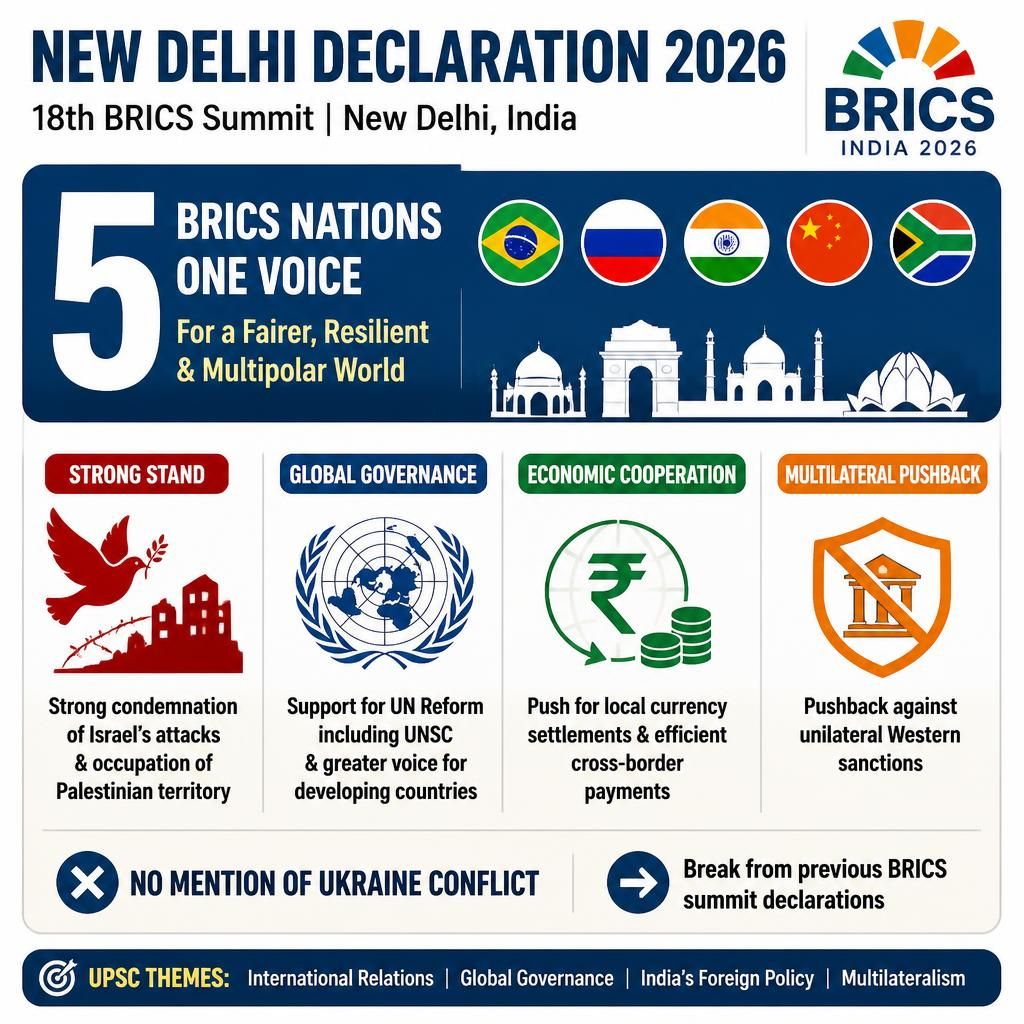
- The declaration included strong criticism of Israel regarding civilian casualties and the occupation of Palestinian territory, and a pushback against unilateral Western sanctions.
- It supported UN reform, including the UN Security Council, and called for greater representation of developing countries in global financial institutions.
- The summit saw close engagement between Prime Minister Narendra Modi and leaders from Iran, Russia, and China.
- Notably, the declaration omitted any references to the Ukraine conflict, a departure from previous BRICS summits.
- The declaration emphasized economic and technological development, including cross-border payments and the use of local currencies for trade.
BRICS.jpg
Detailed Insights:
- The New Delhi Declaration of 2026 reflects India's priorities as BRICS Chair, focusing on strengthening multilateralism and cooperation among Global South nations.
- India's foreign policy is characterized by strategic autonomy and multi-vector engagement, allowing it to engage with diverse global powers and blocs simultaneously.
- The BRICS platform provides India with a comfortable forum to engage with non-Western countries, showcasing a shift in diplomatic optics.
- The absence of Ukraine references in the declaration was likely due to a Russian veto, with India not pushing for its inclusion.
- The strong condemnation of Israel in the declaration aims to balance India's position, especially following earlier statements by PM Modi.
- India consistently supports a two-state solution for the Israeli-Palestinian conflict, advocating for an independent Palestinian state alongside Israel.
- The declaration referenced UN Security Council Resolution 2803 of November 2025, which endorsed a Gaza peace plan and authorized an International Stabilization Force.
- Economic discussions focused on intra-BRICS trade using national currencies and improving cross-border payment mechanisms like BRICS Pay, rather than a common currency.
- BRICS, representing about 40% of the world's GDP and 49% of the global population, acts as a counterpoint to the G7.
- India's diplomatic strategy involves engaging all stakeholders in multiple directions, aiming to be a bridge between the East and West and a voice for the Global South.
Key Concepts Involved:
- New Delhi Declaration of 2026: The official statement adopted at the 18th BRICS Summit in New Delhi, outlining shared visions and priorities.
- Strategic Autonomy: A foreign policy approach where a state makes independent decisions based on its national interests, free from external pressures.
- Multi-vector engagement: A foreign policy strategy of engaging with multiple global powers and blocs simultaneously, rather than aligning exclusively with one.
- Two-state solution: A proposed resolution to the Israeli-Palestinian conflict envisioning an independent Palestinian state alongside Israel.
- BRICS payment mechanism: An initiative, including BRICS Pay, to facilitate cross-border transactions among member countries using local currencies, reducing reliance on the US dollar.
- UN Security Council Resolution 2803: A resolution passed in November 2025 endorsing a Gaza peace plan and authorizing an International Stabilization Force.

SuperKalam is your personal mentor for UPSC preparation, guiding you at every step of the exam journey.
Download the App


STUDY RESOURCES
CONTACT US
ⓒ Snapstack Technologies Private Limited