GS 3: Environment & EcologyGS 2: GovernancePrelimsGS1: Changes in Critical Geographical Features, Water Bodies, Ice Caps, Flora and FaunaGS2: Government policies and interventions for development in various sectors
Losing forest for trees, Pg6
CAG audit exposes Green India Mission's failure to improve forest quality and cover, highlighting a critical gap in India's climate change mitigation efforts.
Practice MCQs
724 Students attempted
Key Highlights:
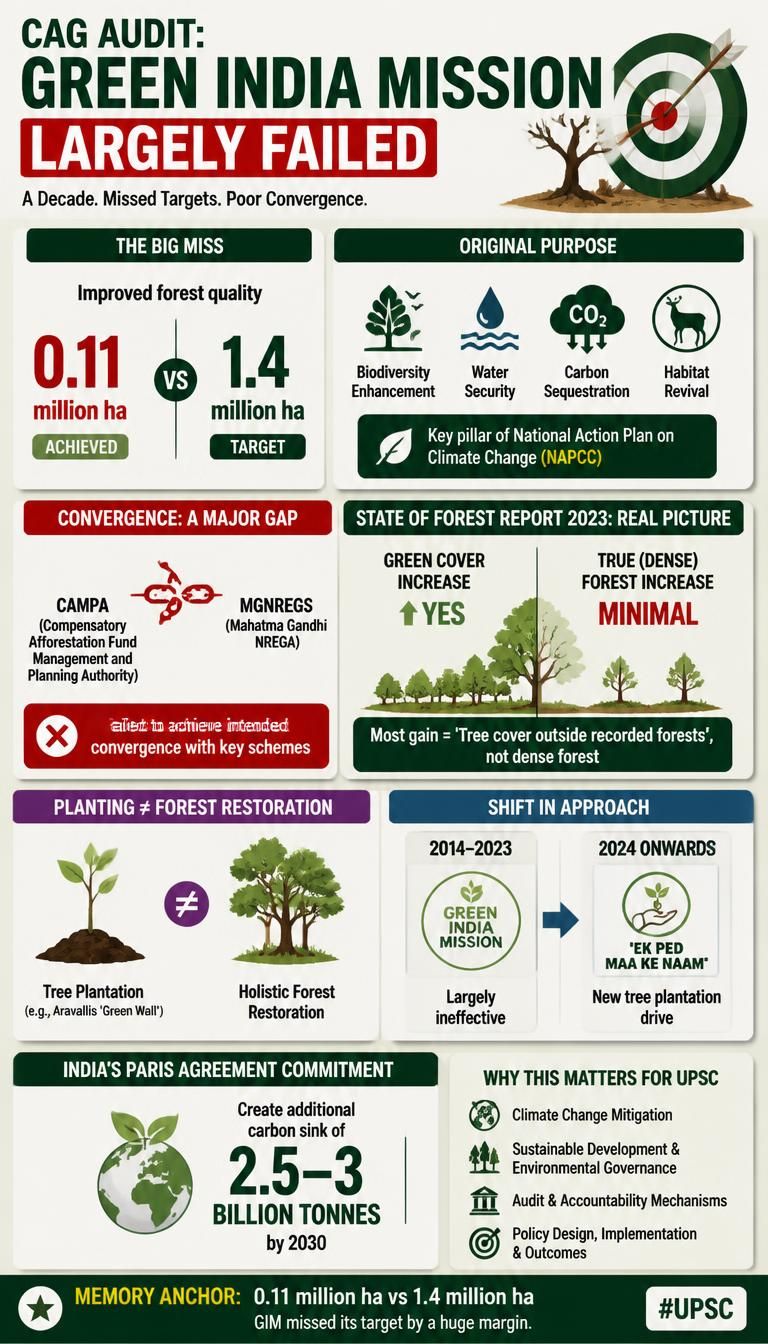
- A performance audit by the Comptroller and Auditor General (CAG) found that the Green India Mission (GIM) largely failed to meet its objectives over a decade.
- GIM improved forest quality over only 0.11 million hectares, significantly short of its 1.4 million hectare target.
- The mission was a key pillar of the National Action Plan on Climate Change and aimed to contribute to India's Paris Agreement commitments for carbon sequestration.
- GIM has been effectively replaced by a new tree plantation drive called 'Ek Ped Maa Ke Naam', launched in 2024.
- The India State of Forest Report 2023 indicated a gain in overall green cover but a minimal increase in 'true forest' area.
GIM.jpg
Detailed Insights:
- GIM was originally conceived with broad ecological goals, including enhancing biodiversity, water security, carbon sequestration, and habitat revival.
- The mission failed to achieve intended convergence with other relevant schemes like the Compensatory Afforestation Fund Management and Planning Authority (CAMPA) and the Mahatma Gandhi National Rural Employment Guarantee Scheme (MGNREGS).
- The India State of Forest Report 2023 revealed that most of the reported green cover increase was 'tree cover outside recorded forests,' not dense forest.
- The article highlights that planting trees, as seen with initiatives like the Aravallis 'Green Wall,' does not equate to holistic forest restoration.
- India's commitment under the Paris Agreement includes creating an additional carbon sink of 2.5 to 3 billion tonnes by 2030.
- The CAG audit underscores a focus on quantitative tree planting rather than qualitative forest ecosystem restoration.
Key Concepts Involved:
- Green India Mission (GIM): A national mission under the National Action Plan on Climate Change focused on protecting, restoring, and enhancing India's forest cover.
- Comptroller and Auditor General (CAG): India's supreme audit institution responsible for auditing government receipts and expenditures.
- National Action Plan on Climate Change (NAPCC): An Indian government plan launched in 2008 outlining strategies to address climate change.
- Paris Agreement: An international treaty on climate change adopted in 2015, aiming to limit global warming.
- Compensatory Afforestation Fund Management and Planning Authority (CAMPA): An authority managing funds for afforestation to compensate for forest land diversion.
- India State of Forest Report: A biennial publication by the Forest Survey of India assessing the country's forest and tree resources.
- Carbon Sink: A natural or artificial reservoir that absorbs and stores more carbon from the atmosphere than it releases.

SuperKalam is your personal mentor for UPSC preparation, guiding you at every step of the exam journey.
Download the App


STUDY RESOURCES
CONTACT US
ⓒ Snapstack Technologies Private Limited