GS 3: EconomyGS 2: International RelationsPrelimsGS2: Bilateral, Regional and Global Groupings and AgreementsGS2: Effect of Policies and Politics of Developed and Developing Countries on India's Interests
Decoding India’s growth in merchandise exports, Pg7
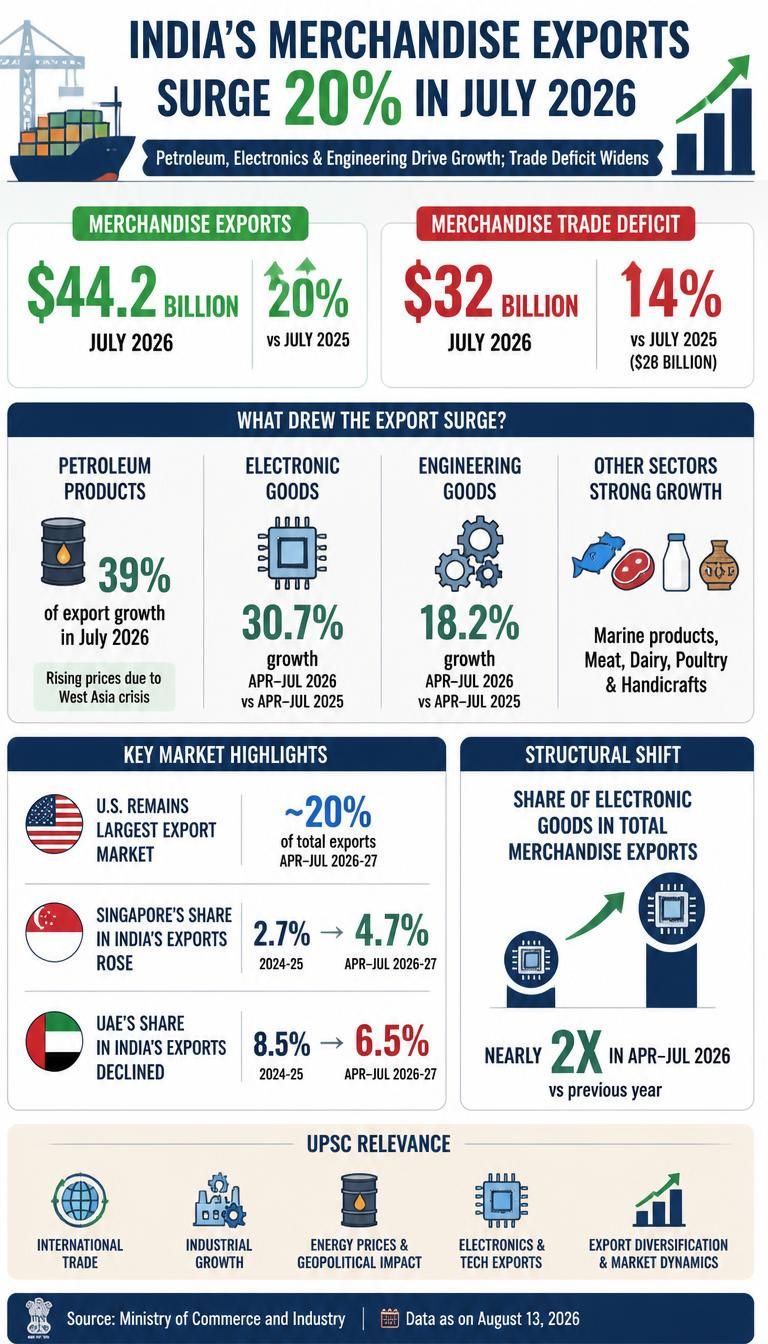
India's merchandise exports surge 20% to $44.2 billion in July 2026, driven by petroleum and electronics, despite widening trade deficit and West Asia conflict.
Practice MCQs
724 Students attempted
Key Highlights:
- India's merchandise exports increased by nearly 20% to $44.2 billion in July 2026 compared to July 2025.
- The growth was primarily driven by petroleum products, electronics, and engineering goods.
- Despite the export surge, India's merchandise trade deficit widened to $32 billion in July 2026 from $28 billion in July 2025.
- The Ministry of Commerce and Industry released this data on August 13, 2026.
- The U.S. remained India's largest merchandise export market, accounting for approximately one-fifth of total exports between April and July 2026-27.
Merchandise Exports.jpg
Detailed Insights:
- Petroleum products contributed significantly to the export increase, accounting for 39% of the growth in July 2026, influenced by rising prices due to the West Asia crisis.
- Electronic goods exports grew by 30.7% and engineering goods by 18.2% in April-July 2026 compared to the same period in the previous year.
- Other sectors like marine products, meat, dairy, poultry, and handicrafts also reported strong growth during this period.
- The share of electronic goods in India’s total merchandise exports nearly doubled in the April-July 2026 period.
- Singapore's share in India's exports rose noticeably from 2.7% in 2024-25 to 4.7% in the first four months of 2026-27.
- The UAE's share in India's exports decreased from 8.5% to 6.5% in the same period, attributed to the ongoing West Asia crisis.
- Export growth to countries such as South Africa, Tanzania, Sri Lanka, Malaysia, and Kenya was largely driven by refined petroleum products.
- India also showed promising non-petroleum driven export increases to Vietnam ($2.6 billion) and Taiwan ($0.8 billion) in April-July 2026.
Key Concepts Involved:
- Merchandise Exports: The total value of physical goods sold by a country to other countries.
- Trade Deficit: Occurs when a country's imports of goods and services exceed its exports.
- Commodity Groups: Categories of goods, often raw materials or primary products, traded in large quantities.
- Export Diversification: The strategy of expanding the range of goods and services a country exports to reduce reliance on a few products or markets.

SuperKalam is your personal mentor for UPSC preparation, guiding you at every step of the exam journey.
Download the App


STUDY RESOURCES
CONTACT US
ⓒ Snapstack Technologies Private Limited