Can SHANTI Act override court on compensation for nuclear disasters, asks SC, Pg10
Supreme Court challenges SHANTI Act 2025's liability caps for nuclear disasters, questioning if it can restrict constitutional courts from awarding suitable victim compensation.
Practice MCQs
724 Students attempted
Key Highlights:
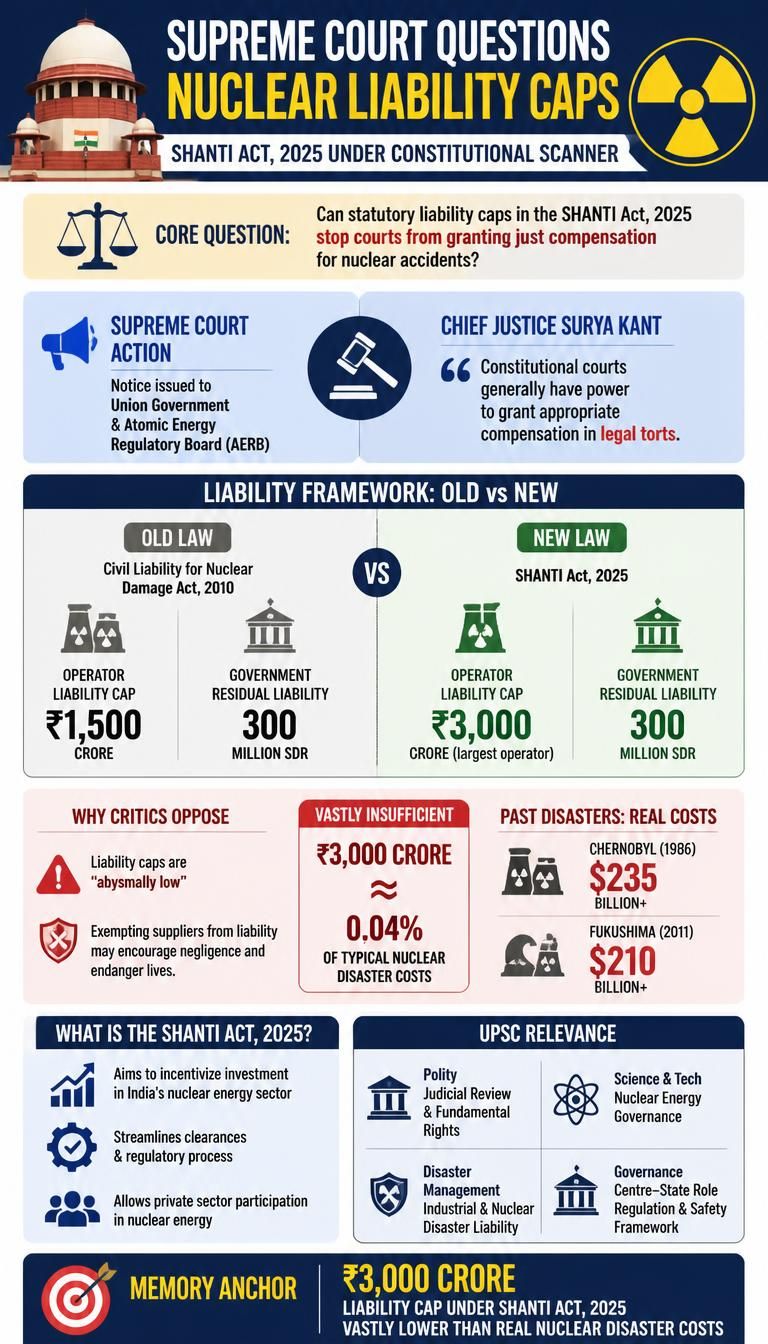
- The Supreme Court has questioned whether the statutory thresholds in the Sustainable Harnessing and Advancement of Nuclear Energy for Transforming India (SHANTI) Act of 2025 can prevent constitutional courts from directing suitable compensation for nuclear plant accidents.
- The SHANTI Act, 2025, which replaces the Civil Liability for Nuclear Damage Act, 2010, caps the government's residual liability at 300 million Special Drawing Rights (SDR).
- Petitioners argue that these liability limits are "abysmally low" and that exempting suppliers from liability could encourage negligence and endanger lives.
- The Supreme Court has issued notice to the Union government and the Atomic Energy Regulatory Board (AERB) regarding the petition challenging the Act's provisions.
Nuclear Liability.jpg
Detailed Insights:
- Chief Justice Surya Kant emphasized that constitutional courts generally possess the power to grant appropriate compensation in cases of legal torts.
- The SHANTI Act, 2025, aims to incentivize investment and streamline clearances in India's nuclear energy sector, including allowing private sector participation.
- The previous Civil Liability for Nuclear Damage Act, 2010, had capped operator liability at ₹1,500 crore and government liability up to 300 million SDR.
- Critics highlight that the liability caps under the SHANTI Act, such as ₹3,000 crore for the largest operator, are vastly insufficient compared to the multi-billion dollar costs of past nuclear disasters like Chernobyl and Fukushima.
- The petition contends that the provisions limiting the liability of operators, suppliers, and manufacturers under the SHANTI Act violate fundamental rights.
- The Atomic Energy Regulatory Board (AERB), established under the Atomic Energy Act, 1962, is tasked with ensuring the safe use of nuclear energy and regulating nuclear facilities in India.
Key Concepts Involved:
- Sustainable Harnessing and Advancement of Nuclear Energy for Transforming India (SHANTI) Act, 2025: A new Indian legislation designed to promote nuclear energy development while establishing a framework for civil liability in nuclear incidents.
- Civil Liability for Nuclear Damage Act, 2010: The former Indian law that established a no-fault liability regime for nuclear accidents, channeling liability to the operator and outlining compensation procedures.
- Atomic Energy Regulatory Board (AERB): India's statutory regulatory body, formed under the Atomic Energy Act, 1962, responsible for nuclear safety and radiation protection.
- Special Drawing Rights (SDR): An international reserve asset created by the International Monetary Fund (IMF), representing a potential claim on freely usable currencies of its member countries.
- Legal Tort: A civil wrong, distinct from a breach of contract or trust, for which a court can provide a legal remedy, typically in the form of monetary damages.
Previous10/10

SuperKalam is your personal mentor for UPSC preparation, guiding you at every step of the exam journey.
Download the App


STUDY RESOURCES
CONTACT US
ⓒ Snapstack Technologies Private Limited