GS 2: GovernanceGS 2: PolityPrelims
India’s Parliament must not stage its Cadaver Synod, Pg8
Parliament warned against 'Cadaver Synod' by proceeding with impeachment inquiry for resigned Justice Varma, undermining judicial independence and constitutional principles.
Practice MCQs
898 Students attempted
Key Highlights:
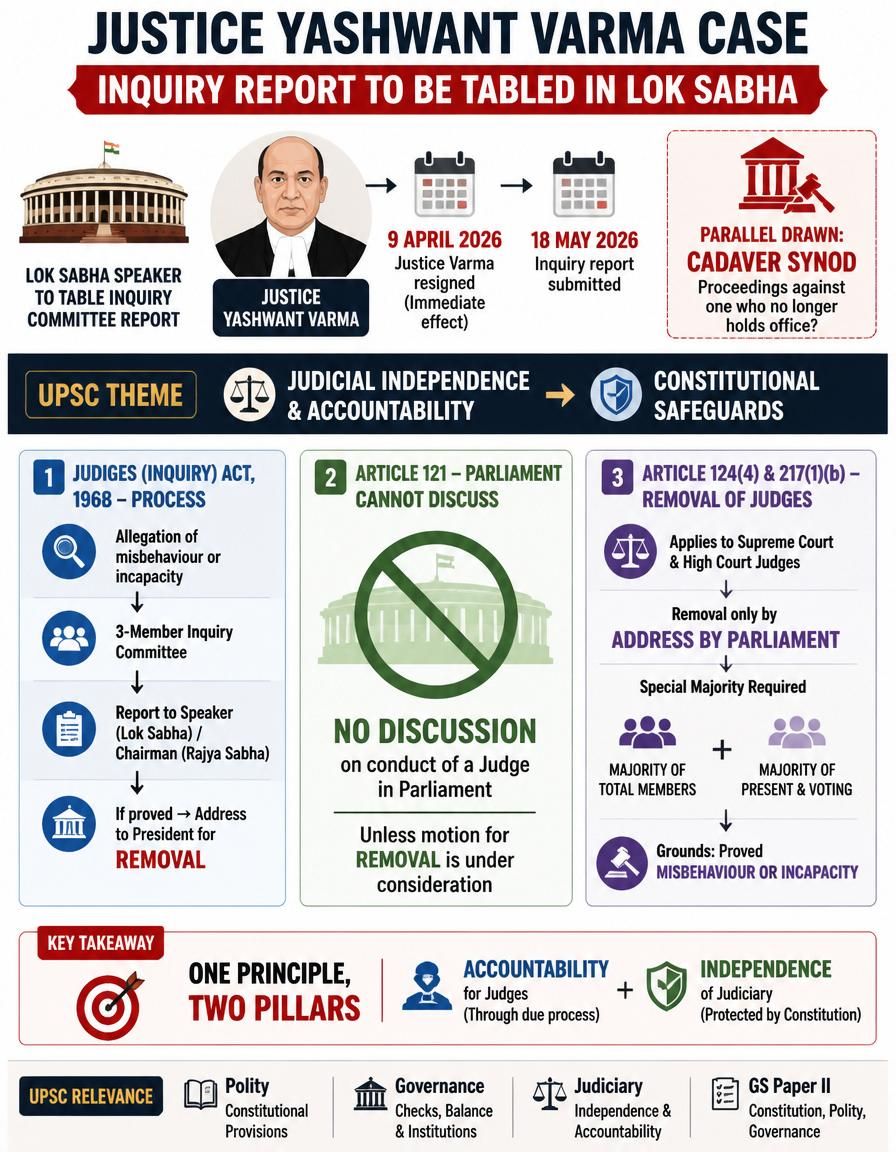
- The Lok Sabha Speaker is set to table the inquiry committee report against Justice Yashwant Varma, who resigned on April 9, 2026.
- Justice Varma's resignation, with immediate effect, occurred before the report, submitted on May 18, 2026, could be presented to Parliament.
- The article draws a parallel to the historical Cadaver Synod, questioning the validity of parliamentary proceedings against a judge who no longer holds office.
- Constitutional provisions, including Article 121 and Article 124(4), govern the discussion and removal of judges, emphasizing judicial independence.
Justice report.jpg
Detailed Insights:
- The Judges (Inquiry) Act, 1968, outlines the procedure for investigating misbehaviour or incapacity of a judge, leading to a potential address to the President for removal.
- Article 121 of the Constitution restricts parliamentary discussion on a judge's conduct unless it is part of a motion for their removal, safeguarding judicial autonomy.
- Article 124(4), applicable to High Court judges via Article 217(1)(b), specifies that removal requires an address by Parliament with a special majority, based on proved misbehaviour or incapacity.
- The Supreme Court, in Union Of India vs Shri Gopal Chandra Misra And Ors. (1978), established that a High Court judge's resignation is a unilateral constitutional act, effective immediately upon submission.
- Precedents like Justice P.D. Dinakaran (2011) and Justice Soumitra Sen (2011) demonstrate that impeachment proceedings typically cease upon a judge's resignation.
- The article argues that continuing proceedings against a former judge would be a theatrical exercise, degrading Parliament rather than serving justice, as the purpose of impeachment is removal from office.
- While impeachment ends with resignation, criminal law and examination of pension benefits remain applicable for any alleged offenses by former judges.
Key Concepts Involved:
- Judges (Inquiry) Act, 1968: The statutory framework regulating the investigation and proof of misbehaviour or incapacity of Supreme Court and High Court judges for their removal.
- Article 121: A constitutional provision that restricts parliamentary discussion on the conduct of judges, except during formal removal proceedings, to protect judicial independence.
- Article 124(4): A constitutional provision detailing the process for the removal of a Supreme Court judge, requiring a special majority in Parliament for proved misbehaviour or incapacity.
- Judicial Independence: The principle that the judiciary should be free from interference by the executive and legislative branches of government, crucial for impartial justice.

SuperKalam is your personal mentor for UPSC preparation, guiding you at every step of the exam journey.
Download the App


STUDY RESOURCES
CONTACT US
ⓒ Snapstack Technologies Private Limited