GS 2: International RelationsPrelims
France, Germany expand defence ties as Europe seeks military autonomy, Pg2
France and Germany boost defence ties, eye military autonomy, and unite against China's economic overcapacity and unfair trade practices.
Practice MCQs
898 Students attempted
Key Highlights:
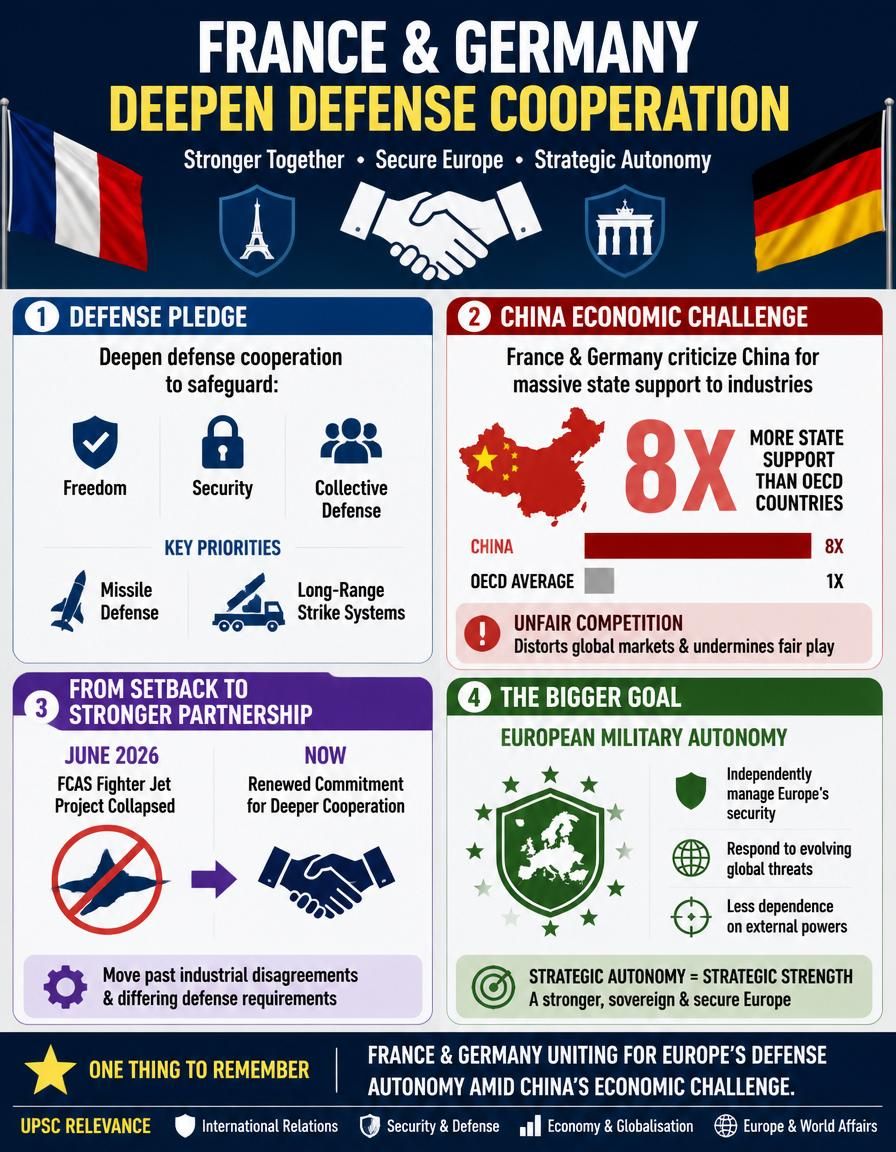
- France and Germany have pledged to deepen defense cooperation and address intense economic competition from China.
- German Chancellor Friedrich Merz and French President Emmanuel Macron met for a joint cabinet meeting to discuss these objectives.
- The leaders aim to safeguard freedom, security, and collective defense, with a focus on missile defense and long-range strike systems.
- They criticized China for providing significantly higher state support to its industries, estimated at least eight times the level seen in Organisation for Economic Co-operation and Development (OECD) countries.
- This renewed cooperation follows the recent collapse of the joint Future Combat Air System (FCAS) fighter jet project in June 2026.
France-Germany.jpg
Detailed Insights:
- The commitment to deepen defense ties aims to move past previous tensions, including the failure of the FCAS project due to industrial disagreements and differing national defense requirements.
- A key motivation for this enhanced cooperation is the pursuit of European military autonomy, enabling the continent to independently manage its security amidst evolving global geopolitical landscapes.
- Concerns were raised about China's economic practices, specifically overcapacity and an undervalued currency, which are perceived to create unfair competition and pressure on European industries.
- France reaffirmed its intention to maintain full responsibility for its nuclear deterrent, a cornerstone of its national defense strategy.
- Germany announced its participation in French nuclear exercises, signaling a step towards strengthening broader European deterrence capabilities.
- The OECD has previously highlighted that state enterprises often receive substantial industrial subsidies, contributing to market distortions and competitive imbalances.
Key Concepts Involved:
- Military Autonomy: A nation's or bloc's ability to independently safeguard its security and pursue foreign policy objectives without excessive reliance on external powers.
- Nuclear Deterrent: A military strategy where a state maintains nuclear weapons to discourage other states from attacking by threatening nuclear retaliation.
- Overcapacity: Production capacity that persistently exceeds demand, leading to high output, accumulating inventory, or sales at below-cost prices, often sustained by state subsidies.
- Undervalued Currency: A currency whose exchange rate is lower than its true economic value, making a country's exports cheaper and imports more expensive.
- Organisation for Economic Co-operation and Development (OECD): An intergovernmental economic organization of 38 member countries founded in 1961 to stimulate economic progress and world trade.

SuperKalam is your personal mentor for UPSC preparation, guiding you at every step of the exam journey.
Download the App


STUDY RESOURCES
CONTACT US
ⓒ Snapstack Technologies Private Limited