GS 2: GovernanceGS 2: PolityPrelims
Centre yields to Andhra Pradesh govt.’s demands, to modify higher education Bill, Pg1
Centre yields to Andhra Pradesh's demands, modifying Viksit Bharat Shiksha Adhishthan Bill 2025 for mandatory State clearance in higher education decisions.
Practice MCQs
898 Students attempted
Key Highlights:
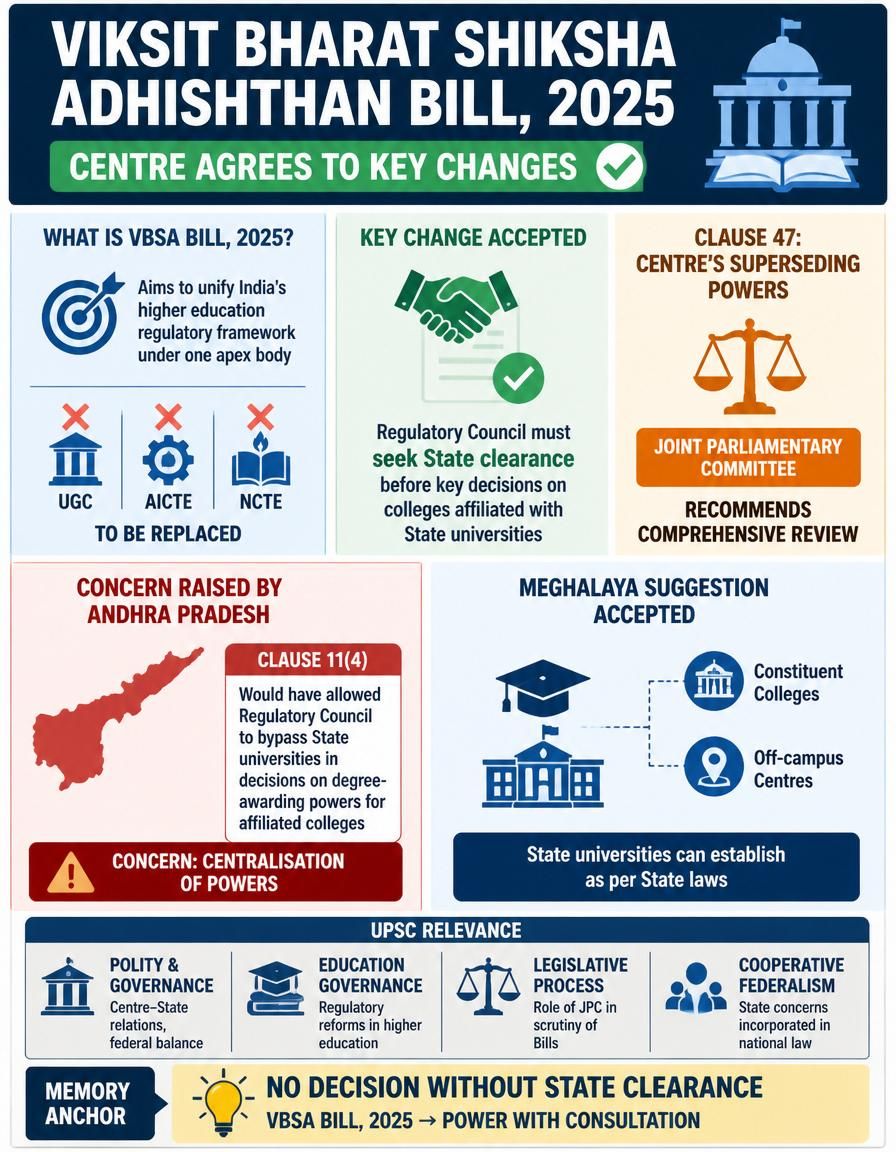
- The Union Education Ministry has agreed to modify the Viksit Bharat Shiksha Adhishthan Bill (VBSA), 2025, addressing concerns raised by the Andhra Pradesh government.
- A new provision will require the proposed Regulatory Council to obtain State government clearance before making key decisions about colleges affiliated with State universities.
- The Joint Parliamentary Committee reviewing the Bill recommended a comprehensive review of Clause 47, which grants the Centre superseding powers over the regulatory framework.
- The Centre also accepted a suggestion from the Meghalaya government to allow State universities to establish constituent colleges and off-campus centers in accordance with State laws.
VBSA.jpg
Detailed Insights:
- The VBSA, 2025, aims to unify India's higher education regulatory framework by replacing existing bodies like the University Grants Commission (UGC), All India Council for Technical Education (AICTE), and National Council for Teacher Education (NCTE) with a single apex body.
- Andhra Pradesh had expressed concerns about the "centralisation" of powers, specifically regarding Clause 11(4), which would have allowed the Regulatory Council to bypass State universities in decisions about degree-awarding powers for affiliated colleges.
- The amendment to Clause 11(4) now mandates a No-Objection Certificate (NOC) from the concerned State government for higher educational institutions substantially funded by the State before they are authorized to grant degrees by the Regulatory Council.
- Clause 12 initially required all universities, including State universities, to seek Regulatory Council approval for establishing new colleges, a provision the Meghalaya government argued would impede institutional autonomy and cause procedural delays.
- The Joint Parliamentary Committee serves as an ad hoc body comprising members from both Lok Sabha and Rajya Sabha, tasked with detailed scrutiny of complex legislative matters, and its recommendations, though advisory, hold significant parliamentary weight.
- The National Education Policy (NEP) 2020 envisions a fundamental transformation of the higher education regulatory system and proposes a gradual phasing out of the traditional affiliating university model by 2035.
Key Concepts Involved:
- Viksit Bharat Shiksha Adhishthan Bill (VBSA), 2025: Proposed Indian legislation to establish a single apex regulatory body for higher education, replacing multiple existing regulators.
- Joint Parliamentary Committee (JPC): An ad hoc committee of the Indian Parliament, composed of members from both Houses, formed to examine specific bills or issues in detail.
- Regulatory Council: One of the proposed councils under the VBSA, responsible for licensing and operational approvals of higher educational institutions.
- Affiliating University Model: A traditional higher education structure where a central university grants affiliation to colleges, controlling curriculum, examinations, and degree awards.
- No-Objection Certificate (NOC): A formal document issued by a government authority indicating no objection to a proposed action or project.

SuperKalam is your personal mentor for UPSC preparation, guiding you at every step of the exam journey.
Download the App


STUDY RESOURCES
CONTACT US
ⓒ Snapstack Technologies Private Limited