GS 2: GovernanceGS 3: Science & TechnologyPrelimsGS 3: Disaster and Disaster ManagementGS 2: Government policies and interventions for development in various sectors
When Orbit Processing Makes Sense — And When It Doesn’t, Pg II
Onboard satellite data processing, or 'computing in orbit,' promises faster, more efficient earth observation for disaster response and agriculture, revolutionizing space data utilization.
Practice MCQs
739 Students attempted
Key Highlights:
- Satellite data for emergency response, such as flood monitoring, is often delayed due to the time required for transmission and ground processing.
- Computing in orbit addresses this by processing data directly on satellites, reducing the volume of data sent to Earth and speeding up availability.
- This onboard processing utilizes Artificial Intelligence (AI) models to filter out irrelevant data, like cloud cover, and prioritize critical information.
- The European Space Agency's Phi-Sat-1 successfully demonstrated the use of AI for selecting relevant Earth observation images in space.
- India's Indian Space Policy 2023 and the establishment of IN-SPACe aim to encourage private sector involvement in developing such advanced space technologies.
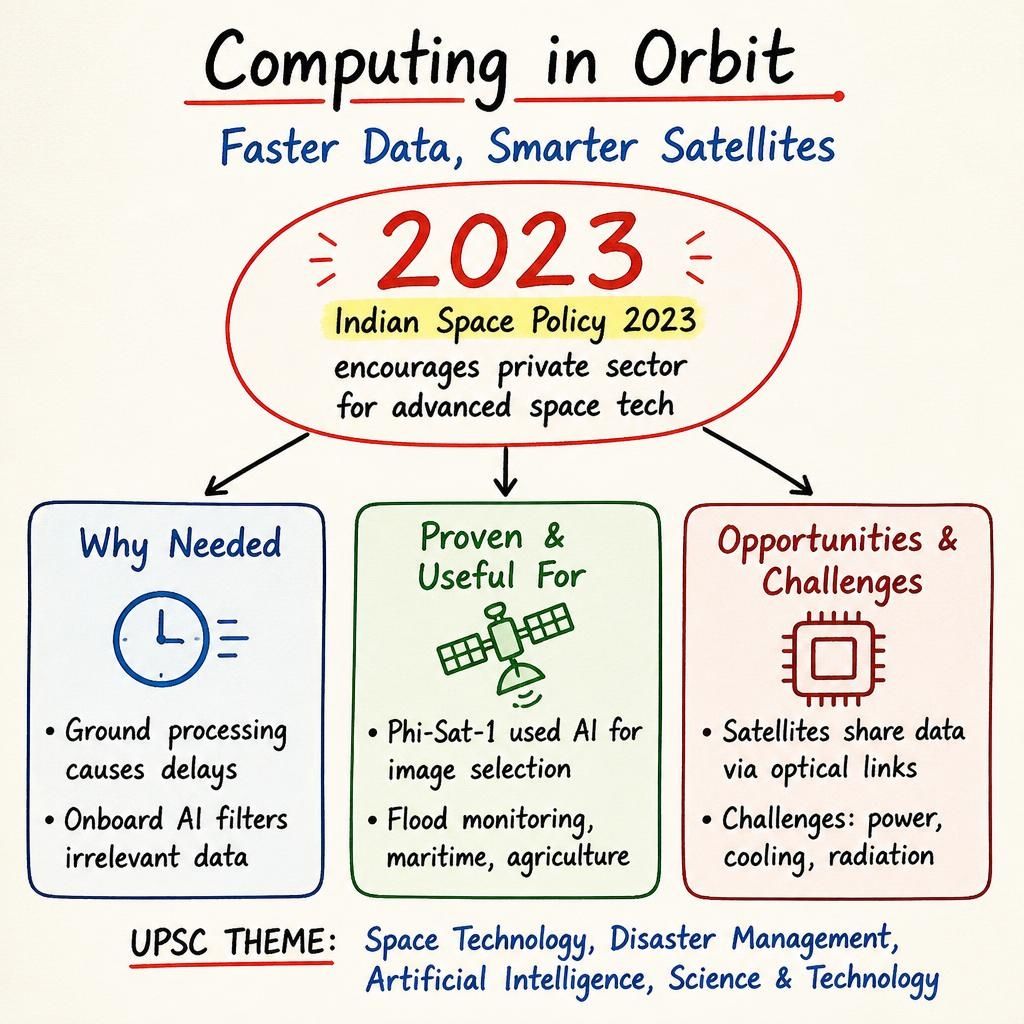
Computing in Orbit.jpg
Detailed Insights:
- The current process involves satellites sending all raw data to Earth, which is then downloaded at ground stations during specific pass windows and subsequently analyzed.
- By processing data onboard, satellites can analyze images for specific features, such as changes in flood extent, and transmit only the most relevant findings.
- Beyond flood monitoring, computing in orbit is beneficial for applications like maritime surveillance for ship identification and precision agriculture for crop health assessment.
- Future advancements envision satellites communicating and sharing data or computing tasks with each other using optical inter-satellite links.
- This collaborative approach could lead to the formation of distributed computing systems in orbit, enhancing overall data processing capabilities.
- However, orbital computing is not intended to replace terrestrial data centers, which remain crucial for training complex AI models and storing vast quantities of data.
- The concept of "computing resources as a service" in space could allow researchers and businesses to utilize onboard processing capabilities without the need to launch their own satellites.
- Significant challenges for in-orbit computing include limited electrical power, the absence of atmospheric cooling, and the harsh environment of space with radiation and extreme temperatures.
- Satellites require specialized, radiation-hardened components and robust redundancy features to ensure reliability and fault tolerance in space.
- The economic viability of computing in orbit depends on whether its advantages, such as reduced data latency and transmission costs, outweigh the substantial expenses of satellite development and launch.
- India possesses a strong foundation in satellite technology and launch vehicles, positioning it well to explore and contribute to this emerging field.
- Developing these capabilities domestically can strengthen India's supply chains, reduce reliance on imported components, and open opportunities in the global space infrastructure market.
Key Concepts Involved:
- Computing in Orbit: The process of analyzing and processing satellite-collected data directly on the spacecraft before transmitting it to Earth.
- Optical Inter-satellite Links: A technology enabling high-speed data communication between satellites using laser beams instead of radio waves.
- Distributed Computing Systems: A collection of independent computers (like satellites) that work together as a single system to solve complex problems.
- Indian Space Policy 2023: A comprehensive policy framework by the Government of India to promote and regulate private sector participation in space activities.
- IN-SPACe: The Indian National Space Promotion and Authorisation Centre, an autonomous body facilitating and authorizing private sector space activities in India.
Previous14/14

SuperKalam is your personal mentor for UPSC preparation, guiding you at every step of the exam journey.
Download the App


STUDY RESOURCES
CONTACT US
ⓒ Snapstack Technologies Private Limited